

Anthropic's AI Watermarks: What Enterprises Need to Know

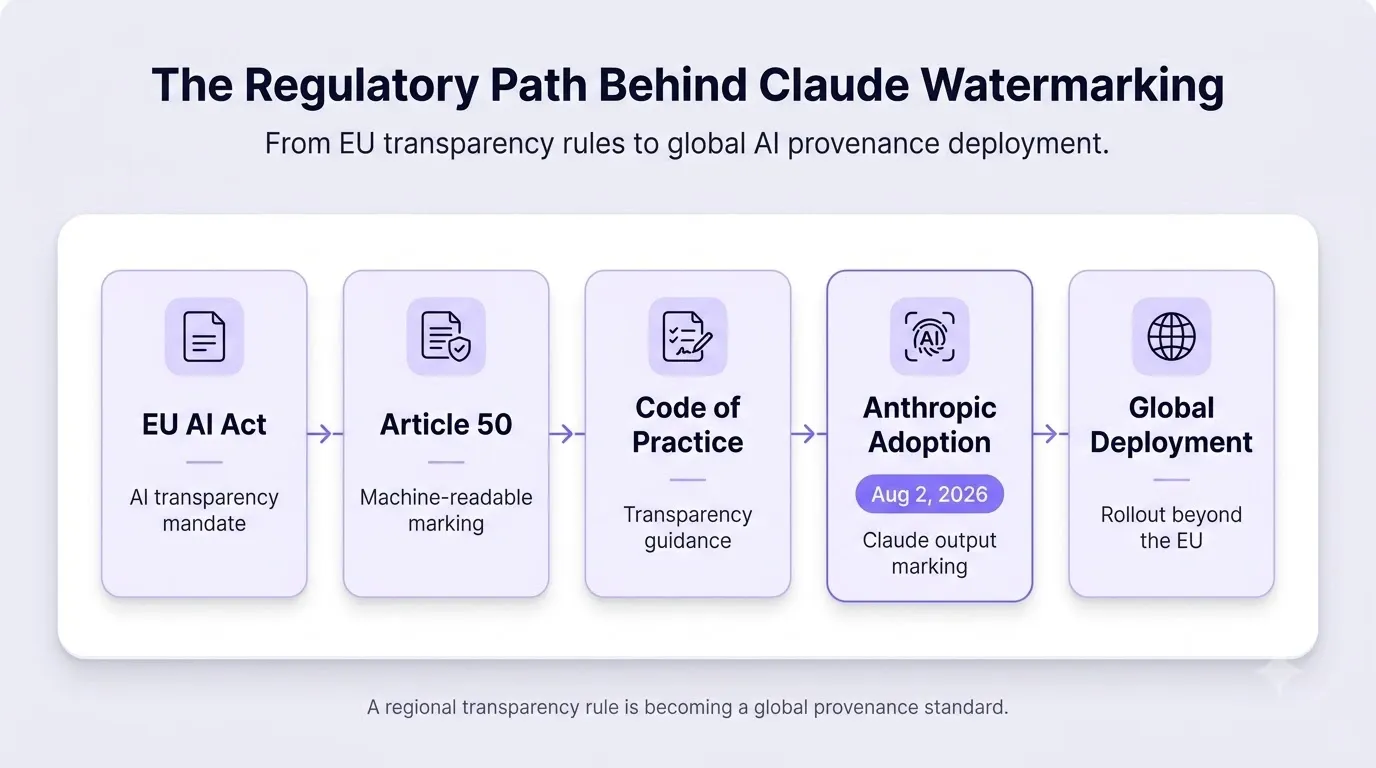
Anthropic announced that every new Claude model released on or after August 2, 2026 will embed invisible watermarks into generated text and attach cryptographically signed provenance metadata to supported image files. The move brings Anthropic into compliance with Article 50 of the EU AI Act, which requires AI-generated content to be identifiable in machine-readable form and but rather than limiting the feature to Europe, Anthropic is rolling it out globally across Claude.ai, the Claude API, Claude Code, Claude Cowork, and Claude Tag.
The announcement, made public this week, marks a real shift in how frontier AI providers approach transparency. Discussions about AI-generated content have historically centered on third-party detection tools and plagiarism concerns. Anthropic is moving the responsibility into the model itself, embedding provenance signals during generation rather than relying on external detectors after the fact. As more providers prepare for the EU AI Act's transparency requirements, OpenAI joined the C2PA coalition and partnered with Google to embed SynthID watermarking into its own image outputs back in May 2026, watermarking looks set to become a standard capability across the industry rather than an optional feature.
This guide explains how Anthropic's watermarking system actually works, what it can and can't tell you, and the part that matters most for security and compliance teams is why provenance is only one layer of enterprise AI governance, not a replacement for it.
AI Governance Doesn't End With Watermarks
Enterprise AI security starts much earlier: protecting prompts, enforcing policy, and monitoring AI interactions in real time, long before a watermark is embedded into the output.
Why Is Anthropic Watermarking Claude?
Anthropic is watermarking Claude to comply with the EU AI Act's transparency requirements, while making AI-generated content easier to identify across enterprise and consumer workflows. Specifically, Anthropic has signed the EU's Code of Practice on Transparency of AI-Generated Content, which supports compliance with Article 50 of the EU AI Act.
Article 50 is one of the most far-reaching provisions in the Act. Unlike the regulation's high-risk AI requirements, which apply only to specific use cases like hiring or credit scoring, Article 50 applies broadly: it requires providers of generative AI systems to ensure AI-generated content can be identified through machine-readable marking. The provision covers systems generating synthetic audio, image, video, or text content specifically, which is worth noting, since Claude's current announcement covers text and image files but not audio or video, because Claude doesn't natively generate those formats.
Anthropic's decision to deploy globally, not just for EU users, reflects a pattern that's becoming common: maintaining separate compliance workflows by region is operationally expensive enough that providers increasingly default to a single global standard once one major jurisdiction forces the issue. The rollout applies to Claude.ai, the Claude API, Claude Code, Claude Cowork, and Claude Tag, and marking is applied at the model level, so it doesn't depend on which specific product surface a user is working in.
One scope detail worth flagging directly: this applies only to new Claude models launched on or after August 2, 2026. Older models are not automatically retrofitted, Anthropic says it's working to add marking support to earlier models during the EU AI Act's transition period, but that work isn't complete as of this writing.
How Do Claude's Invisible Watermarks Actually Work?
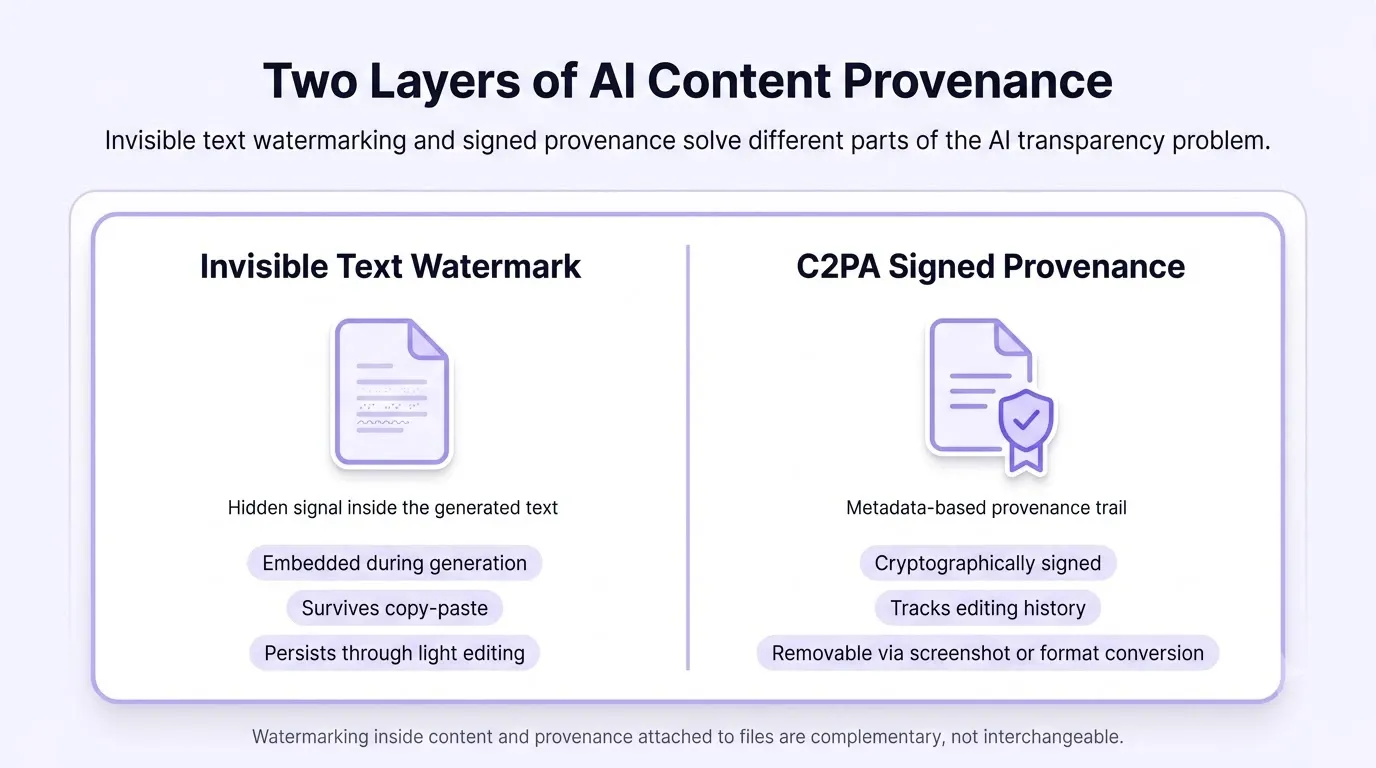
Anthropic's implementation combines two distinct technologies to identify AI-generated content: an invisible statistical watermark embedded directly into generated text, and cryptographically signed C2PA provenance metadata attached to supported image files. Neither signal is visible to a normal reader, both are designed to be detected algorithmically, not seen.
Invisible Text Watermarking
Claude's text watermark is embedded during generation itself: rather than inserting hidden characters, the model subtly biases its selection toward statistically similar token candidates according to a detection key, creating a pattern invisible to human readers but detectable algorithmically. According to Anthropic, this doesn't change the meaning, quality, or readability of the response and the model is only choosing between semantically equivalent words and phrasings it would have used anyway.
This approach has a few practical properties. Because the watermark is part of the generated text itself, it survives copy-paste between documents and applications, and light editing generally isn't enough to remove the statistical evidence. Anthropic has said it will publish technical documentation enabling third-party watermark detection, and a dedicated detection API is planned; but as of this writing, that documentation and API haven't shipped, so no independent party can currently verify Anthropic's technical claims about robustness.
Signed File Provenance With C2PA
For supported file formats like PNG, JPG, and SVG, Claude uses a different mechanism based on the Coalition for Content Provenance and Authenticity (C2PA) standard, now adopted by more than 6,000 member organizations including Adobe, Microsoft, Google, and the BBC. Rather than modifying visible content, C2PA attaches cryptographically signed metadata recording how a file was created or processed, functionally closer to EXIF data than a traditional watermark.
C2PA metadata depends on the file container itself, which makes it fundamentally more fragile than the text watermark: taking a screenshot, converting formats, or re-saving through software that strips metadata removes the provenance record entirely, even though the visible content is unchanged. Open-source tools that strip C2PA metadata already exist publicly, which lowers the bar for anyone motivated to remove it deliberately, not just accidentally.
Does a Watermark Prove AI Authorship?
No. A detected watermark indicates that Claude contributed to generating or modifying the content, it does not establish who originated the ideas, how much of the document is AI-generated versus human-written, or how the content was ultimately used. Anthropic itself is explicit that this is a technical indicator, not proof of origin.
This distinction matters because generative AI is increasingly an editing tool, not just a content creator. An employee might write an entire report independently and use Claude only to tighten the language or summarize one section and the resulting document could still carry Anthropic's watermark even though the substantive work was entirely human.
The reverse is equally true: the absence of a watermark doesn't mean a document is human-authored. Heavy editing, translation, paraphrasing, or generation by a different AI model entirely can all prevent or remove the statistical signal. Very short passages, reportedly under a couple hundred tokens, though Anthropic hasn't published an exact figure, don't accumulate enough statistical evidence for reliable detection at all. This is why watermark detection alone is a poor basis for plagiarism reviews, academic integrity decisions, or compliance investigations, and a negative result proves nothing.
What Are the Real Limitations of AI Watermarking?
Watermarking improves transparency; it does not eliminate uncertainty, and it was never designed as a security or enforcement mechanism. Several specific limitations are worth understanding before treating it as an enterprise control.
Short content resists detection. Emails, chat responses, headings, and brief summaries frequently fall below the length threshold needed for statistically reliable watermark detection.
Heavy editing degrades or removes the signal. Any rewriting that substantially changes word choice and token structure, including asking a different AI model to rewrite the text, can defeat the watermark, and Anthropic itself frames the mark as something that "may persist through some editing," not something guaranteed to survive it.
C2PA metadata is trivially stripped. Screenshots, format conversions, and social platform re-uploads routinely strip file metadata as an incidental side effect of normal handling, no adversarial intent required.
Low-entropy content resists watermarking structurally. The technique depends on the model having multiple valid, semantically equivalent word choices to bias between. Source code, where syntax often dictates one correct output, offers far less of that flexibility than an essay or report.
It doesn't cover audio or video, because Claude doesn't natively generate those formats, a real gap relative to Article 50's full text scope, even if not a gap in Anthropic's current obligation.
Most importantly: it answers one question only, did an AI model likely contribute to this content and cannot answer whether sensitive data was entered into the prompt that produced it, whether a prompt injection attack manipulated the output, whether an AI agent executed an unauthorized action, or whether internal policy was followed before the content was ever generated. Those are runtime questions, and provenance is fundamentally a post-generation signal.
See What Actually Happens Before the Watermark Gets Applied
Watermarking tells you an AI model was involved. It says nothing about what data reached that model or what the AI was instructed to do.
What Does This Mean for Enterprise AI Governance?
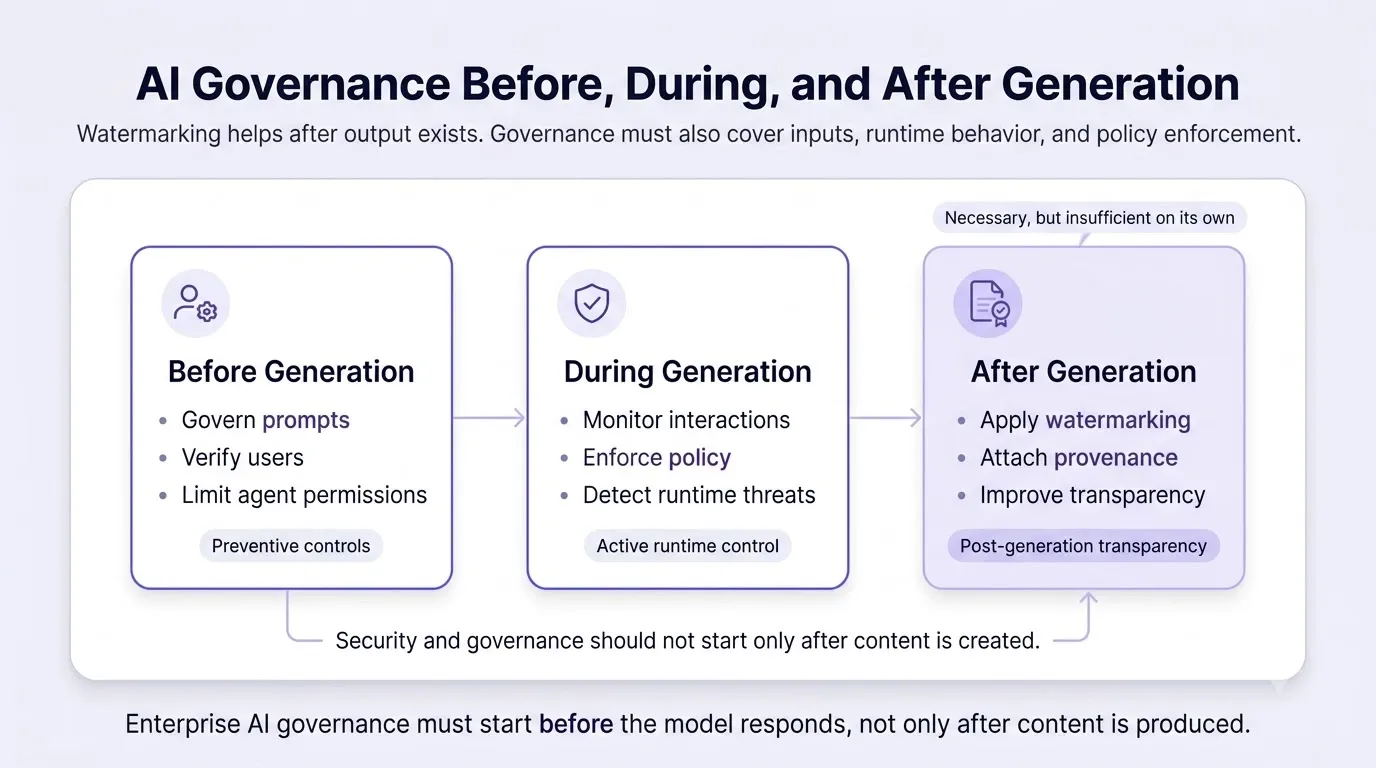
Watermarking begins after content has been generated. AI governance begins before the model produces an output. The two solve genuinely different problems and should be treated as complementary layers, not substitutes for each other.
A watermark can help establish whether Claude contributed to a document. It cannot determine whether sensitive customer data was entered into the prompt that generated it, whether an employee violated internal AI policy, or whether an autonomous agent took an action nobody authorized and those decisions happen during the interaction, well before any watermark is embedded into the final output. This is the same distinction LangProtect's guide to AI governance implementation covers in more depth: a governance program that only reviews outputs after the fact isn't actually governing anything, it's documenting incidents after they've already happened.
A mature AI governance program typically layers several distinct controls, each covering a different point in the interaction:
- Interaction monitoring — inspecting prompts, responses, and tool calls to understand how employees and AI agents are actually using generative AI, not just what they eventually publish
- Policy enforcement — preventing sensitive or regulated data from reaching the model in the first place, rather than discovering the exposure after a response has already been generated. LangProtect's guide to AI DLP and sensitive data exposure covers why this has to happen at the prompt layer, not the output layer
- Runtime security — detecting prompt injection, jailbreak attempts, and excessive AI agent permissions while systems are actively processing requests, which LangProtect's guide to prompt injection covers in full
- Audit-ready evidence — interaction logs, user attribution, and policy decisions that demonstrate governance controls during internal reviews or regulatory audits, covered in LangProtect's guide to AI audit logs and forensic visibility
These controls operate entirely independently of watermarking. Even if every AI-generated document a company produces carries a valid provenance signal, the organization still needs visibility into the interaction that produced it, provenance explains what the output is; runtime governance explains how it came to exist in the first place. An AI-generated report can carry a perfectly valid watermark while still containing confidential customer information, originating from a manipulated prompt, or resulting from an unauthorized agent action. Watermarking will never catch any of those, because it was never built to.
What Should Enterprises Do Next?
Anthropic's watermarking rollout is a real step toward AI transparency, but it isn't a governance program, and treating it as one leaves the actual risk surface uncovered.
Review your AI transparency obligations directly. Organizations operating in or serving the European market should confirm how Article 50's requirements apply to their specific AI systems, and note that even companies outside the EU may be affected if they deploy AI services to European users or embed AI-generated content into products Europeans use.
Don't confuse provenance with security. A watermark can tell you Claude was involved in producing something. It cannot tell you whether sensitive information reached the model, whether the prompt was manipulated, or whether policy was followed. Continued investment in prompt inspection, sensitive data protection, and policy enforcement remains necessary regardless of whether an output happens to carry a watermark.
Prepare for broader C2PA adoption across your toolchain, since Anthropic now joins a large and growing set of vendors like Adobe, camera manufacturers, and other AI labs that are attaching provenance metadata by default. Confirm your internal workflows can preserve these credentials where it matters, while treating them as an additional trust signal rather than definitive proof.
Update AI governance policy to address content provenance explicitly, not just acceptable use. Most existing policies say little about how AI-generated content should be identified internally, when provenance should be preserved through a workflow, or which business processes require human review before AI-assisted content is published externally. LangProtect's guide to AI governance requirements in 2026 covers the broader regulatory landscape this update needs to account for.
Build governance across the full AI lifecycle, not around a single technology. Watermarking, runtime security, policy enforcement, and audit logging each address a different part of the AI lifecycle; no single one of them, including this week's announcement, is a complete answer on its own.
Frequently Asked Questions
What are Anthropic's invisible watermarks?
Anthropic's invisible watermarks are machine-readable statistical signals embedded into text generated by new Claude models. They're designed to help identify AI-generated content without changing its appearance, in support of transparency requirements under the EU AI Act.
Why did Anthropic introduce watermarking now?
The rollout is driven primarily by Article 50 of the EU AI Act and the associated Code of Practice on Transparency of AI-Generated Content, which Anthropic has signed. Anthropic chose to implement the requirement globally rather than limiting it to European users.
What is C2PA provenance metadata?
C2PA (Coalition for Content Provenance and Authenticity) is an open standard, now used by more than 6,000 member organizations, that attaches cryptographically signed metadata to supported files recording how digital content was created or modified.
Can Anthropic's watermarks be removed?
The text watermark is designed to survive copying, pasting, and light editing, but heavy rewriting, translation, or paraphrasing; including passing the text through a different AI model, which can remove the statistical signal. C2PA file metadata is more fragile and can be stripped through screenshots, format conversion, or ordinary re-saving.
Does a watermark prove AI authorship?
No. A detected watermark indicates Claude likely contributed to the content, but it doesn't establish whether the ideas originated from a human or how much of the final work was AI-generated. Anthropic describes this as a transparency signal, not proof of authorship.
Does watermarking improve AI security?
Not directly. Watermarking improves transparency after content has already been generated. It doesn't prevent prompt injection, stop sensitive data from reaching the model, catch unauthorized AI agent actions, or enforce internal policy; those require runtime AI governance, not provenance.
Can enterprises verify Claude-generated content today?
Partially. C2PA-tagged files can already be verified using compatible provenance tools, but Anthropic's dedicated text watermark detection API hasn't shipped yet, as of this writing it's confirmed as planned but not publicly available, so independent verification of text watermarks isn't yet possible outside Anthropic itself.
Will other AI providers adopt similar watermarking?
Very likely, and it's already underway; OpenAI joined the C2PA coalition and partnered with Google to embed SynthID watermarking into its image outputs in May 2026. As Article 50 obligations apply more broadly across the industry, machine-readable content marking is expected to become a standard capability rather than a differentiator.
Provenance Is One Layer. Governance Is the Whole System.
Anthropic's watermarking rollout is a genuinely significant step for AI transparency, and one of the first large-scale implementations of the EU AI Act's Article 50 in practice. But it answers a narrower question than most enterprises reading the headlines will assume: it identifies AI involvement after content exists. It says nothing about whether that content should have been generated in the first place, what data went into producing it, or whether the interaction that created it followed policy.
Provenance and runtime governance solve different problems and need to be built together. Organizations that treat this week's announcement as a governance milestone rather than a transparency feature will find the actual risk like sensitive data exposure, prompt manipulation, unauthorized agent action which are completely uncovered by a watermark that was never designed to catch it.
AI Transparency Is Only One Layer of Enterprise AI Security
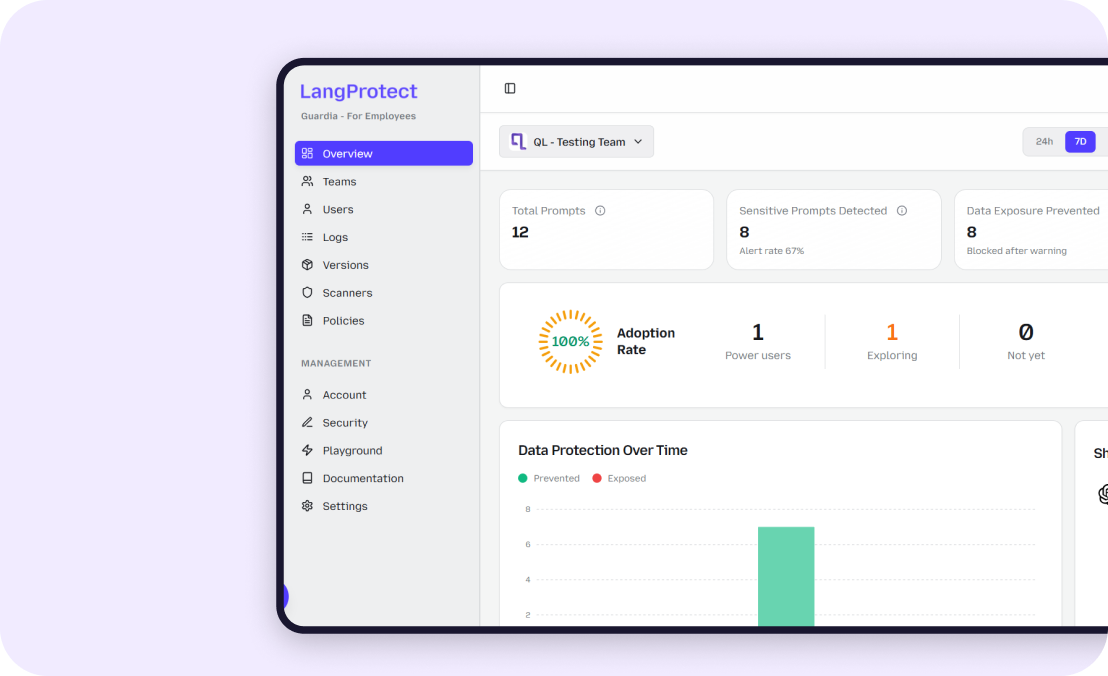
Discover how LangProtect helps organizations monitor AI usage, enforce policy, and secure AI applications before content is ever generated, not just after.