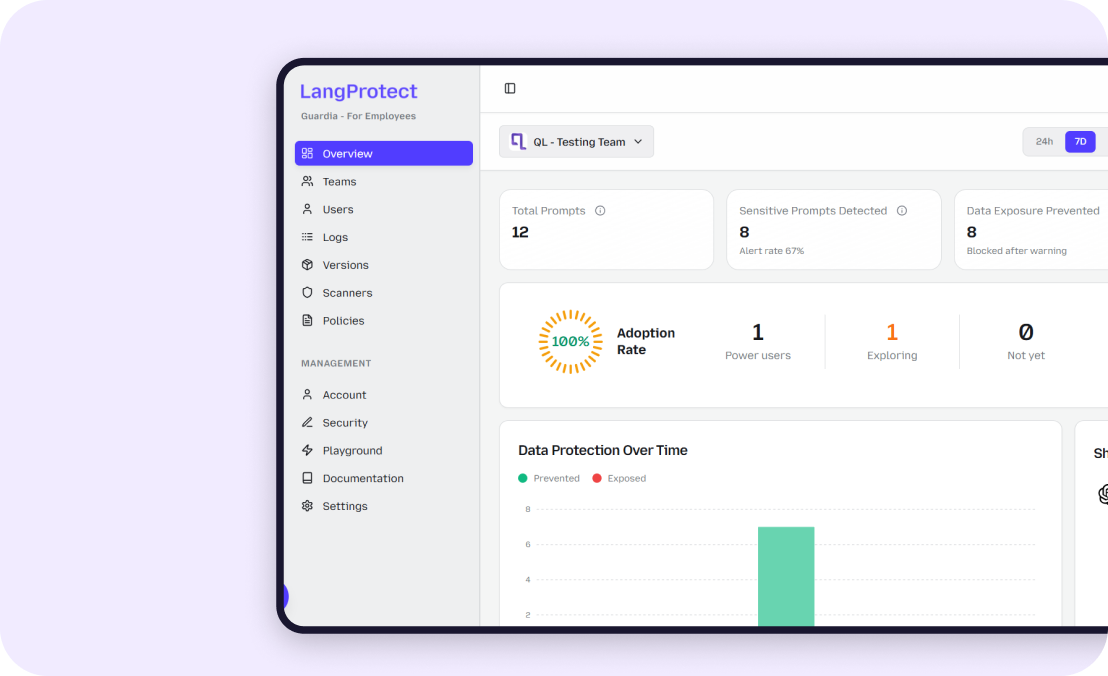


AI Governance Implementation Guide: From Policy to Runtime Controls


A mid-size insurer finishes its AI governance rollout: an 80-page policy, a signed-off NIST AI RMF checklist, an ISO 42001 gap assessment on file. Six months later, a state AG inquiry asks for interaction logs proving a specific underwriting model didn't use a prohibited data category in a specific customer's file. The compliance team has the policy. They have the checklist. They do not have a single log of what the model actually did. The policy was real. The enforcement was not.
Nothing about that outcome is unusual. DigiCert's AI Trust Outlook, published July 7, 2026 from a survey of 1,001 IT and security decision-makers, found that 78% of organizations have already experienced an AI-related security incident or identified an AI-related vulnerability; and only 53% can fully trace an AI-generated decision back to the model and source data that produced it. Nearly eight in ten organizations have already had the incident. Fewer than half could explain it if asked.
That gap, between what's written and what's running, is where AI governance programs fail audits, not where they fail to get written. LangProtect's breakdown of what AI governance actually requires in 2026 covers the six controls and three regulatory frameworks; EU AI Act, DORA, SEC, driving that requirement. This guide picks up the harder question those controls raise: which governance frameworks actually tell you how to build the runtime layer, what a realistic maturity path from policy to proof looks like, and where organizations most commonly derail along the way.
On May 14, 2026, Colorado quietly removed the one thing many companies were treating as their AI compliance safety net: the rebuttable presumption of compliance for organizations following a recognized risk framework like NIST AI RMF or ISO 42001. Paperwork alone was never the defense regulators imagined it would be.
This guide covers how NIST AI RMF, ISO 42001, and the current regulatory landscape map to a runtime control program; the four-stage maturity model that takes a program from documented to provable; the pitfalls that most commonly stall that progression; the real cost of staying at Stage 1; and where to go for the implementation detail behind each stage; the specific policy language, the control-mapping mechanics, the audit log schema, the approval workflow, and the metrics that keep it running once it's built.
Want to See What Your AI Governance Program Can Actually Prove?
Most governance documents look complete on paper. Very few can produce a log of what an AI system did last Tuesday.
What Is AI Governance Implementation, and Why Do Most Programs Stall at Policy?
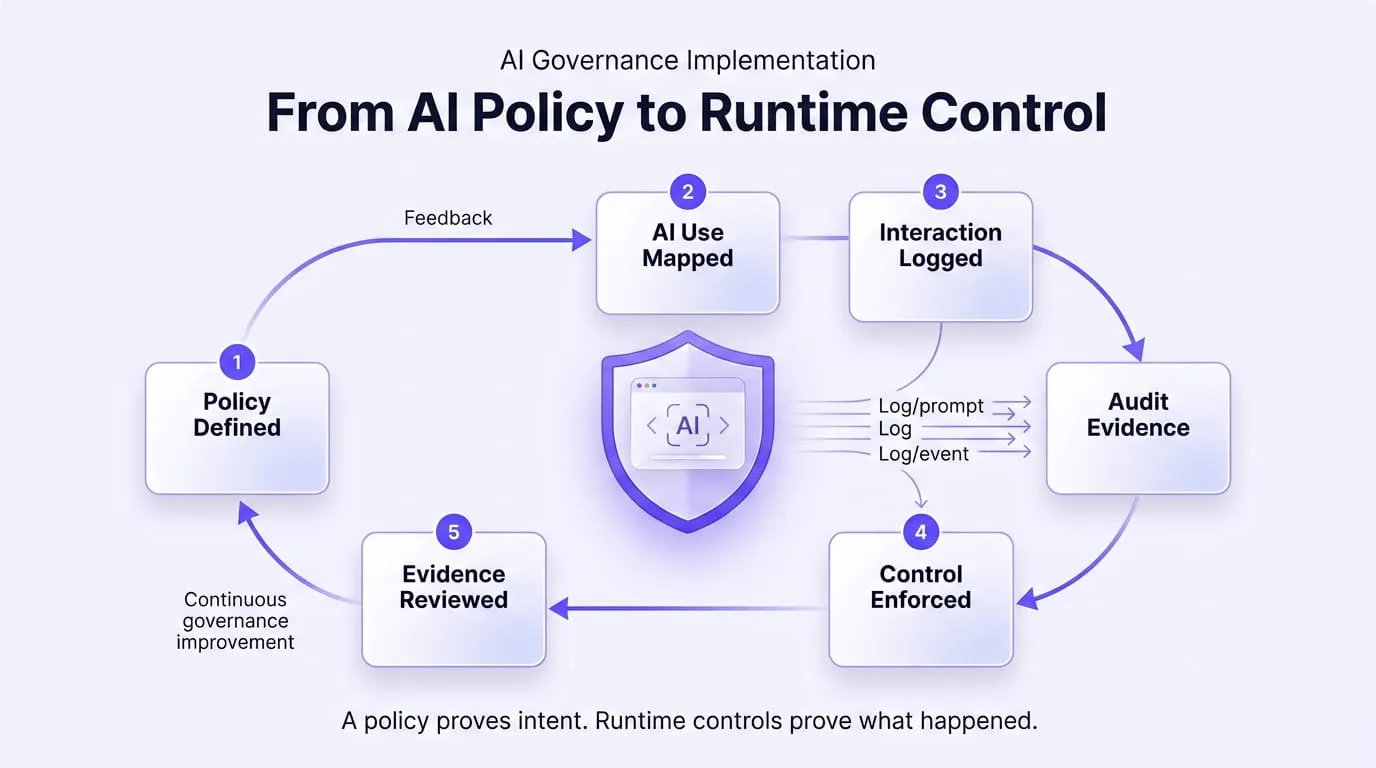
AI governance implementation is the process of converting written AI policy; acceptable use rules, risk classifications, approval workflows, into enforced technical controls that run automatically wherever AI is actually used. A governance program that lives only in a document is not implemented; it's drafted.
The distinction is easy to state and hard to operationalize, which is exactly why so few programs cross it.
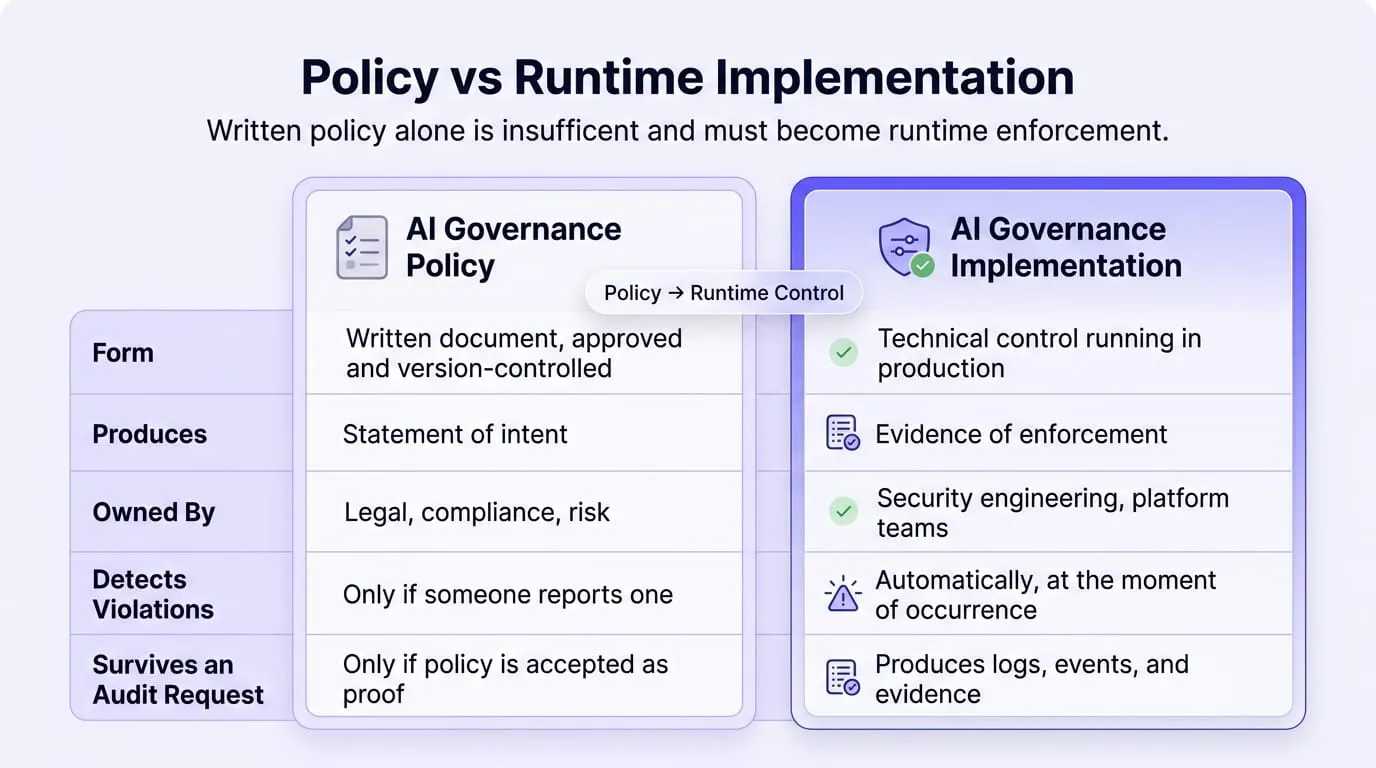
Neither side of that table is optional. A technical control with no policy behind it is enforcing nothing in particular, it's just a rule someone in engineering decided on. A policy with no technical control behind it is a hope. The two have to be built together, and in most organizations, they aren't, because they're built by different teams on different timelines with no shared checkpoint.
The structural reason programs stall is organizational, not technical. Policy is written by legal and compliance teams, but enforcement requires telemetry and control points that exist at the technical layer, owned by security and engineering, and the two groups rarely coordinate during rollout. Legal finishes the policy, declares the initiative complete, and moves to the next compliance priority. Security, if it's involved at all, inherits a document with no implementation budget and no clear owner for the runtime piece. The result is what NIST's own framework calls the Measure gap: organizations complete the documentation-heavy functions of a governance framework and stall at the one function that requires runtime data.
Two questions determine whether a program is implemented or just documented:
- Can you see every AI interaction that presents a business or compliance risk? Visibility into prompts, responses, and AI agent activity is the precondition for everything else; you cannot govern what you cannot observe.
- Can you act on one in real time? A governance program that only reviews AI activity after the fact isn't preventing anything; it's documenting incidents after they've already happened.
If the answer to either question is no, the governance program is still operating through documentation rather than technical enforcement; the same distinction covered in more depth in LangProtect's analysis of why AI requires a new security layer beyond traditional controls. Traditional security platforms inspect networks, endpoints, and applications. AI governance requires visibility into prompts, responses, and agent actions; a layer conventional tooling was never built to see into, which is precisely why governance and security have to be designed together rather than sequentially.
What Does the Gap Between AI Policy and AI Reality Actually Look Like?
The gap between AI policy and AI reality shows up at the exact moment someone asks for proof; an auditor, a regulator, a customer's legal team, or an internal investigator; and the only thing on file is the policy itself, not evidence that it was followed.
Gartner predicts that by 2028, organizations that implement comprehensive AI governance platforms will experience 40% fewer AI-related ethical incidents than those relying on fragmented, documentation-only governance approaches. The distinction driving that gap isn't better-written policies, it's whether a mechanism exists that consistently enforces and verifies them. Two scenarios illustrate exactly where that mechanism is usually missing.
Scenario 1: The Audit Request
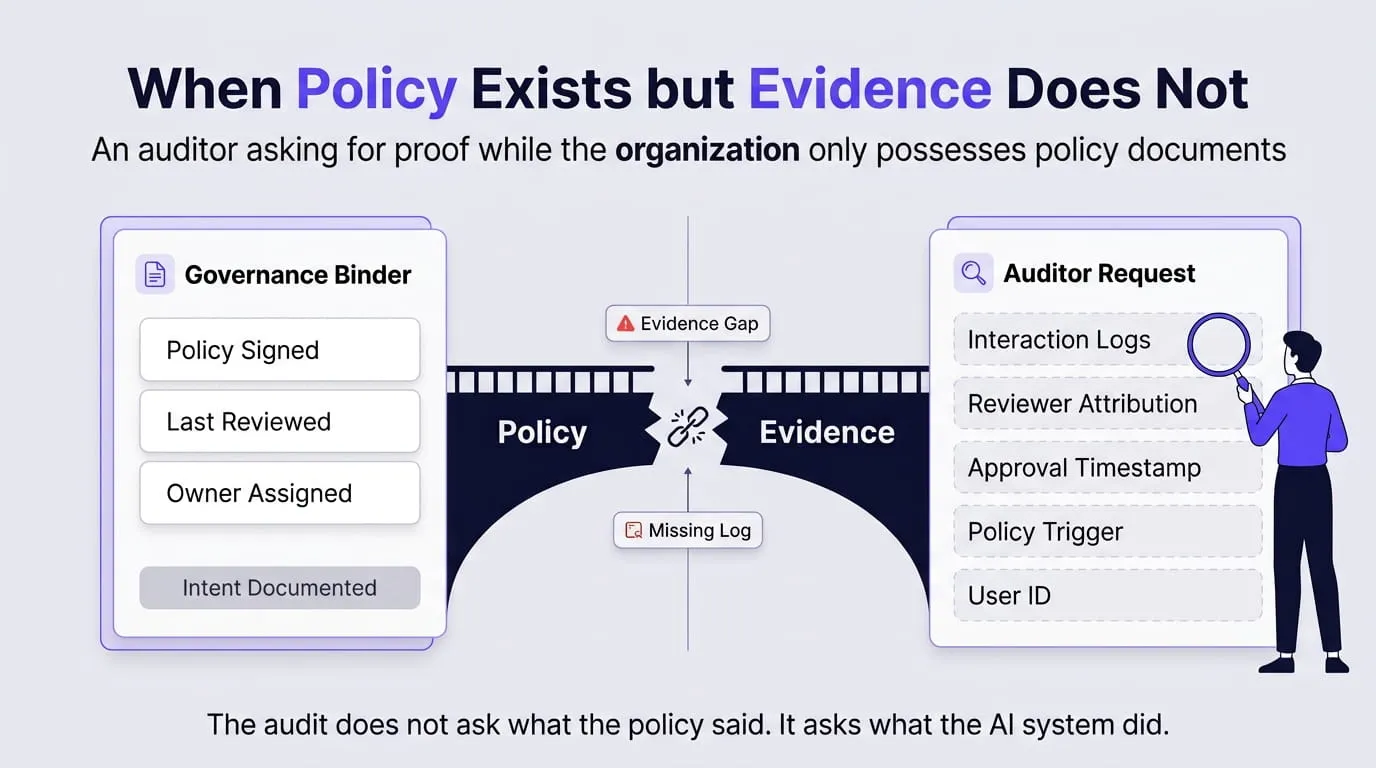
// What the governance binder shows:
Policy: "All high-risk AI use requires human review before action."
Signed: Yes | Last reviewed: Q1 2026 | Owner: Compliance

// What the auditor actually asked for:
"Provide the log of every high-risk AI decision in March 2026,
the human reviewer for each, and the timestamp of review."

// What exists:
Interaction logs:       NONE
Reviewer attribution:   NONE
Approval timestamp:     NONE

VERDICT: Policy exists. Evidence does not.
The governance policy clearly defines the control. The organization simply has no technical evidence showing the control was applied. This isn't a rare edge case, it's the default outcome for any program that stopped at Stage 1 of the maturity model covered later in this guide.
Scenario 2: The Internal Drift
A company's AI acceptable-use policy prohibits pasting customer PII into public AI tools. Every employee acknowledges the policy at onboarding, and it's reinforced through periodic security awareness training. Six months later, an internal governance review reveals a different reality: employees have been routinely copying claim summaries, customer names, policy numbers, and support conversations into consumer AI assistants to get through everyday tasks faster. None of it was malicious. It simply became normal workflow, because nothing at the browser or network layer ever checked whether the policy was being followed.
The review typically surfaces three distinct failures, not one:
- No visibility into AI interactions - security teams can't determine which employees used which public tools or what information was shared, because no interaction logs exist to support an investigation.
- No runtime policy enforcement - the acceptable-use policy prohibited sharing customer data, but no control existed to detect, block, or redact it before it reached an external service.
- No continuous compliance monitoring - governance was treated as a one-time training exercise instead of an ongoing operational process, so as employee behavior evolved, nothing flagged the drift.
Why "Trust but Don't Verify" Is the Default Failure Mode
Most governance rollouts train employees once and assume compliance persists. In practice, AI usage changes fast; employees adopt new tools, vendors ship new capabilities, and workflows evolve; while governance policy stays static unless someone actively re-verifies how AI is actually being used.
NIST's AI Risk Management Framework addresses this directly through its Measure function, which explicitly requires runtime evidence rather than policy documents alone. Without interaction-level telemetry showing how AI systems are actually used, whether controls are being applied, and where violations occur, governance teams can define objectives and classify risks, but they have no way to determine whether their controls remain effective in day-to-day operation. Governance becomes a documentation exercise instead of a continuous control program, which is the exact bottleneck the next section maps in detail.
See How LangProtect Turns Policy Into Enforced, Logged Controls
How Do NIST AI RMF, ISO 42001, and Current Regulation Map to a Runtime Control Program?
No single framework tells you how to build runtime controls, they tell you what to govern and how to prove it. NIST AI RMF structures the internal control lifecycle. ISO 42001 makes that lifecycle certifiable. Binding regulation sets the legal deadlines and evidence standards those controls need to meet. None of them ships an enforcement mechanism, that's the part organizations have to build themselves, and it's the part most governance rollouts never budget for.
NIST AI RMF: The Internal Control Lifecycle
NIST's AI Risk Management Framework organizes governance into four functions, designed to operate as a continuous cycle rather than a one-time project: Govern, Map, Measure, and Manage.
Govern: Establishing the Foundation
Govern is where most programs actually start, and it's a documentation-heavy function almost by design. Organizations define AI policies, assign ownership across legal, security, compliance, and business teams, and establish accountability structures. This function answers "how should AI be governed?" and because the deliverables are documents (policies, RACI charts, escalation paths), it's the function every governance program manages to complete.
Map: Building Visibility Before Building Rules
Map identifies where governance should actually apply. Organizations inventory every AI system in use including shadow AI nobody formally approved and classify each use case by business risk. This creates visibility into the AI landscape before any technical control gets deployed, and it's the second function most programs complete, because it's still fundamentally a cataloging exercise rather than an engineering one.
Measure: Where Nearly Every Program Stalls
Measure validates whether governance controls are actually working, and it's the first function that requires operational evidence rather than documentation. Organizations need interaction logs, prompt history, records of policy violations, human approval events, and blocked requests; runtime telemetry that shows whether AI systems are operating within the boundaries Govern and Map established. Most programs simply don't have this data, because generating it requires the same interaction-layer infrastructure that Stage 3 of the maturity model below is built around. For many organizations, this is the exact point where governance stalls: the policies and inventories already exist, but there's no telemetry to evaluate whether any of it is working.
Manage: Turning Evidence Into Continuous Improvement
Manage uses the data Measure produces to refine policy, adjust controls, investigate incidents, and reduce emerging risk based on operational evidence instead of assumption. Without Measure feeding it, Manage collapses into reactive incident response, reacting to whatever surfaces through luck or a customer complaint, rather than running as a functioning feedback loop.
This is why NIST AI RMF implementation depends as much on operational telemetry as it does on documentation. Govern and Map define the expected outcome. Measure and Manage demonstrate; and improve; whether that outcome is actually happening. A program that stops after the first two functions has built half a framework and called it complete.
ISO 42001: The Certifiable Evidence Layer
While NIST AI RMF helps organizations structure governance internally, ISO/IEC 42001 transforms that governance into a certifiable management system; the first international standard specifically written for AI management systems.
The distinction that matters: ISO 42001 doesn't ask whether a policy exists. It asks whether an organization can consistently demonstrate that its governance processes are operating effectively, verified by a third-party auditor rather than accepted on the organization's own word. Certification typically requires an organization to maintain:
- A documented inventory of AI systems and use cases
- Risk assessments and risk treatment records
- Defined governance responsibilities and accountability structures
- Continuous monitoring activities; not a point-in-time assessment
- Records showing governance controls are reviewed and improved over time
Notice that none of these can be satisfied by policy documents alone. The continuous-monitoring requirement is the one organizations most commonly discover too late: auditors increasingly expect evidence that controls remain effective after deployment, not just that they were designed correctly on paper. This is exactly why organizations pursuing ISO 42001 certification typically discover mid-process that they need audit-ready AI interaction logs before certification is even achievable, the standard's continuous-monitoring bar can't be satisfied retroactively by reconstructing evidence after the fact.
ISO 42001 certification remains voluntary, but it's increasingly requested by enterprise procurement teams and treated by regulators as stronger evidence of governance maturity than self-attestation, precisely because it involves independent verification rather than a vendor's own claims about itself.
Why the Regulatory Ground Keeps Shifting and Why That's Not a Reason to Wait
Two developments in May 2026 illustrate the same underlying pattern from opposite directions; one regulation getting a longer runway, one losing its safe harbor entirely.
The EU AI Act's high-risk (Annex III) obligations were deferred, though the timeline is worth getting precisely right. The European Commission proposed the delay as part of its Digital Omnibus initiative in November 2025; EU negotiators reached provisional political agreement on May 7, 2026, deferring standalone high-risk (Annex III) obligations from August 2, 2026 to December 2, 2027, and obligations for high-risk AI embedded in regulated products (Annex I) from August 2, 2027 to August 2, 2028. As of this writing, the European Parliament has formally endorsed the agreement (June 16, 2026) and the Council has given final approval (June 29, 2026); formal publication in the Official Journal is expected before the original August 2, 2026 date. Transparency obligations under Article 50 are not part of this deferral and largely remain on schedule; watermarking and synthetic-content disclosure requirements shift by only a few months, to December 2, 2026, rather than the 16-month deferral applied to high-risk obligations. Organizations with EU exposure should treat the delayed dates as the current planning baseline while recognizing that the Act's core architecture; risk tiers, conformity assessment, the AI Office's oversight role didn't move at all.
Colorado's original AI Act; the one many US companies were using as their NIST-alignment test case, was rewritten by SB 189, signed May 14, 2026, which delays the effective date to January 1, 2027 and strips out the rebuttable-presumption safe harbor for following NIST AI RMF or ISO 42001 entirely. The original Colorado AI Act (SB 205) offered a legal presumption of reasonable care to organizations that could demonstrate alignment with a recognized risk management framework. SB 189 removes that presumption along with the mandatory risk-management-program and algorithmic-impact-assessment requirements, replacing them with a narrower, disclosure-based framework centered on automated decision-making technology (ADMT) and consequential decisions.
The lesson isn't "wait for the law to settle." It's that laws built around documentation; impact assessments, self-attestation, framework safe harbors, are exactly the ones getting rewritten or repealed under industry pressure, while laws built around disclosure and record-keeping are surviving intact. Colorado didn't get less strict across the board; it got more specific about what has to be demonstrable, and less forgiving about accepting a framework checklist as proof. Runtime evidence outlasts policy paperwork regardless of which version of the law ultimately lands, because "we followed NIST AI RMF" was never going to be a durable legal position on its own and as of May 2026, in at least one major US jurisdiction, it explicitly no longer is.
The Framework-to-Control Comparison
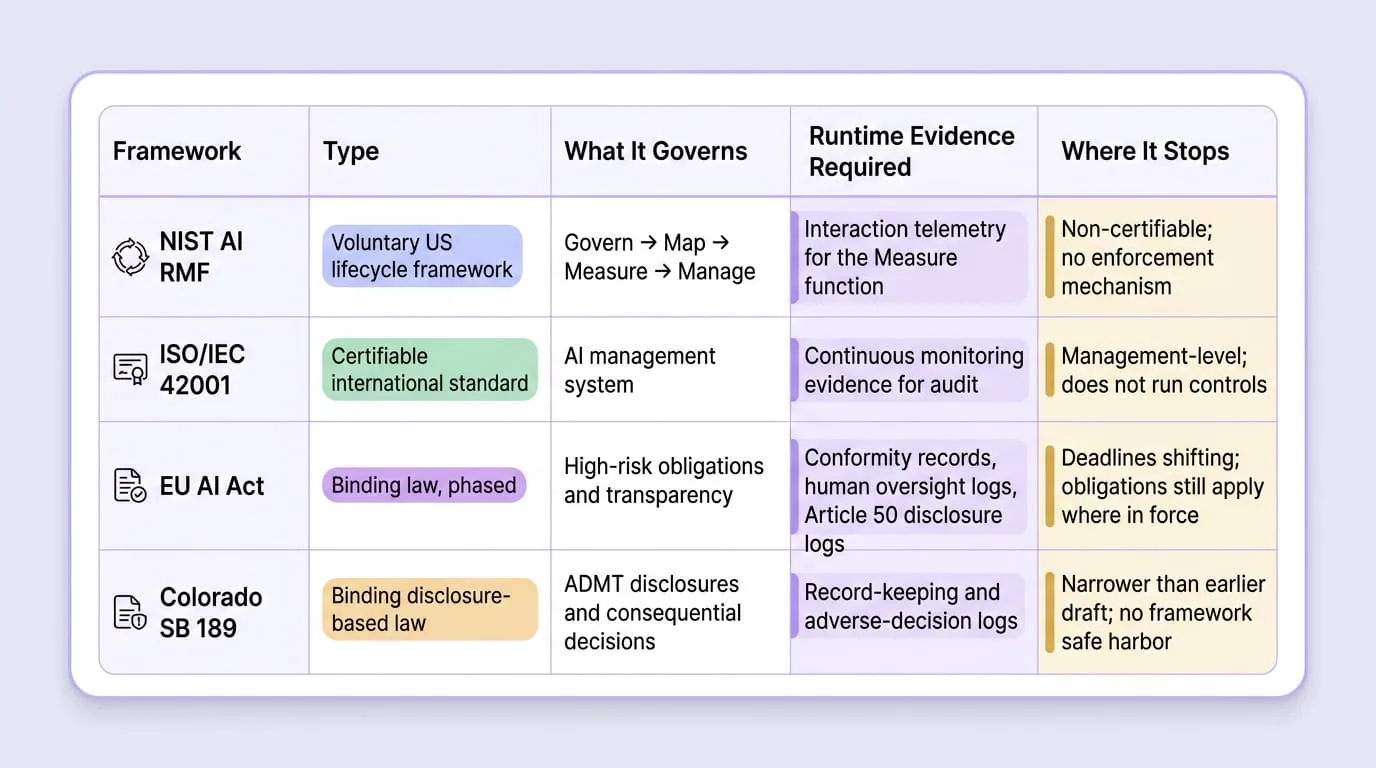
Every framework converges on the same requirement: a runtime record of what the AI system actually did. They disagree on scope and legal force. They agree completely on the evidence they need, which is exactly why building the runtime layer once, correctly, satisfies all four simultaneously rather than requiring four separate compliance projects.
What Does Governance Maturity Actually Look Like? Four Stages From Documented to Provable
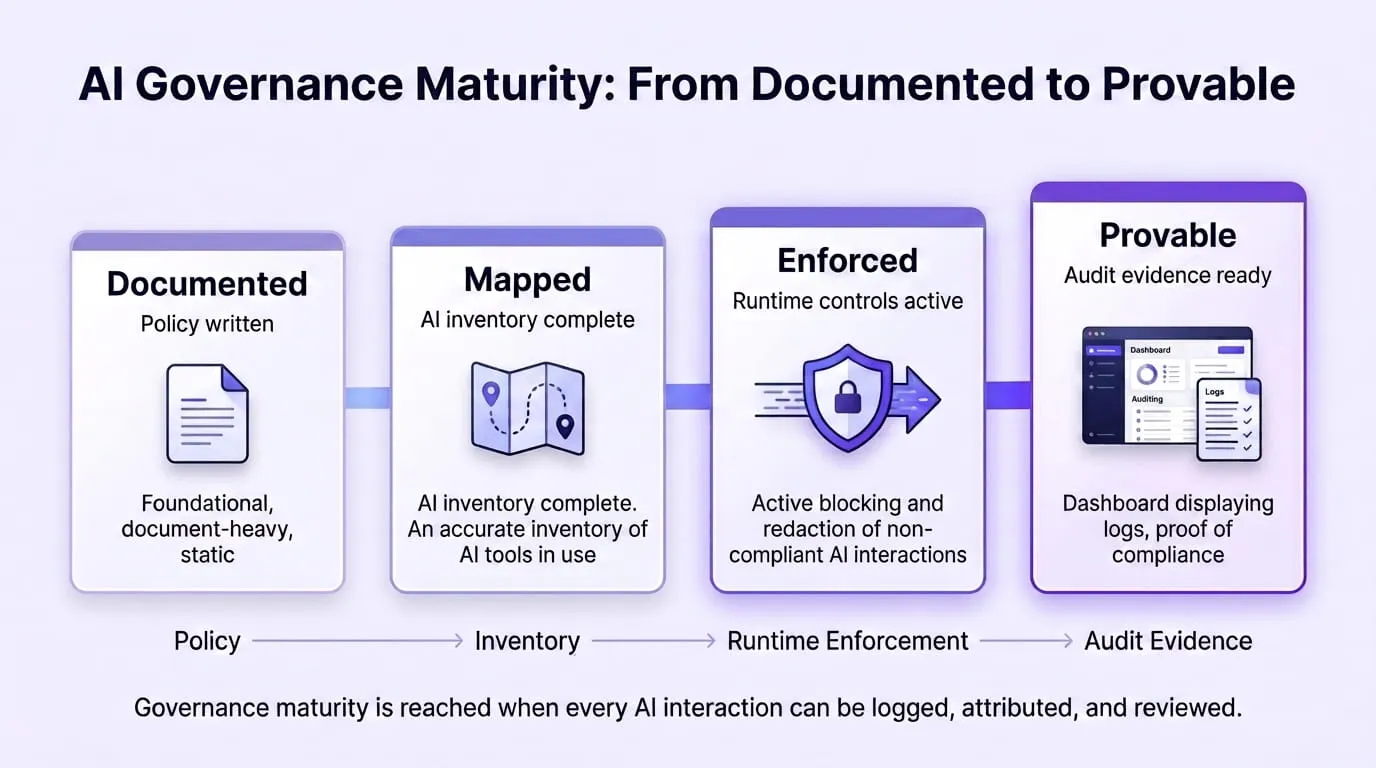
Implementing AI governance at runtime follows four stages: Documented, Mapped, Enforced, and Provable. Most organizations sit at Stage 1; a real policy, zero technical enforcement, which is exactly the insurer's position in the opening scenario when the audit request arrived. Each stage below states what it looks like in practice, what commonly goes wrong at that stage, and where to go for the implementation depth this pillar deliberately doesn't try to replicate.
[DIAGRAM: Four-stage horizontal flow]
Documented → Mapped → Enforced → Provable
   ?            ?️          ?️          ?
Policy       Inventory   Runtime      Audit
written      complete    enforcement  evidence
Stage 1: Documented
Policy exists, approved, and communicated at onboarding. No technical control checks whether it's followed. If asked for evidence of a specific decision, the team can produce the policy; not proof it was applied.
The most common gap at this stage isn't the absence of a policy; it's a policy too generic to enforce. "Use AI responsibly" can't be turned into a technical rule. "No customer PII in prompts submitted to unsanctioned tools" can. A policy that can't be restated as a testable condition, something a system could check true or false, will never make it past Stage 1, no matter how thoroughly it's reviewed and signed off. For the specific language enterprise teams use to make ChatGPT, Claude, and Gemini usage policies enforceable rather than aspirational, see LangProtect's AI usage policy template for enterprise teams.
Stage 2: Mapped
AI tool inventory complete, including shadow AI. Risk classifications assigned per use case, aligned to NIST's Map function. No enforcement yet; violations are still discovered after the fact, if at all.
Building this inventory isn't a one-time spreadsheet exercise. New AI tools get adopted by individual teams faster than a security review cycle can keep pace with, which is why an accurate Stage 2 needs a standing intake process rather than a quarterly audit that's stale by the time it's finished. A realistic inventory tracks, at minimum: what data each tool can access, what it can output, who has access to it, whether it's third-party hosted, and whether any inspection layer currently sits in front of it. If a security team can't answer all five for every AI tool in the environment, the inventory isn't actually complete, it's a snapshot of what was known at the time it was taken. See LangProtect's guide to building an AI tool approval workflow for employees for how to structure intake, risk-tier new tools consistently, and avoid the workflow becoming enough of a bottleneck that employees route around it entirely. LangProtect Guardia is built specifically to surface this inventory automatically, including the tools no one formally approved in the first place.
Stage 3: Enforced
Runtime controls active at the interaction layer; blocking, redacting, or routing AI use according to policy in real time. NIST's Measure function now has actual data to work with. ISO 42001 monitoring evidence starts accumulating automatically instead of manually.
This is the stage where a governance policy actually becomes a security control, and it's rarely a direct, one-to-one translation. "Require human review for high-risk decisions" doesn't compile into a rule on its own; someone has to define what counts as high-risk in a way a system can evaluate, what "review" technically means (a blocking gate versus a logged notification), and what happens if no reviewer responds within a defined window. Skipping that translation step is the most common reason Stage 3 rollouts stall: teams deploy a generic guardrail product, declare the stage complete, and discover months later that the guardrail was never actually configured against their specific policy language. LangProtect's guide to turning AI governance policies into enforceable security controls walks through that translation step by step, including where policy language is too ambiguous to enforce as written and needs to be rewritten before it can become a rule at all. For AI agents and MCP-connected tools specifically where "enforcement" also means scoping what an agent is allowed to call or access, not just what a human can type into a prompt box; LangProtect Vector governs that layer directly.
Stage 4: Provable
Every AI interaction, sanctioned and shadow; is logged, attributed, and retrievable. An audit request like the one in the intro gets answered with a log export, not an apology. Quarterly reports double as ISO 42001 and NIST Measure evidence without extra work.
Two things separate a genuinely provable program from one that just feels mature: logs that actually contain the fields an auditor asks for, and someone reviewing that evidence on a standing cadence before an auditor ever does. It's entirely possible to reach Stage 3, generate logs for months, and still fail an audit at Stage 4, because the logs capture that an interaction happened without capturing who reviewed it, what policy applied, or whether an enforcement action fired.
A Stage 3 log and a Stage 4 log often look deceptively similar until an auditor asks a specific question:
// Stage 3: an enforcement event fired, but the record is incomplete
{
  "timestamp": "2026-06-10T14:22:07Z",
  "event": "prompt_blocked",
  "tool": "internal_llm_app"
}
// Auditor asks: who was the user? what policy triggered this?
// what data was involved? was a human ever notified?
// None of that is captured. The event happened. The evidence didn't.

// Stage 4: the same event, captured with the fields an audit requires
{
  "timestamp": "2026-06-10T14:22:07Z",
  "event": "prompt_blocked",
  "tool": "internal_llm_app",
  "user_id": "emp-40217",
  "policy_id": "PII-EXTERNAL-MODEL-01",
  "data_category": "customer_PII",
  "enforcement_action": "block",
  "human_notified": true,
  "reviewer_id": "sec-ops-04",
  "review_timestamp": "2026-06-10T14:25:41Z"
}
The difference isn't the enforcement mechanism, both scenarios successfully blocked the same prompt. The difference is whether the resulting record can answer the specific questions an audit is going to ask. LangProtect's guide to AI governance evidence covers the specific log fields and report formats auditors request in practice, and LangProtect's guide to the AI governance metrics CISOs should review weekly covers what that ongoing review should actually look like as a standing operational habit, not a pre-audit scramble that starts the week a regulator's letter arrives.
The Sequencing Rule: Where to Actually Start
Telemetry has to come before policy enforcement, you cannot enforce rules against AI use you can't see. The practical sequence:
- Inventory every AI tool in use, including shadow AI.
- Classify each one by risk, aligned to NIST's Map function.
- Deploy interaction-layer logging and enforcement; logging first, enforcement following once the data confirms what's actually happening in production.
- Route logs into governance reporting so the same evidence stream supports NIST Measure and ISO 42001 continuous-monitoring requirements simultaneously, rather than building separate reporting pipelines for each.
Attempting to skip straight to enforcement without first establishing visibility is the single most common implementation mistake, and it creates blind spots that no amount of policy language can address after the fact; you end up enforcing rules against the 20% of AI usage you happened to know about, while the other 80% continues unmonitored. For a deeper look at the discovery step specifically, see LangProtect's guide to shadow AI.
How Does Governance Implementation Differ Across AI Deployment Types?
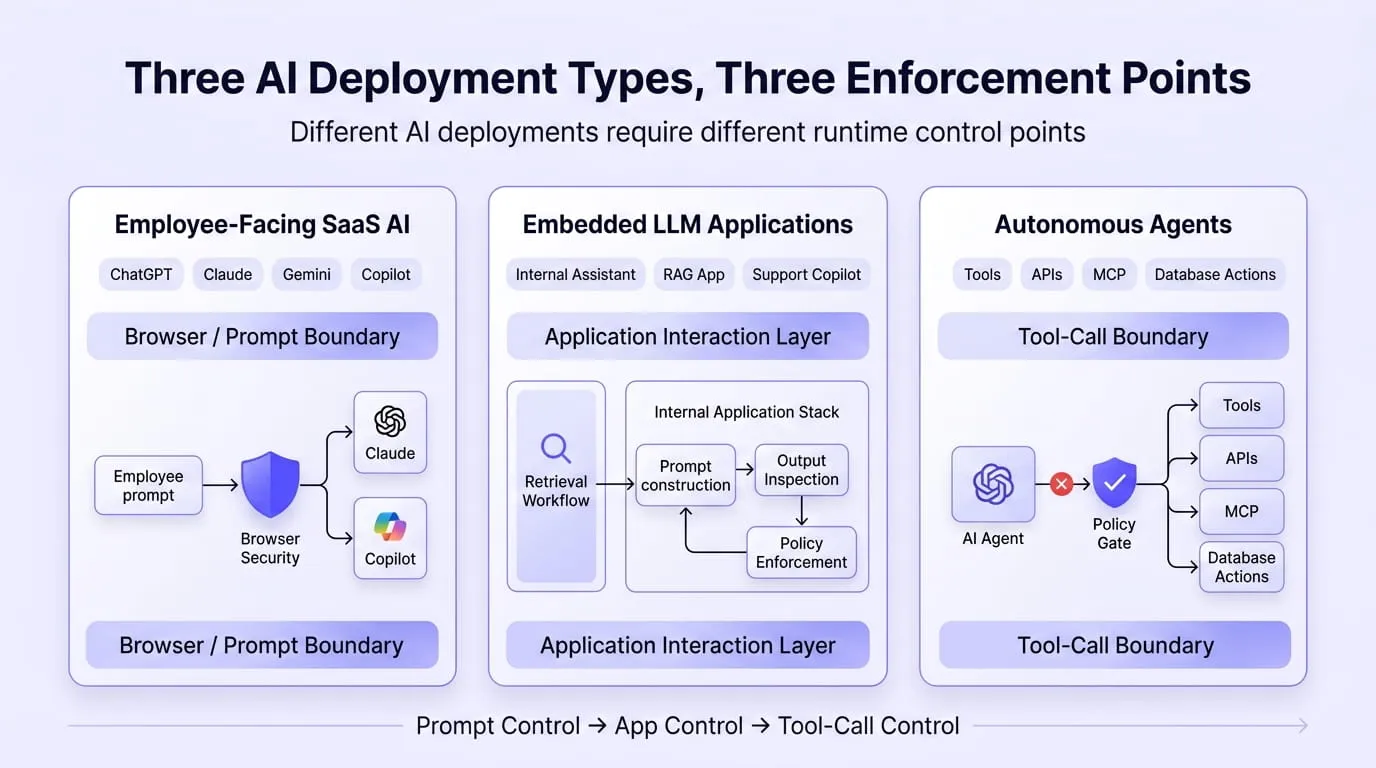
The four-stage model above applies universally, but what gets inventoried, enforced, and logged at each stage looks different depending on how AI actually reaches your environment. Most organizations are running all three deployment types simultaneously without having separated them in their governance planning, which is itself a common reason Stage 2 mapping efforts undercount what they're supposed to be counting.
Employee-Facing SaaS AI Tools
This is the browser-based case: employees using ChatGPT, Claude, Gemini, or dozens of AI-enabled SaaS products through personal or enterprise accounts. The governance challenge here is almost entirely about the prompt and output boundary; what an employee types in, and what comes back, because the organization has no control over the model itself, only over what reaches it.
- Stage 1 (Documented) needs to name specific tools and specific data categories, not "AI tools" as a category; "no claim numbers or policyholder names in prompts to ChatGPT, Claude, Gemini, or any unreviewed AI tool" is enforceable; "use AI responsibly" is not.
- Stage 2 (Mapped) is where shadow AI concentrates most heavily, since browser-based tools require no procurement approval and no IT provisioning to start using.
- Stage 3 (Enforced) happens at the browser or network egress layer, inspecting and redacting content before it leaves the device.
- This is the deployment type LangProtect Guardia is built around visibility and enforcement at the point where an employee's intent meets an external model.
Embedded and In-House LLM Applications
This is the case where your organization builds or licenses an AI-powered application; a customer support assistant, an internal document-search tool, a contract-review product; with a model integrated directly into a product your teams or customers use. The governance challenge shifts from "what did an employee type" to "what did the application do with the data it was given access to," including retrieval pipelines, system prompts, and structured business logic wrapped around the model call.
- Stage 1 needs to specify data classification boundaries per application, not per employee behavior; which data sources a given application is permitted to retrieve from, and what output classifications require redaction before reaching a user.
- Stage 2 requires mapping each application's data access scope specifically, not just "the app uses an LLM"; the risk profile of a document-search tool over public marketing content is nothing like the same architecture pointed at HR records.
- Stage 3 enforcement happens at the application's interaction layer, inspecting what gets retrieved and what gets returned, independent of the underlying model vendor.
- This is the deployment type LangProtect Armor is built around runtime enforcement for the applications your organization builds or deploys, not just the ones your employees casually adopt.
Autonomous Agents and MCP-Connected Tools
This is the newest and least governed case: AI agents with the ability to call tools, query databases, and take multi-step actions with limited human review per step. The governance challenge here isn't primarily about content moving through a prompt, it's about scope of action. An over-permissioned agent isn't leaking data through a conversation; it's executing tool calls that were never explicitly authorized for that specific task.
- Stage 1 policy has to define action boundaries, not just data boundaries; which tools an agent class is permitted to call, and which actions require a human approval gate before execution rather than after.
- Stage 2 mapping needs to inventory not just "which agents exist" but which tools, APIs, and data sources each agent has been granted access to; access that frequently accumulates beyond what any single task actually requires.
- Stage 3 enforcement means scoping tool calls in real time, not just inspecting text; blocking an unauthorized API call is a different technical problem than redacting a sentence.
- This is the deployment type LangProtect Vector governs directly, and it's the category where Stage 2 mapping gaps are most severe industry-wide, simply because agentic tooling is newer than the governance processes most organizations built to track it.
Treating these three deployment types as a single "AI governance" category is itself a common source of Stage 2 undercounting; a tool inventory built entirely around browser extensions will miss every embedded application and every agent with standing API access, even though all three carry real governance risk.
Most AI governance programs don't fail from a single dramatic gap, they stall incrementally, at predictable points, for reasons that have little to do with the technology itself. Six patterns account for the large majority of stalled rollouts.
Pitfall 1: Treating Govern and Map as the Finish Line
Because Govern and Map produce tangible deliverables; a signed policy, a completed inventory; they feel like the project is done. Measure and Manage require ongoing infrastructure and ownership, not a one-time deliverable, so they're the functions that get deprioritized once the "governance project" is declared complete and the team disbands. The fix is definitional: a governance program isn't done at Govern and Map. It hasn't started enforcing anything yet.
Pitfall 2: Writing Policy the Technical Team Can't Enforce
Policy language written entirely by legal or compliance, without a technical reviewer in the room, routinely produces requirements that sound precise but can't be operationalized; "use AI ethically," "avoid bias," "exercise appropriate judgment." None of these compile into a rule. Every policy clause destined for Stage 3 enforcement should pass a simple test during drafting: can this be restated as a condition a system could evaluate as true or false? If not, it needs a technical co-author before it's finalized, not after.
Pitfall 3: No Single Owner Across the Full Lifecycle
Governance frequently gets handed off between teams at each stage; legal owns Documented, IT owns Mapped, security owns Enforced, compliance owns Provable; with no single person accountable for the program moving from one stage to the next. Handoffs without an owner are where momentum dies; each team completes its piece and waits for someone else to pick up the baton, and often no one does.
Pitfall 4: Underestimating Shadow AI at the Mapping Stage
Organizations routinely map only the AI tools that went through a formal procurement process, missing the browser extensions, personal accounts, and team-level SaaS subscriptions that make up a large share of actual usage. A Stage 2 inventory that only counts sanctioned tools isn't wrong, exactly; it's just answering a much narrower question than the one governance actually needs answered.
Pitfall 5: Deploying a Generic Guardrail Instead of a Configured Control
Buying a prompt-filtering or DLP-for-AI product and calling Stage 3 complete, without actually mapping the product's rule engine to the organization's specific policy language, produces a control that blocks something; usually generic PII patterns; while missing the policy's actual intent entirely. A tool is not a control until it's configured against a specific, written rule.
Pitfall 6: Building Evidence Only When an Audit Is Announced
Retroactively assembling "evidence" after an audit notice arrives is the single clearest sign of a Stage 1 or Stage 2 program masquerading as Stage 4. Genuine Stage 4 evidence is continuous by construction, it exists whether or not anyone asked for it yet, which is the entire point of the distinction between a filing cabinet and a control loop.
These six pitfalls share a common thread: none of them are technology failures. A team can buy the right enforcement product, implement it correctly, and still stall at Stage 2 because no one owns the handoff to Stage 3, or because the policy that's supposed to drive enforcement was never written in a form a system could evaluate. The maturity model in the previous section describes the destination. These pitfalls describe why so many programs get within sight of it and stop anyway, usually not because the remaining work is technically hard, but because it's organizationally unclaimed.
What Does It Actually Cost to Stay at Stage 1?
The business case for moving past documentation isn't abstract. Three data points, from three different vantage points, converge on the same conclusion.
DigiCert's July 2026 AI Trust Outlook found 78% of organizations have already experienced an AI-related security incident or identified a vulnerability, this isn't a future risk being planned against, it's a present-tense majority. The same survey found that only 53% of organizations can fully trace an AI-generated decision back to its source model and data. Put those two numbers together: most organizations have already had the incident, and roughly half of them couldn't reconstruct how it happened even if they tried.
Gartner's prediction that comprehensive AI governance platforms will produce 40% fewer AI-related ethical incidents by 2028 quantifies the other side of the same equation; the delta isn't between "governed" and "ungoverned" in the abstract, it's specifically between programs with technical enforcement and programs relying on fragmented, documentation-only approaches.
And Colorado's removal of the NIST/ISO safe harbor changes the legal calculus directly: an organization that spent a year and a real budget achieving NIST AI RMF alignment, expecting that alignment to function as a legal defense, now has that expectation removed in at least one major US jurisdiction, with no guarantee other states won't follow the same pattern as their own legislative sessions revisit AI law. A framework checklist was never going to be a permanent legal shield. Runtime evidence is the only artifact that survives a regulatory rewrite, because it demonstrates what actually happened rather than what an organization committed to doing.
There's a fourth cost that rarely makes it into a business case but shows up constantly in practice: procurement friction. Enterprise customers and partners increasingly ask vendors to demonstrate AI governance maturity as part of security review, not "do you have a policy," but "can you show us evidence of enforcement." A Stage 1 program produces a PDF. A Stage 4 program produces a log export and a dashboard screenshot, and closes that review cycle in a fraction of the time. For organizations selling into regulated industries; financial services, healthcare, government; that difference increasingly shows up directly in sales cycle length, not just audit outcomes.
Where This Guide Fits: The AI Governance Implementation Series
This guide covers the framework mapping and maturity model; the "what and why" of runtime governance. Each stage above has a companion guide that covers the "how," in implementation depth this pillar deliberately doesn't duplicate:
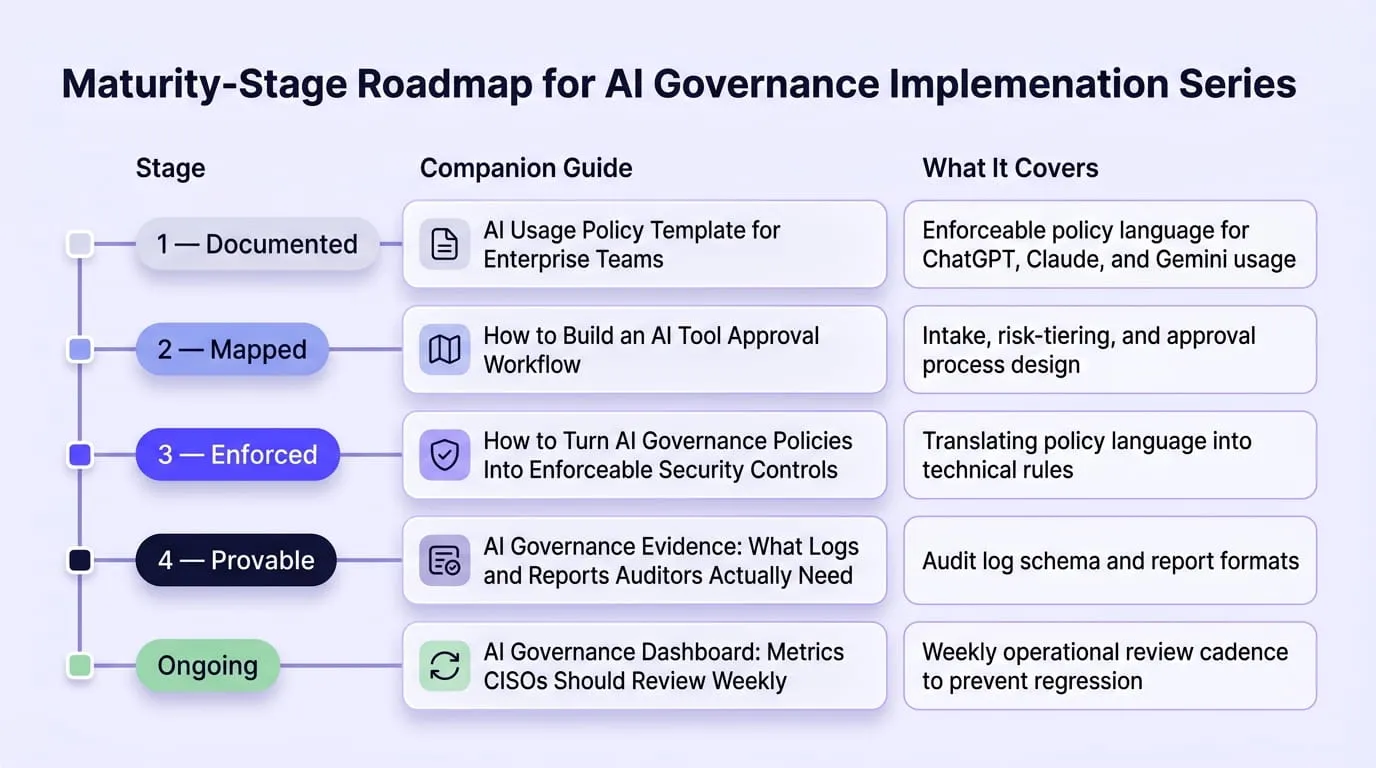
For the platform view of how these controls come together; inventory, enforcement, and evidence generation in a single layer, see LangProtect's Enterprise AI Governance solution or download the full solution brief.
Governance Is a Control Loop, Not a Filing Cabinet
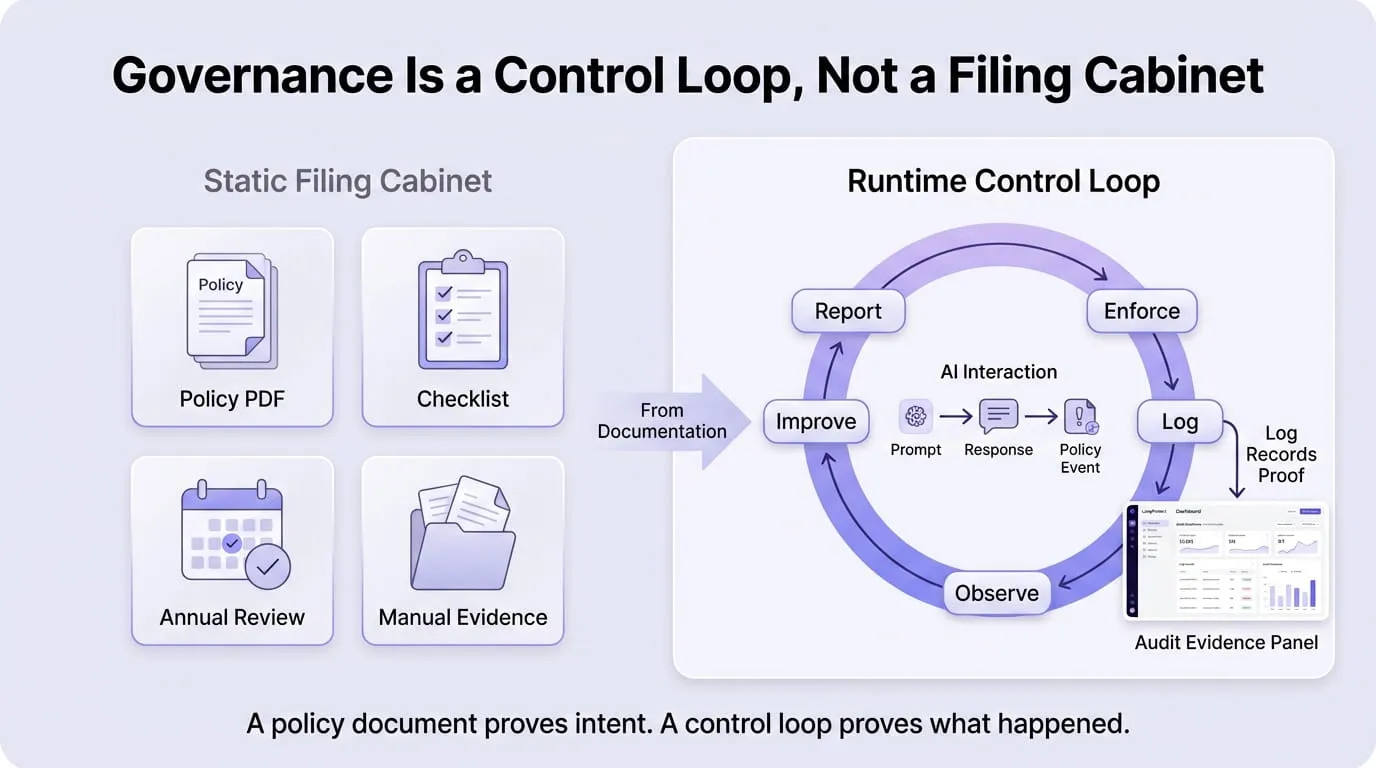
A policy document proves intent. A runtime control proves what happened. Regulators, auditors, and increasingly your own customers are starting to ask for the second thing, not the first; and as Colorado just showed, the laws that assumed documentation was enough are the ones getting rewritten.
The question isn't whether your organization has an AI governance policy. Most do now; 78% have already had reason to wish they'd gone further. The question is whether you can produce a log of what your AI systems did last Tuesday and whether anyone reviewed it.
Ready to Move From Documented to Provable?
Book a 30-minute AI governance implementation assessment, we'll map exactly where your program stands today.
Prefer to read first? Download the LangProtect solution brief for the full platform overview.
Frequently Asked Questions
What is the NIST AI RMF Measure gap?
The Measure gap is the point where most AI governance programs stall. Organizations complete Govern (write the policy) and Map (inventory AI systems) but can't execute Measure because they have no interaction telemetry to benchmark against. Without runtime data on what AI systems actually did, Measure has nothing to assess, and Manage becomes reactive incident response instead of a functioning control loop.
Is ISO 42001 certification required to prove AI governance maturity?
No, ISO 42001 certification is voluntary, but it's increasingly requested by enterprise procurement teams and treated by regulators as stronger evidence of control maturity than self-attestation, since it involves third-party audit. Organizations can demonstrate governance maturity without certification if they have equivalent runtime monitoring evidence; certification simply provides externally verified proof of the same thing.
Does the EU AI Act delay mean companies can pause governance work?
No. The Digital Omnibus agreement defers Annex III high-risk system obligations to December 2, 2027, but Article 50 transparency obligations remain largely on their original timeline, and organizations with active EU exposure should treat the formal adoption as a planning baseline rather than a reason to stop. More importantly, governance implementation shouldn't hinge on a single regulation's deadline; runtime controls, interaction logging, and continuous monitoring create value regardless of which compliance date applies, and satisfy several regulatory frameworks at once.
What happened to Colorado's AI Act risk-framework safe harbor?
Colorado's original AI Act included a rebuttable presumption of compliance for organizations following a recognized risk management framework like NIST AI RMF or ISO 42001. SB 189, signed May 14, 2026, removed that provision along with the duty-of-care and impact-assessment requirements, replacing them with a narrower disclosure-based framework effective January 1, 2027. Following NIST AI RMF is still good operational practice, but it's no longer an automatic legal defense in Colorado.
What's the fastest path from a written AI policy to enforced controls?
Start with interaction-layer logging across every AI tool in use, including unsanctioned shadow AI, before writing any enforcement rules you can't enforce policy against activity you can't see. From there, map logged activity against existing risk classifications, then layer in real-time blocking or redaction for the highest-risk categories first, following the Stage 1→4 sequence covered above.
Can existing security tools handle AI governance enforcement, or is new tooling required?
Traditional DLP, SIEM, and CASB tools generally can't inspect AI prompt and response content, which is where most governance-relevant activity happens; they were built to catch file transfers and network anomalies, not natural-language instructions. AI governance enforcement typically requires a purpose-built interaction-layer tool that feeds structured events back into existing security and compliance systems, rather than a wholesale replacement of the stack.
How long does it take to reach Stage 3 (Enforced) governance maturity?
Organizations starting from Stage 1; policy only, no telemetry; typically reach Stage 3, active runtime enforcement with monitoring evidence flowing into compliance reporting, in 8–14 weeks, contingent on completing tool inventory and risk classification first. The main variable is how much shadow AI use exists before the inventory phase even begins.
Why do organizations reach Stage 3 but still fail an audit?
Because Stage 3 (Enforced) and Stage 4 (Provable) are evaluated differently; enforcement generates events, but an audit needs those events captured in a specific, complete evidentiary form. A program can be actively blocking and redacting AI interactions in real time and still fail an audit if the resulting logs don't capture who reviewed a flagged interaction, which policy triggered an action, or whether an approval actually occurred before an action executed. Reaching Stage 4 requires validating the log schema itself against what an auditor will actually request, not just confirming that enforcement events are firing.
Is a governance maturity assessment a one-time project or an ongoing process?
Ongoing. Reaching Stage 4 is a milestone, not an end state; new AI tools get adopted continuously, policies need periodic revision as regulation shifts, and enforcement rules drift out of alignment with actual usage patterns if no one is reviewing them. Organizations that treat Stage 4 as "done" typically regress within a few quarters as new shadow AI tools reintroduce Stage 1-style blind spots alongside an already-enforced core. A standing operational cadence, not a project with an end date, is what keeps a Stage 4 program at Stage 4.
Tags
Related articles
DPDP Act and AI Security: What Rules 6 and 7 Mean for Prompts, Agents, and Logs
Anthropic's AI Watermarks: What Enterprises Need to Know