

What is Shadow AI and How to Protect Against It

In today's fast-paced business landscape, AI is a game-changer. Research shows that AI can boost employee productivity by up to 40%. Whether it's automating tasks, generating content, or enhancing customer interactions, the promise of AI is undeniable.
However, with great power comes great responsibility. While AI can make employees faster and more efficient, it also significantly increases the risk of data exposure. In fact, AI can double the chances of sensitive information being compromised.
This paradox is what we call the "Productivity Paradox": AI makes us more productive but exposes our data to greater risks. This issue is especially critical in the context of Shadow AI
A term that refers to the unsanctioned use of generative AI (GenAI) tools within an organization. Employees often adopt these tools without IT’s knowledge, sidestepping official channels in the name of efficiency. However, this unchecked use can create significant security and compliance risks for businesses.
At LangProtect, we believe that simply blocking these AI tools isn’t the solution. The idea of "banning" AI fails to recognize the underlying issue. Instead of trying to shut down these productivity boosters, the key lies in enabling secure AI. Shadow AI isn’t inherently malicious—it’s a byproduct of what we call the Utility Gap.
Employees are acting as “de facto procurement departments”, choosing tools that make their jobs easier, but often at the cost of organizational security. Rather than focusing on restricting the use of AI, businesses must embrace AI governance and security measures that allow AI to function safely.
With the right tools, like LangProtect, organizations can enable secure AI usage and prevent data leakage, while maintaining the productivity boost AI offers. In this guide, we’ll dive deep into the world of Shadow AI, explore the risks it brings, and provide actionable solutions to ensure that your AI adoption doesn't come at the cost of your data security.
Let's explore how businesses can protect themselves from the growing threat of unsanctioned AI use while benefiting from its many advantages.
What Exactly is Shadow AI in 2026?
Shadow AI refers to the unsanctioned use of generative AI (GenAI), large language models (LLMs), and AI agents within an organization without IT oversight or approval. It typically involves employees using these tools for work purposes, bypassing official channels and creating significant security and compliance risks.
As AI tools become more integrated into our everyday work, the rise of Shadow AI presents a growing challenge for businesses. Unlike sanctioned tools that are carefully vetted by IT departments, Shadow AI thrives in environments where employees bypass the controls set by their organization’s security policies.
But what exactly does Shadow AI look like in practice?
Here are the three primary flavors of Shadow AI in 2026:
Standalone Chatbots (BYOAI):
This is the most common form of Shadow AI. Employees use personal accounts on platforms like ChatGPT, Claude, or Gemini to get quick answers, generate content, or perform complex tasks.
While these tools can dramatically boost productivity, they often lack the necessary oversight to ensure that sensitive or proprietary data isn’t inadvertently shared with external systems. The key risk here is that employees use these tools without realizing the potential for data leakage.
Browser Extensions:
AI-powered browser extensions, such as AI writing assistants and code-debugging tools, are another gateway for Shadow AI.
These tools may seem harmless, but once installed, they collect and process the data employees interact with across various platforms—often without proper scrutiny or awareness from the IT team.
The danger lies in the ease with which employees can download these tools, resulting in AI-driven productivity gains at the cost of security breaches.
Silent Drift:
Perhaps the most insidious form of Shadow AI, Silent Drift refers to AI features that are introduced silently within already sanctioned apps like Teams or Salesforce.
When these apps update, new AI-driven capabilities often go unnoticed by IT and security teams, leaving organizations exposed to hidden risks.
Employees may unknowingly leverage AI features embedded in their tools, which may not be monitored for compliance, data protection, or potential misuse.
Shadow IT vs. Shadow AI: The Evolution of Risk
As organizations continue to embrace digital transformation, the lines between Shadow IT and Shadow AI are becoming increasingly blurred. While Shadow IT—the unauthorized use of IT resources—has been a concern for years, the rise of AI-powered tools introduces a new dimension of risk. Understanding how Shadow IT and Shadow AI differ, and how they evolve, is crucial for organizations looking to safeguard their data.
What is Shadow IT?
Shadow IT refers to the use of hardware, software, or IT services within an organization without the approval or oversight of the IT department. Employees typically turn to unauthorized apps or tools that they believe will improve their workflow, bypassing corporate restrictions. Common examples include using third-party cloud storage services like Dropbox or collaboration tools like Slack without formal approval.
The Emergence of Shadow AI
Shadow AI takes Shadow IT a step further by incorporating generative AI and large language models (LLMs) into business workflows without IT's involvement. Unlike traditional software tools, AI tools like ChatGPT, Claude, or Google Gemini are not just applications—they are decision-making assistants capable of generating content, analyzing data, and even interacting with customers.
Shadow AI may involve:
- Employees using personal accounts on platforms like ChatGPT or Claude to perform work tasks.
- AI extensions embedded in browsers, which interact with personal or company data.
- AI features embedded in sanctioned tools (like Microsoft Teams or Salesforce) that silently activate during updates.
The Evolution of Risk: How Traditional Security Can't Keep Up
The key difference between Shadow IT and Shadow AI lies in the nature of the risk. While Shadow IT poses static risks (such as unauthorized access or insecure storage), Shadow AI introduces dynamic risks that can evolve and scale rapidly. Here’s why Shadow AI is harder to track and control:
-
AI Complexity: Traditional security models are built to handle simple data access controls. AI, however, involves dynamic data processing and pattern recognition, which complicates detection.
-
Data Leakage: With Shadow IT, unauthorized apps may access data stored on company servers. But with Shadow AI, the AI tool might train on your data, essentially embedding sensitive company information into the AI model itself, which could then be accessed or exfiltrated by anyone with access to that tool.
-
Malicious Manipulation: Unlike regular apps, AI systems can be exploited through methods like prompt injections, where seemingly harmless queries can manipulate the AI to provide unauthorized access to sensitive information.
The Risks of Shadow AI in Action
The risks posed by Shadow AI can lead to severe consequences, ranging from data leakage to compliance violations. Below are some common risks associated with Shadow AI:
- Data Exfiltration: Employees unknowingly upload sensitive information (e.g., customer data, proprietary code) to AI platforms, which may not comply with data protection laws like GDPR or HIPAA.
- Prompt Injection: Attackers or even employees may manipulate AI models to extract confidential data or generate harmful outputs that bypass existing security protocols.
- Silent Drift: AI features in sanctioned tools like Teams or Salesforce can be activated through updates, creating hidden vectors for data leakage and AI abuse.
| Dimension | Shadow IT | Shadow AI |
|---|---|---|
| Risk Type | Static (unauthorized access, storage) | Dynamic (data leakage, model poisoning) |
| Detection Difficulty | Moderate (with regular audits) | High (due to evolving AI behaviors) |
| Data Impact | Unauthorized file sharing | Data embedded in AI models, exfiltrated via queries |
| Vulnerability Type | Misconfigured apps, outdated security | AI prompt vulnerabilities, training data leaks |
| Mitigation | Traditional DLP, network monitoring | AI-specific controls (e.g., model weights, prompt sanitization) |
Why Traditional Security Fails Against Shadow AI
Traditional security measures like firewalls, DLP, and identity management systems were built to handle static security threats. Shadow IT posed a challenge, but Shadow AI introduces a new class of evolving, context-aware risks that traditional systems cannot easily detect or mitigate. Unlike file-based threats, AI models operate in ways that are less predictable and more difficult to audit.
- Firewalls can’t detect the semantic intent of AI queries.
- DLP systems aren’t designed to monitor dynamic AI interactions, such as data input and prompt injections.
- Traditional access control is ill-equipped to handle the autonomous nature of AI models.
Mitigation Strategies: A New Approach for Shadow AI
To defend against Shadow AI, organizations need to adopt AI-aware security strategies that go beyond traditional methods. Here are some key steps to consider:
- Real-time Monitoring: Implement AI security firewalls like LangProtect to monitor AI traffic in real-time and prevent unauthorized data access.
- Prompt Injection Protection: Employ methods to sanitize prompts and block any injection attempts that could alter AI behavior.
- AI Governance: Develop an AI governance framework that defines acceptable use policies, sanctions unauthorized AI tools, and ensures compliance.
The "Utility Gap": Why the Great AI Ban Failed
As AI technology continues to infiltrate workplaces, organizations are faced with a difficult dilemma: should they ban unapproved AI tools to reduce the risk of data breaches, or should they embrace the power of AI to boost productivity?
The truth is, many businesses have tried to ban AI outright, but these attempts have largely failed.
This failure is due to a fundamental issue: the "Utility Gap"—a gap between what employees perceive as useful and what the company deems secure.
The Psychology of Efficiency
Employees are constantly under pressure to deliver faster results. In many cases, they turn to unapproved AI tools because these tools help them get work done quicker and more efficiently. Employees view these tools as necessary to meet deadlines and achieve targets.
The desire for immediate output often outweighs the concern for long-term security and compliance. As a result, the Utility Gap widens: employees find tools that offer greater productivity, while businesses struggle to keep up with the potential risks these tools introduce.
Decentralized Purchasing
In today’s decentralized corporate environment, 84% of application adoption is driven by business units, not IT departments. This shift has left security teams playing catch-up.
Employees in departments like marketing, sales, and HR are increasingly empowered to choose their own tools, often bypassing official channels and IT approval.
While this empowers employees to work more efficiently, it opens the door to Shadow AI usage, as employees gravitate toward powerful, unsanctioned AI tools that streamline their tasks.
The Risk of Over-Sharing
One of the most alarming findings comes from CybSafe/NCA research, which revealed that 38% of employees openly share confidential data with AI tools.
Whether it's pasting sensitive client information into ChatGPTor using AI writing assistants to generate company documents, employees often don't realize that they are exposing valuable data.
This over-sharing of information occurs without proper oversight and can lead to unintended data breaches, especially when employees use personal accounts for work-related tasks.
The Risk Matrix: Security, Compliance, and Ethics
As Shadow AI continues to gain traction within organizations, the associated risks grow in complexity. From data exfiltration to advanced attack vectors and regulatory compliance issues, businesses must stay vigilant to prevent catastrophic breaches. This section outlines the key risks that come with the rise of Shadow AI, providing insight into how organizations can address these evolving threats.
Data Exfiltration (The Samsung & DeepSeek Precedents)
One of the most significant risks posed by Shadow AI is data exfiltration—the unauthorized transfer of sensitive information to external platforms. The Samsung case and the DeepSeek precedent provide real-world examples of how AI tools can be leveraged to steal corporate data.
- Samsung: In 2023, Samsung employees inadvertently exposed sensitive source code to ChatGPT, leading to the leak of proprietary data. This incident occurred when employees used ChatGPT for coding assistance without realizing that the data they shared was stored externally and outside of company controls.
- DeepSeek: Similarly, DeepSeek—a malicious entity—exploited generative AI tools to perform data exfiltration on a massive scale. Using AI-powered tools to bypass traditional security controls, DeepSeek was able to siphon off confidential information and intellectual property.
These incidents are prime examples of how data leakage via Shadow AI can have devastating effects on both business reputation and intellectual property.
Quote: Data leaks through AI tools are data leaks on steroids—more efficient, less detectable, and highly scalable." – Security Expert
Advanced Attack Vectors (For the Technical CISO)
The risks associated with Shadow AI are not limited to accidental data exposure. The advanced attack vectors at play include sophisticated tactics such as prompt injection, model weight poisoning, and training data extraction. Here's how these tactics work:
Prompt Injection:
- Definition: Prompt injection occurs when an attacker manipulates the input given to an AI system to alter its behavior, often bypassing safety guardrails.
- Impact: Attackers can exploit AI's decision-making capabilities to access restricted data, perform unauthorized actions, or even make AI-generated outputs harmful to the organization.
- Example: In an enterprise setting, a shadow AI tool may be tricked into revealing confidential documents or giving malicious instructions to a legitimate AI system.
Model Weight Poisoning:
- Definition: This risk occurs when unvetted open-source models are poisoned with malicious data, which alters their performance in ways that benefit attackers.
- Impact: Attackers could compromise AI systems by subtly altering model weights, leading to unreliable or malicious model outputs. These models may then make harmful decisions or leak proprietary information.
- Example: A generative AI tool integrated into an enterprise environment may inadvertently provide misleading or dangerous recommendations, such as incorrect financial advice or faulty medical diagnostics, due to poisoned training data.
Training Data Extraction:
- Definition: This technique involves competitors or malicious actors querying a trained AI model to extract sensitive training data—including proprietary code, confidential reports, or customer information.
- Impact: The AI model, which stores vast amounts of data, can be exploited to leak information it has "learned" during its training phase, without even needing direct access to the original data sources.
- Example: Competitors can query the AI to reconstruct proprietary data (e.g., source code, customer details) that was used to train the model, leading to intellectual property theft.
The Regulatory Hammer
In addition to the security risks posed by Shadow AI, organizations also face mounting regulatory compliance challenges. Governments and regulators around the world are now focusing heavily on AI governance, and businesses must align their security practices to avoid hefty fines and penalties.
GDPR/EU AI Act: Fines of Up to 4% of Global Revenue
- The General Data Protection Regulation (GDPR) and the EU AI Act impose stringent requirements on how organizations handle data and implement AI systems.
- Non-compliance with these regulations can result in fines of up to 4% of global revenue—a financial blow that could devastate a company’s reputation and operations.
SOC2/HIPAA:
- While SOC2 and HIPAA compliance frameworks focus on data protection and privacy, they face limitations when it comes to AI tools.
- Traditional Data Loss Prevention (DLP) systems fall short of monitoring AI interactions, making it harder for organizations to audit AI tool usage and ensure compliance. Shadow AI, which often operates outside the purview of the IT department, can easily bypass these traditional security measures.
- Without proper oversight, organizations may find themselves non-compliant, risking legal consequences and reputational damage.
How to Track, Manage, and Secure Shadow AI with LangProtect
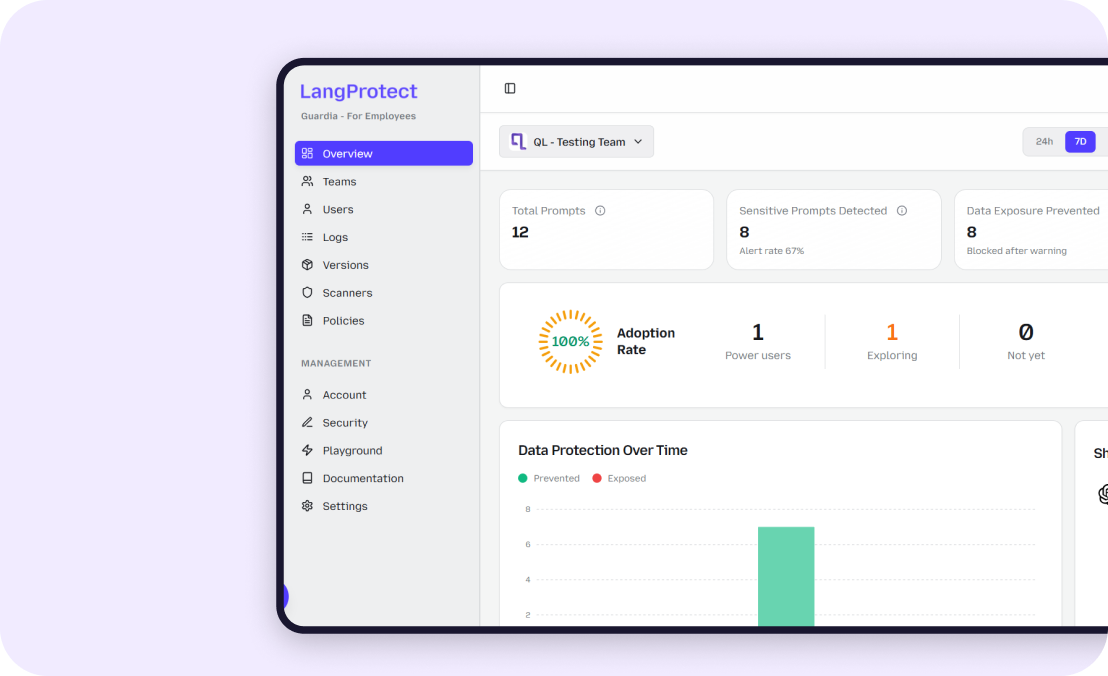
As Shadow AI continues to proliferate in organizations, the need for a comprehensive, proactive security solution is more critical than ever. LangProtect stands at the forefront of addressing these concerns by offering a real-time AI security firewall that ensures businesses can benefit from AI tools without compromising sensitive data or violating compliance regulations.
LangProtect: Real-Time AI Security with "Zero Surprise Tolerance"
Unlike traditional security solutions that only alert you after a breach has occurred, LangProtect takes a proactive approach. It offers real-time intervention to prevent data exposure, ensuring that Shadow AI risks are managed before they can escalate into a full-blown security incident. LangProtect is built to provide "Zero Surprise Tolerance"—meaning organizations can confidently adopt AI tools without the constant worry of unknown risks. By integrating LangProtect into your AI workflow, you ensure that every interaction with AI is monitored and secured, leaving no room for surprises or breaches.
Core Features of LangProtect
LangProtect offers a range of powerful features designed specifically to secure AI interactions and address the unique risks associated with Shadow AI:
Real-Time PII Masking:
One of the most critical features of LangProtect is its ability to mask personal identifiable information (PII) in real time. Before any sensitive data reaches a large language model (LLM) or any unsanctioned AI tool, LangProtect ensures that it is automatically masked or redacted. This means that even if employees unknowingly input confidential information, LangProtect will prevent that data from being exposed to external systems.
Jailbreak & Toxicity Detection:
LangProtect is also equipped to detect and block harmful AI outputs before they reach users. Whether it’s toxic language, prompt injections, or any other malicious content, LangProtect’s real-time filters stop unsafe AI interactions in their tracks, ensuring that only trusted and compliant data is processed.
Auditability:
LangProtect provides the transparency that businesses need to meet security and compliance requirements. With audit logs, security teams can track and audit AI interactions, making sure that CTOs can confidently deploy LLM-powered features across their organization, knowing that every action is fully traceable. This is essential for compliance with regulations like GDPR and SOC2, where data traceability is a requirement.
Why LangProtect is Essential for Managing Shadow AI
Traditional security systems like firewalls and DLP systems simply can't keep up with the dynamic, ever-evolving nature of Shadow AI. LangProtect’s real-time intervention capabilities ensure that data leakage, model poisoning, and other AI-specific threats are blocked before they can compromise your business. With LangProtect, businesses can:
- Monitorunsanctioned AI tool usage in real-time.
- Prevent data leaks by masking PII before it's exposed.
- Block harmful AI outputs and mitigate AI-related risks.
- Maintain audit logs for compliance and security visibility.
LangProtect not only helps secure AI tools but ensures that business productivity can continue uninterrupted. Employees can safely use the tools they rely on, while LangProtect continuously works in the background to prevent security breaches and compliance violations.
The 4 Steps to Secure AI Governance
To effectively manage the risks associated with Shadow AI and ensure secure AI adoption, businesses need a strategic approach. At LangProtect, we’ve developed a 4-Step Framework that helps organizations safeguard their AI ecosystem. These steps focus on defining clear policies, enabling secure AI environments, protecting sensitive data, and ensuring continuous monitoring to prevent security breaches.
Step 1: Define – Crafting an AI Acceptable Use Policy
The first step in secure AI governance is to define what constitutes acceptable AI usage within your organization. By establishing an AI Acceptable Use Policy (AUP), you set the rules and guidelines for which AI tools are authorized and how employees can use them.
Why it matters: An AI AUP clarifies which tools are sanctioned by IT, outlines the types of data that can be shared with AI tools, and ensures that employees understand the security and compliance standards they must follow.
Key components:
- Approved AI tools list.
- Data protection guidelines.
- Security and compliance protocols.
Step 2: Enable – Creating Sanctioned AI Sandboxes
To balance innovation with security, the next step is to create Sanctioned AI Sandboxes where employees can experiment with AI tools in a controlled environment.
Why it matters: These sandboxes allow employees to use AI tools for experimentation and development without exposing the organization to the risks of Shadow AI. This satisfies the CTO's "Speed-first" mindset, giving teams the freedom to innovate while maintaining security.
Key components:
- Pre-approved AI tools within the sandbox.
- Access controls to prevent unauthorized usage.
- Data isolation to prevent exposure of sensitive information.
Step 3: Protect – Implementing the AI Bill of Materials (AI BOM)
The third step focuses on protecting your organization from unknown or unauthorized AI tools. Implementing an AI Bill of Materials (AI BOM) is essential for tracking and managing the components of your AI ecosystem.
Why it matters: An AI BOM provides a detailed inventory of all AI tools used in the organization, ensuring that each one is vetted for security, compliance, and ethical use.
Key components:
- Inventory of AI tools.
- Version control for updates.
- Third-party service integrations.
Step 4: Audit – Continuous Monitoring of Silent Drift
Finally, continuous auditing and monitoring are critical to detecting “Silent Drift”, where AI features silently activate in sanctioned apps, going unnoticed by IT teams.
Why it matters: Silent Drift can introduce new AI capabilities that bypass security controls, leading to unintended risks. Regular monitoring and auditing ensure that your organization maintains control over AI usage and prevents unsanctioned tools from entering the environment.
Key components:
- Real-time monitoring for new AI features.
- Automatic alerts for unapproved AI tools.
- Frequent audits to track changes and identify risks.
Conclusion
As we move toward 2026, the competitive edge will belong to the "Managed" enterprise—one that embraces AI tools securely and responsibly. Those who try to restrict AI use entirely will only limit innovation and productivity, while those who manage AI interactions effectively will stay ahead of the curve.
With Shadow AI posing significant risks to data security and compliance, businesses need to take proactive steps to secure their AI environments. LangProtect Guardia offers the real-time security needed to track, manage, and protect AI interactions, ensuring that organizations can adopt AI without compromising their data or compliance.
Don’t let Shadow AI compromise your next audit
Secure your workforce with LangProtect Guardia and safeguard your AI-driven future today
Related articles
Zero-Day AI: How to Detect Unlisted AI Tools
What is Shadow AI and Why It's Costing Enterprises Millions