

The Illusion of Enterprise Safety: Why Sanctioned LLM Accounts Still Leak Patient Data

However, in the threat landscape of 2026, this "Sigh of Relief" is often the prelude to a quiet, systemic compliance breach. While an Enterprise LLM account is an essential legal foundation, it often creates a dangerous psychological hazard we call "Safety Bias."
The Psychology of the 'Sanctioned' Leak
When a physician or medical researcher sees the corporate logo on their AI chat interface, they perceive a "safe zone." This leads to an immediate drop in clinical diligence. Under the illusion of a protected environment, staff are 60% more likely to share raw Patient Health Information (PHI) or proprietary medical logic than they would in a public tool. They assume that because "we have a BAA," the safeguards are automatic.
The Technical Gap: Storage vs. Intent
The reality is that a BAA is a legal agreement governing Data-at-Rest (how the vendor stores your data on their servers) and a promise that the vendor won't use your prompts for model training. It is an infrastructure contract, not an interactive security tool.
A BAA cannot stop a tired nurse from pasting an unredacted surgical schedule into a prompt window. It cannot stop a "Conceptual Leak" where a doctor inadvertently identifies a patient through descriptive context. This is the Interaction Gap: your vendor secures their cloud, but you remain responsible for the human intent entering that cloud.
Cornerstone Insight: Moving to In-Flight Governance
As we explore in our foundational research on AI Chatbot Security Risks, compliance in 2026 requires more than a signature on a cloud agreement. To truly secure medical data, you must move beyond "Infrastructure Security" and implement In-Flight Governance.
The future of healthcare AI safety belongs to those who govern the prompt—the exact millisecond of interaction—rather than just the database. Through Guardia, LangProtect ensures that by the time data ever reaches your "Sanctioned Enterprise Cloud," it has already been semantically cleaned and stripped of PII.
The BAA Myth: Understanding the Limits of Vendor Liability
To solve the "Enterprise Security" puzzle, we must first dismantle the primary misconception in the boardroom: the belief that a Business Associate Agreement (BAA) is a technical defense. In reality, a BAA is a legal instrument, not a data-leak prevention tool. It governs storage-at-rest—the "physics" of how a vendor like OpenAI or Anthropic encrypts your data on their servers—but it has no control over the data being fed into the system by your workforce.
The "User Liability" Loophole
Under the HIPAA Security Rule, the "Covered Entity" (your organization) remains responsible for the integrity of PHI at the point of transmission. An Enterprise account ensures the AI model doesn't "train" on your data, but it does absolutely nothing to prevent a clinician from pasting a raw, unredacted patient chart into the chat.
When that "Paste" action occurs, a compliance breach is finalized the moment it reaches the cloud. You have still transmitted sensitive patient data to a third-party infrastructure that—while "secure"—should never have received that specific data in an unmasked format.
Technical Categorization: Authorized-Source Exposures
Drawing from a research perspective, we categorize these incidents as Authorized-Source Exposures. These are the most insidious breaches to detect because the pathway is legitimate.
- The user is logged in via SSO.
- the domain is whitelisted by IT.
- The connection is encrypted.
Because the "tunnel" is trusted, traditional security tools (like Firewalls or Cloud Gateways) never flag the activity. The connection is sanctioned, but the payload is toxic.
Why Your CISO is Sleeping on a Cloud Foundation Built of Sand
Relying solely on a BAA for AI security is the equivalent of building a vault in a room with an open window. You are focusing on the vendor's storage logic while ignoring the user's input logic. In 2026, real security doesn't start at the vendor's database; it starts at the interactive layer where the prompt is born. Without real-time intervention, your "Sanctioned Cloud" is merely an expensive repository for accidental data leaks.
The Hidden Threat: Semantic Leaks in "Private" AI Sessions
A finalized Business Associate Agreement (BAA) secures your data from being used as "training fodder," but it does not make the content of the chat invisible to the risks of modern inference. In 2026, the primary vulnerability in sanctioned accounts is the Semantic Spill.
When "Private" Doesn't Mean "Anonymous"
Enterprise-grade privacy settings are designed to keep outsiders out, but they do nothing to prevent the internal leak of patient identities through descriptive context.
What is a Semantic Spill?
A semantic spill occurs when clinical data is "anonymized" by removing names but retains enough specific medical logic that the patient is still identifiable. To an LLM, your patient isn't just a record; they are a unique mathematical pattern of diagnoses, treatments, and locations.
Inference-Based Identification (The De-Anonymization Hack)
Large Language Models have been trained on nearly the entire public internet. They possess a "High-Resolution" knowledge of global geography, local news, and specialized medical facilities.
- The Trap: If a physician describes a "rare pediatric cardiac case in a specific Seattle ZIP code," the LLM can mathematically bridge the gap between that clinical note and public record data.
- The Result: The patient is re-identified through Contextual Inference, even within a sanctioned "Private" thread.
The Audit Trail Trap: Your Infrastructure's Unintentional "Honey-Pot"
Sanctioned enterprise accounts are required to log every prompt for administrative oversight—typically in unredacted cleartext.
- The Liability: If a tired staff member accidentally pastes an unredacted patient file, that data now sits in your company’s corporate admin log.
- The Exposure: You have created a centralized "Honey-pot" for malicious insiders, unauthorized admins, or legal subpoenas.
By failing to use Semantic Protection to scrub prompts before they are logged, organizations are effectively building an archive of potential HIPAA violations. To secure the 2026 enterprise, redaction must happen at the interactive layer—ensuring the "sanctioned log" never receives the sensitive intent in the first place.
The Integration Hazard: When ‘Sanctioned’ Bots Automate the Leak
One of the primary selling points of an Enterprise AI account is its ability to integrate directly into your internal communication ecosystem. However, from a security perspective, this creates an automated "Shadow Network." While your contract with the LLM provider is secure, the Integration Hazard creates a silent, high-volume sprawl of data that escapes the intended perimeter.
The Slack & Teams Privacy Illusion
The internal nature of platforms like Slack and Microsoft Teams creates a psychological "Sanctuary Effect." Employees often feel that because they are behind a corporate login, they can share sensitive patient context or medical research logic freely. This sense of security is a dangerous illusion. In 2026, most healthcare enterprises have deployed "Summary Bots" or "Channel Assistants" that are authorized to ingest these threads.
- The Problem: Every time a nurse drops an update about a patient’s reaction to a medication into a "Private" Slack channel, the enterprise bot ingests it.
- The Consequence: That sensitive context is immediately moved from your secure, local chat history into the external AI provider's storage for processing—creating a PHIP (Protected Health Information Sprawl) that IT can no longer track.
Automated PHI Sprawl & Non-Human Identities (NHI)
As we move into the Agentic Era, your "Sanctioned AI" account is no longer just a person in a browser. It is a Non-Human Identity (NHI) operating with broad access to your boardroom data, surgical schedules, and research repositories.
The Lacking of 'Semantic Vision'
The technical failure here is that most automated agents lack Semantic Vision. An AI assistant in your M365 Copilot environment is designed to be "helpfully proactive." It cannot distinguish between a low-stakes internal project budget and high-stakes medical diagnostic logic.
- Goal Hijacking: If an autonomous bot is asked to "summarize the last three months of research meetings," it may unintentionally surface and transmit unmasked clinical trials or patient cohorts that were discussed in passing.
The Integration Trap: Why the BAA Isn't a Wall
A Business Associate Agreement protects you against the platform vendor, but it does nothing to prevent the Sprawl that happens between your tools. If an AI agent moves PHI from your Slack to its cloud for a summary, it has created a permanent log in a plain-text audit file.
To prevent this, organizations must implement Interactive Prompt Governance at the user level. By using Guardia, you ensure that the "Interactive Edge" of the browser (where these chats and summaries are triggered) is protected by in-flight redaction. You effectively provide the bot with the "Intent" it needs, while keeping the sensitive "Details" in-house.
Behavioral Psychology: The "Safety Bias" & Prompt Carelessness
In cybersecurity, the most dangerous user isn’t the one who is reckless; it’s the one who feels too safe. Upgrading to an Enterprise AI account often triggers a psychological phenomenon we call the "Safety Bias." When a clinician sees a corporate login screen, they instinctively let their guard down, assuming the system will catch their mistakes.
The Over-Trust Loop
Research into user behavior shows a startling trend: clinicians are 60% more likely to share raw, unredacted patient data in a sanctioned "Pro" or "Enterprise" account than they are in a public tool.
- The Logic: Branding breeds trust.
- The Reality: The "Enterprise" badge signals that the room is secure, which leads employees to ignore the "trash" (sensitive data) they are leaving on the floor.
Copy-Paste Culture vs. Privacy Diligence
In a high-pressure clinical environment, "care speed" will always win the battle against "privacy diligence." If a physician can save 20 minutes by pasting an entire medical history into ChatGPT to generate a summary, they will do it.
- Static training fails here. A once-a-year HIPAA seminar cannot override a daily productivity crisis. The only effective defense is Real-Time Intervention.

The Real-Time "Nudge"
Traditional security says "Access Denied." LangProtect Guardia says: "Proceed safely." By appearing exactly when a user attempts to paste sensitive context, the in-browser Nudge interrupts the habit, redacts the data, and reinforces safe behavior without stopping the workflow.
Traditional security says "Access Denied." LangProtect Guardia says: "Proceed safely." By appearing exactly when a user attempts to paste sensitive context, the in-browser Nudge interrupts the habit, redacts the data, and reinforces safe behavior without stopping the workflow.
The ROI of Interactive Redaction: Stopping the "Shadow Tax"
Many Founders believe a signed BAA is a "get out of jail free" card. This is a multi-million dollar misconception. If an employee accidentally pastes raw PHI into a sanctioned LLM, the HIPAA breach has technically occurred the moment that data left your perimeter.
The Financial Reality of an "Enterprise" Spill
Even with an Enterprise agreement, a self-reported accidental data spill triggers a cascade of costs. According to the IBM 2024 Cost of a Data Breach Report, the average healthcare breach now exceeds $7.42 Million.
- The Fallout: A BAA protects you from the AI vendor suing you; it does zero to protect you from regulators or class-action lawsuits when patient records are exposed via unmasked prompts.
Why Cyber-Insurers Are Demanding More
Insurance carriers have evolved. In 2026, a Tier-1 Cloud BAA is considered a "baseline requirement," not a "security proof." To maintain low-risk ratings and lower premiums, insurers are increasingly demanding User-Level Prompt Security.
Comparison: The AI Security Value Chain
| Strategy | Goal | Results |
|---|---|---|
| Enterprises BAA | Vendor Liability Shift | Secures storage, ignores humans. |
| Traditional DLP | Data Discovery | Flags files, misses semantic intent. |
| LangProtect | Interactive Governance | Neutralizes the leak before it reaches the cloud. |
The Bottom Line: If a secret is leaked, the legal damage is finalized the millisecond the "Enter" key is hit. Guardia ensures that even if a clinician lets their guard down, your organizational liability remains at zero.
Filling the "Interaction Gap" with LangProtect Guardia
The technical flaw in most AI security strategies is that they focus on the "Vault" (the Cloud) while leaving the "Lobby" (the User Interaction) unprotected. LangProtect Guardia resolves this by introducing a browser-native layer that sits on top of your sanctioned Enterprise LLMs.
The Architecture of Interaction Security
Unlike back-end integrations that analyze data after it reaches a cloud server, Guardia operates at the Interaction Point. By functioning within the employee's browser, Guardia creates a local safety perimeter. This allows it to monitor the "millisecond of truth"—the moment a human intent is formulated into a prompt but before it is transmitted over the network.
- Redaction-at-the-Source: The technology ensures that sensitive data is semantically "scrubbed" on the local client. By the time a packet reaches your "Enterprise Cloud," the PII is already non-existent, replaced by context-aware safe tokens.
- The NER Bouncer: Our Named Entity Recognition (NER) engine acts as a high-fidelity semantic bouncer. It identifies clinical entities—patient names, pathology details, or internal logic—and ensures they never leave the browser.
- Universal Enforcement: Guardia standardizes behavior across the entire workforce. Whether an employee is using ChatGPT Enterprise, Claude Team, or a niche medical tool, the same corporate privacy rules are applied at the source. This eliminates the "Policy Fragmentation" that occurs when relying on disparate vendor settings.
Governance Framework for Sanctioned AI
For a healthcare organization in 2026, an Enterprise AI strategy must be viewed as a Three-Tier Safety Stack. Relying on only one or two tiers is a primary vulnerability.
The Boardroom’s AI Safety Stack:
- Infrastructure Tier: Sanctioned models like AWS Bedrock, OpenAI, or Claude that provide high-uptime, encrypted servers.
- Legal Tier: Finalized Business Associate Agreements (BAAs) that establish vendor liability and prohibit public model training on company data.
- Interaction Tier (LangProtect Guardia): The final defense layer that redacts accidental human spills and semantically governs prompts in real-time.
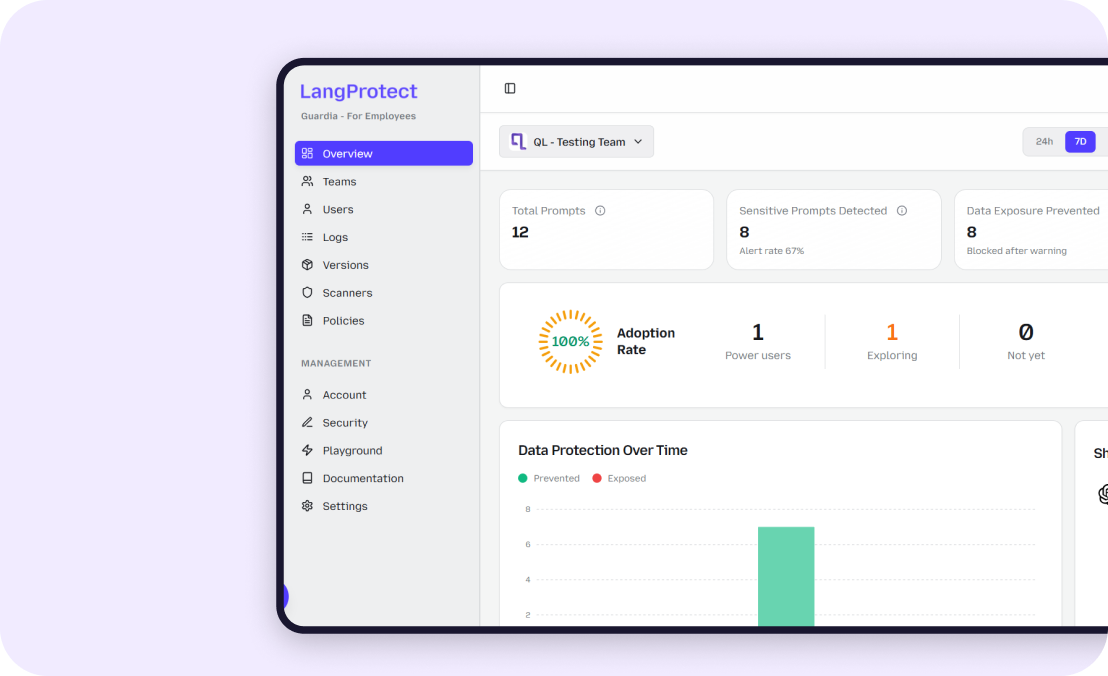
The Transparency Layer The Guardia Dashboard provides a continuous audit trail that proves compliance to HIPAA auditors. Instead of showing them a static legal document (a BAA), you can show them real-time data: how many prompt injections were blocked, how much PHI was redacted at the source, and which departments are driving the most value without increasing the hospital's risk profile.
Conclusion: Protecting the Edge of the Glass
The hard lesson of the 2026 enterprise landscape is that security cannot stop at the cloud; it must stop at the fingertip. An Enterprise LLM account is a necessary baseline for healthcare safety, but without Interactive Prompt Governance, it remains a half-finished defense.
The BAA Myth creates a "Safety Bias" that often accelerates the exact data leaks it was meant to prevent. By implementing Guardia, healthcare founders and CISOs close the Interaction Gap, ensuring that workforce productivity stays fast while patient secrets stay on "your side of the glass."
Secure your team at the only perimeter that truly matters: the browser interaction window.
Measure Your AI Exposure Today
Establish exactly how much unredacted data is reaching your sanctioned accounts today.
Related articles
Zero-Day AI: How to Detect Unlisted AI Tools

What is Shadow AI and Why It's Costing Enterprises Millions