

Sanitization vs. Redaction vs. Smart Redaction: What's the Actual Difference?

An employee at an insurance company asks an internal AI assistant: "Draft a follow-up email to John Martinez about his claim #48291, his adjuster mentioned the water damage estimate came in at $14,200." Run through a naive keyword-blocking filter, that prompt gets stripped down to something like "Draft a follow-up email to [REDACTED] about his claim [REDACTED], his adjuster mentioned the [REDACTED] estimate came in at [REDACTED]." The AI can no longer write a coherent email. The employee, faced with a broken tool, does the predictable thing: pastes the original, unredacted version into a consumer AI tool that has no filter at all.
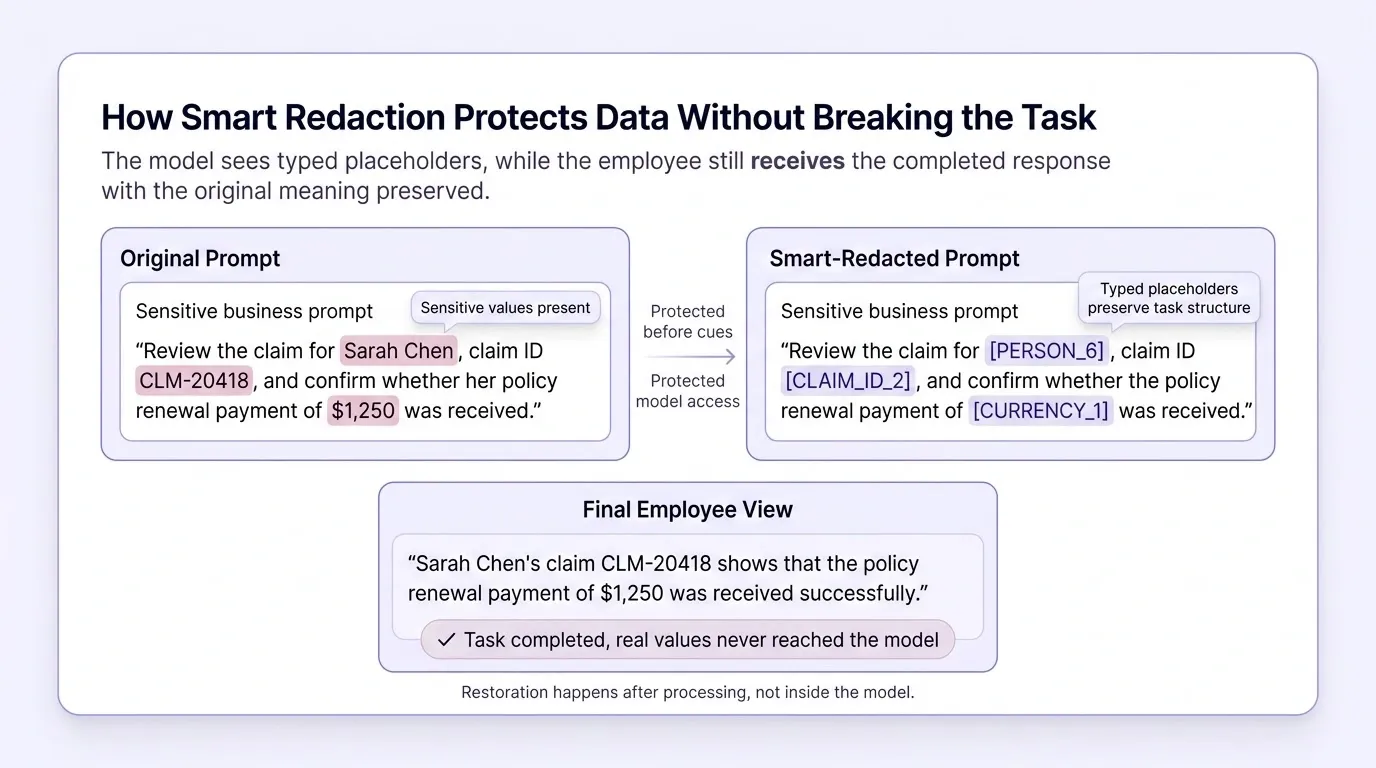
A better-designed system produces a different outcome entirely. The employee's name, claim number, and dollar figure get replaced with typed placeholders, something like '[PERSON_6]', '[CLAIM_ID_2]', '[CURRENCY_1]' before the prompt ever reaches the model. The AI drafts a complete, coherent email using those placeholders to understand the request's structure. Then, before the response reaches the employee, the real values get substituted back in. The employee sees a finished, accurate email. The AI model never saw the customer's name, claim number, or dollar figure at any point.
This is the failure mode that makes the difference between sanitization, redaction, and smart redaction matter far more than it sounds like it should. The three terms get used almost interchangeably in vendor marketing and security discussions, but they describe meaningfully different techniques with different tradeoffs and picking the wrong one for a given use case is a common, avoidable reason enterprise AI security controls get quietly bypassed by the people they're meant to protect.
This guide defines each term precisely, explains why the distinction has real operational consequences, and covers how to decide which technique fits a given AI workflow.
See What Naive Redaction Is Actually Costing Your AI Adoption
Overly aggressive data controls don't stop AI risk, they push employees toward tools that have no controls at all.
What Do Sanitization, Redaction, and Smart Redaction Actually Mean?
These three terms describe a spectrum of increasing technical sophistication, not three interchangeable synonyms for "removing sensitive data." Each makes a different tradeoff between protection strength and preserved utility.
What Is Data Sanitization?
Data sanitization is the complete, irreversible removal of sensitive information from a dataset or request, with no mechanism to recover the original value afterward. Academic research on the empirical impact of sanitization on language models defines it precisely this way: sanitization removes personally identifiable information without introducing additional noise, ensuring the information cannot be recovered either directly or in collaboration with a third party. This distinguishes it from anonymization techniques that add statistical noise to preserve some analytical utility while obscuring individual records; sanitization simply deletes the value outright.
Sanitization is the right choice when a system has no legitimate need for the specific data at all; training data pipelines that don't need real customer names to learn a pattern, logs being prepared for long-term archival, or datasets being shared with a lower-trust environment where even a masked reference to the original value is unacceptable risk.
What Is Redaction?
Redaction masks or blocks sensitive data, typically by replacing it with a generic placeholder like '[REDACTED]', '***', or a similar marker, so a human or system reviewing the content can see that something was removed without seeing what it was. Unlike sanitization, redaction is sometimes reversible in controlled circumstances (a secured, access-limited unredaction process exists), and it prioritizes clearly signaling that removal occurred over preserving the surrounding content's usability.
This is the oldest and most familiar of the three techniques; it's the direct digital descendant of a black marker over a paper document and it's exactly why it fails so often in AI workflows specifically. A blacked-out line in a legal document doesn't need to remain legible to a human reader who already knows what kind of information was there. An AI model processing a redacted prompt has no such context: '[REDACTED]' conveys nothing about whether the missing value was a name, a dollar figure, or a case number, and the model's ability to complete the task degrades accordingly.
What Is Smart Redaction?
Smart redaction is context-aware masking: instead of replacing sensitive data with a generic placeholder, the system identifies the specific type of entity like a name, a date, a medical record number, a dollar amount; and substitutes it with a typed token that preserves enough structure for a downstream system to complete its task correctly. A real implementation replaces a person's name with something like '[PERSON_6]', a date with '[DATE_TIME_3]', or a medical record number with '[MRN_12]'; typed, numbered placeholders rather than a single generic tag, so the model can distinguish between different entities of the same type within one conversation.
One correction worth making explicitly here, because it's easy to get wrong: a well-designed smart redaction system is often deliberately reversible within a defined scope, not despite the goal of protecting data, but because of it. If the substitution is tracked in a secure, session-scoped mapping, the real values can be restored into the final output the employee sees, after the AI model has done its reasoning without ever seeing them. This produces a strictly better outcome than either irreversible sanitization (which the employee would experience as a broken response) or generic redaction (which never restores anything at all), the model never sees the sensitive value, but the human still gets a complete, accurate answer.
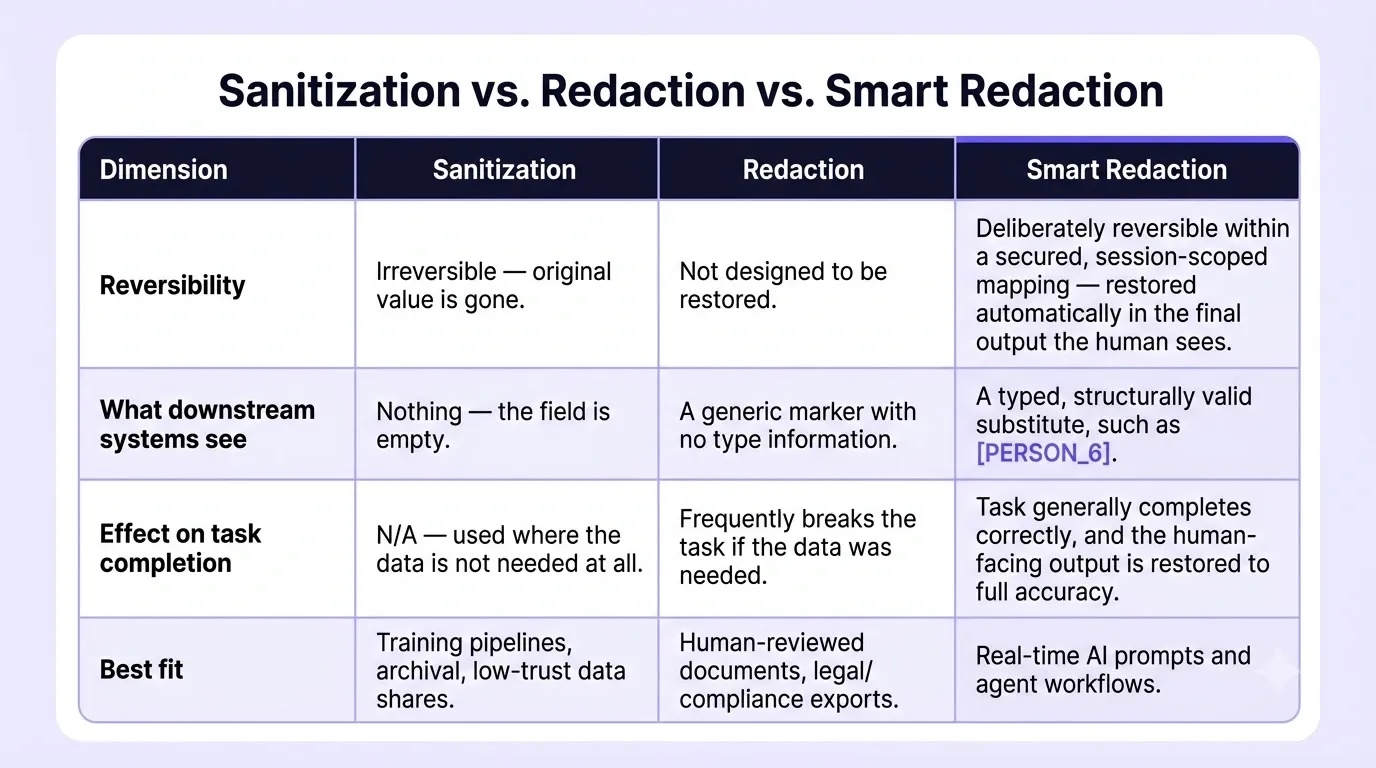
The three techniques aren't ranked from worst to best, they solve different problems. The mistake enterprises make repeatedly is applying redaction, the technique built for human-reviewed static documents, to real-time AI prompts, an entirely different context where the "reader" is a model that needs the missing information's shape to do anything useful with what remains.
Why Does Naive Redaction Break AI Workflows?
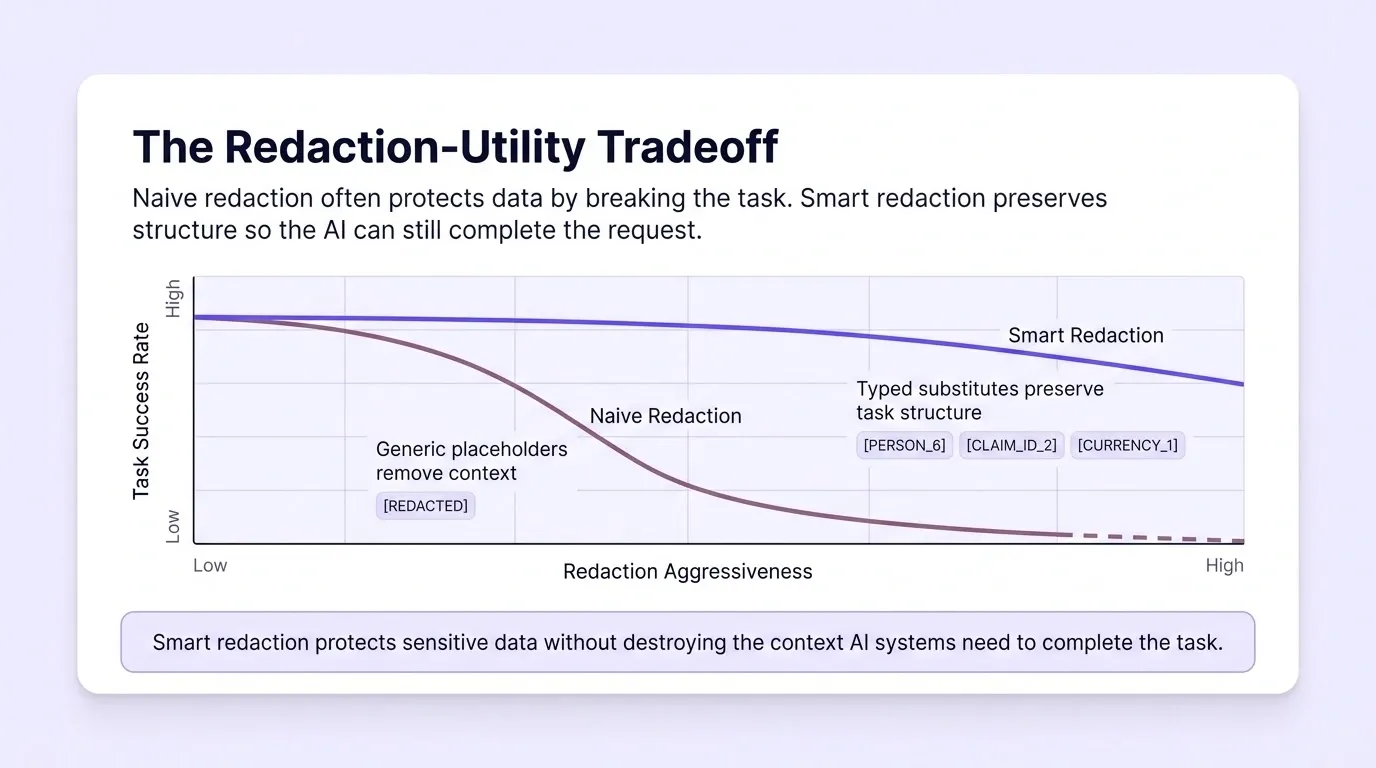
Naive redaction breaks AI workflows because large language models rely on surrounding context to interpret a request correctly, and a generic placeholder destroys exactly the contextual signal the model needs, without necessarily reducing risk any more effectively than a smarter approach would.
The same empirical research measuring sanitization's impact on language models found that across most tasks studied, performance dropped by less than 2.5% when data was properly handled; a tolerable cost for meeting data protection requirements in production, but that finding depends heavily on how the sensitive data is handled, not just whether it's handled. A blunt, type-agnostic redaction approach concentrates far more of that performance cost in exactly the tasks where context matters most: drafting communications, summarizing documents, or reasoning about structured data like claims, invoices, or case files.
This produces a predictable, well-documented failure pattern across enterprise AI DLP deployments, sometimes called the redaction-utility tradeoff:
Over-aggressive redaction breaks legitimate tasks, which trains employees to see the security control as an obstacle rather than a safeguard and employees facing a broken tool don't usually stop working, they route around the control entirely, often toward an unmonitored consumer AI tool with no protection at all. LangProtect's guide to why banning ChatGPT creates shadow AI risk covers this same displacement dynamic in a related context; restriction without a usable alternative doesn't eliminate the underlying behavior, it just moves it somewhere less visible.
Under-aggressive redaction or no redaction at all, leaves data exposed, which is the risk the control existed to prevent in the first place. LangProtect's guide to AI DLP and sensitive data exposure covers why traditional DLP tooling, built for structured file transfers, already struggles to catch this category of exposure even before the redaction-quality question enters the picture.
Generic placeholders provide no forensic value. A log full of '[REDACTED]' markers tells an auditor that something was removed, but not what category of data was involved, how often a given data type appears across interactions, or whether the same pattern of exposure keeps recurring; all information a properly typed smart-redaction log preserves by design. This ties directly into the broader audit-evidence problem LangProtect's guide to AI audit logs and forensic visibility covers a security event that can't be categorized after the fact is much harder to investigate, trend, or report on.
Why "It Looks Redacted" Isn't the Same as "It's Redacted"
Naive redaction fails in two distinct ways, and enterprises evaluating AI data controls need to understand both. The first, breaking task completion, is covered above. The second is more alarming: sometimes the sensitive data was never actually removed at all, it was just visually covered, and the underlying failure pattern has repeated across some of the highest-profile document releases of the last decade.
The technical root cause is consistent across nearly every public case: a black rectangle drawn over text in a word processor or PDF editor covers the visible rendering of the content without touching the underlying text layer, the separate data stream that lets a document be searched, copied, or extracted. Forensic analysis of these failures has found the underlying mechanics haven't meaningfully changed in nearly two decades: draw a shape over a word, and the word is still there, selectable and copyable, for anyone who tries.
This isn't a hypothetical edge case. It's a pattern that keeps recurring at the highest levels of government, corporate, and legal disclosure:
- In 2014, The New York Times attempted to redact classified information from published NSA documents, and readers discovered the blacked-out text could be revealed with a simple copy-paste.
- In 2019, Paul Manafort's legal team used black rectangles to cover sensitive passages in a court filing related to the Mueller investigation; the underlying text remained intact, and a reporter's copy-paste revealed details about campaign polling data shared with Russian contacts.
- During the FTC's challenge to Microsoft's acquisition of Activision Blizzard, court filings from both sides contained improperly redacted business information like unannounced game titles, release dates, and strategy documents involving Apple, Google, and Snap were extractable directly from the filed documents.
- As recently as December 2025, the Department of Justice's release of documents related to the Epstein investigation showed the identical failure like the victim names and witness information that appeared blacked out on screen remained recoverable in the underlying file, with redactions applied inconsistently across otherwise identical references in the same document set.
Four different institutions, spanning more than a decade, made the same category of mistake: they confused looking redacted with being redacted, and none of them tested whether the underlying content was actually removed before publishing.
The AI-Native Version of the Same Mistake
The parallel to enterprise AI data protection is direct, even though the technology is different. A keyword-blocklist filter that scans a prompt for exact string matches; "block if the text contains a Social Security number pattern" produces the same false confidence as a black box over a PDF: it looks like protection, and it fails the instant the input doesn't exactly match what the filter was built to catch. A slightly reformatted number, a typo, a synonym, an encoding trick, or simply describing the sensitive information in different words instead of stating it directly can all slip straight through a pattern-only filter the same way selecting and copying text slips past a black rectangle.
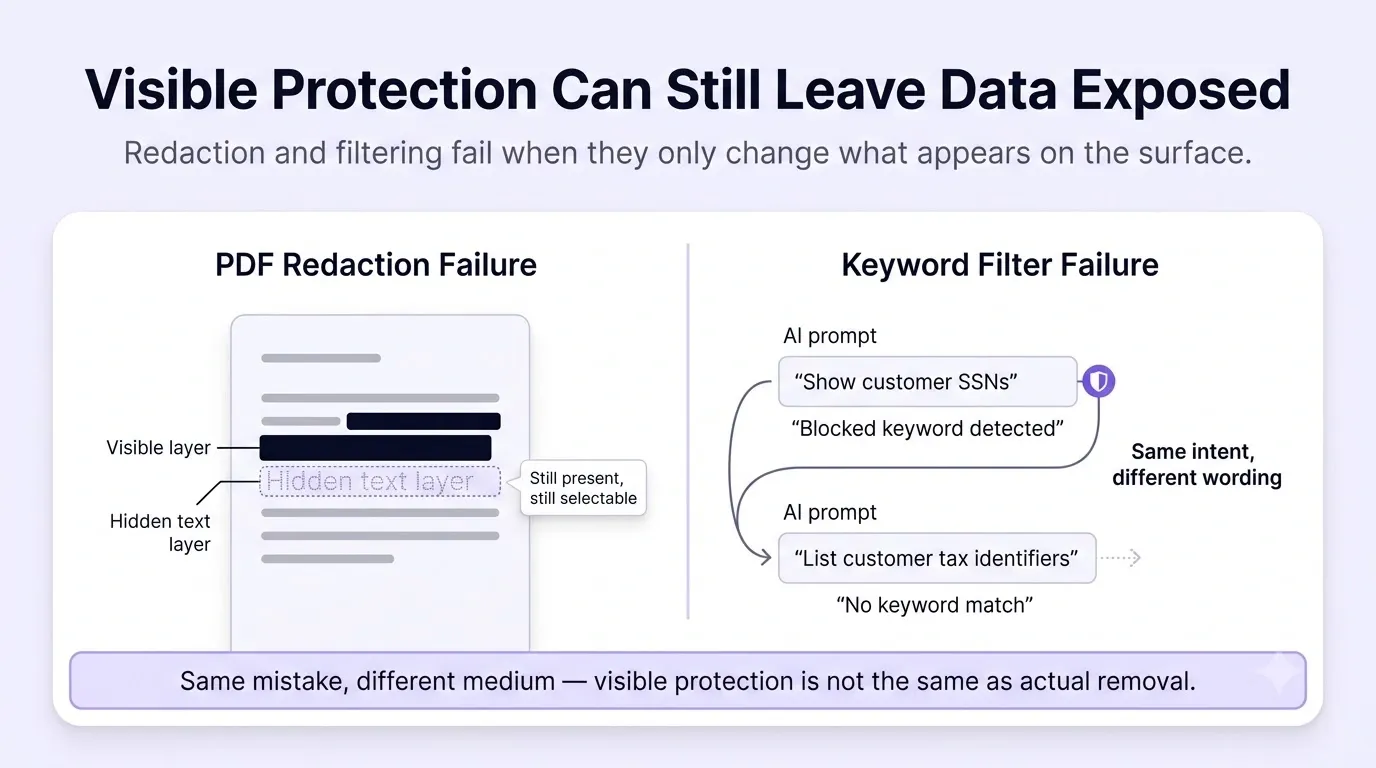
This is precisely why detection quality matters as much as substitution quality in a genuinely effective redaction pipeline. A system can have excellent smart-redaction substitution logic like format-preserving, context-consistent, task-safe and still fail completely if the detection layer underneath it never identifies the sensitive value in the first place. The lesson from a decade of public redaction failures isn't really about black boxes specifically; it's that any protection mechanism needs to be verified against adversarial and edge-case inputs before anyone trusts it, not assumed to work because the output looks correct on a normal example.
How Does Smart Redaction Actually Work in Practice?
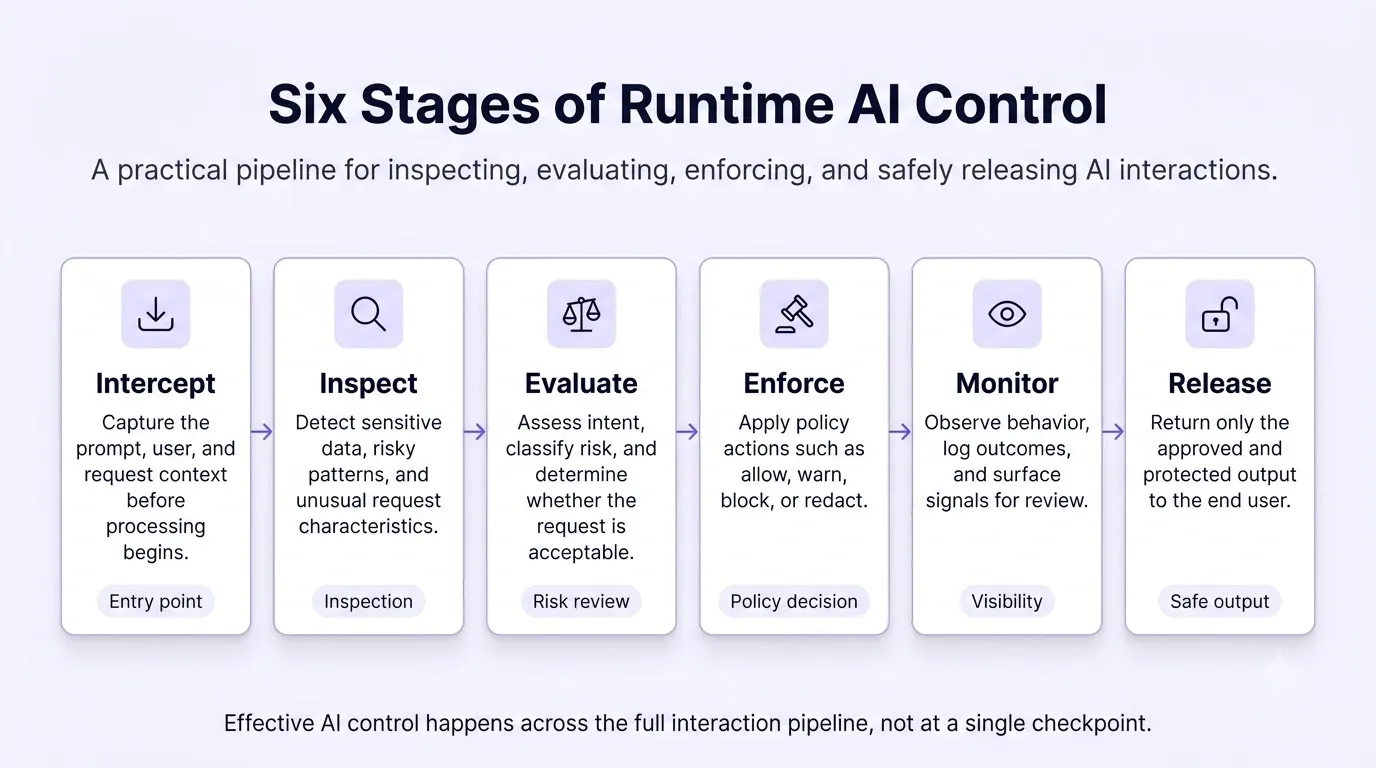
Smart redaction works by running entity detection on every request first, then deciding which based on active policy like whether to leave a detected entity in place, strip it, or tokenize it, before anything reaches the AI model. In a production implementation, this happens through a fixed pipeline rather than an ad-hoc filter:
- Inbound intercept — the request is captured before it leaves the browser or application, at the only point the plaintext content is accessible before transmission
- Entity detection and tokenization — every request runs through a named-entity-recognition pass (a common foundation here is Microsoft Presidio, an open-source NER engine, extended with custom recognizers for region-specific identifiers and clinical terminology) to identify PII, PHI, credentials, and similar sensitive categories
- Policy evaluation — additional scanners attached to the active policy run against the now-sanitized content, and the highest-severity result determines what happens next
- Enforcement action — the system allows the prompt, shows a warning, blocks it outright, or submits the redacted or tokenized version, depending on policy
- Response interception — once the model replies, the response is captured before it renders, so output-direction checks can run and leaked secrets or unsafe content can be caught before the employee ever sees it
- Restoration and logging — if smart redaction was applied, token placeholders in the response get replaced with their real values, pulled from an encrypted, session-scoped mapping, and the audit log records only the tokenized version at every stage, never the restored one
That last stage is the detail most naive implementations miss entirely: from the moment entities are detected onward, every downstream component like the policy engine, the AI model, the audit log, any alert sent to a security team which operates only on the tokenized version. The real values live in exactly one place: an encrypted, session-scoped mapping that ties a placeholder like '[PERSON_6]' back to the actual name, accessible only long enough to restore the final response the employee sees. A well-built session mapping is also append-only within a session and existing entries never get overwritten, which is what lets the same customer name get replaced with the identical placeholder every time it recurs across a multi-turn conversation, so the model can still track that it's discussing one consistent person throughout the exchange rather than several unrelated masked values.
A well-designed substitution preserves several properties the original value had:
- Type-specific formatting — a date gets replaced with something that still parses as a date, a medical record number with something that still parses as an identifier, not a single generic tag that erases the distinction between entity types
- Consistency within a session — the same entity gets the same placeholder every time it appears, so the model's reasoning about the conversation stays coherent
- A clean restoration path — the substitution is tracked precisely enough that the real value can be placed back into the final output with no residue of the placeholder remaining, and no need for the sensitive value to have touched the model at any point
This is conceptually related to format-preserving tokenization, a technique long used in payment card security to mask card numbers while keeping data in a form that existing systems can still process without modification. Applying the same underlying principle to AI prompts preserve the shape, replace the substance, restore it for the human at the end; is what separates smart redaction from a blunt find-and-replace pass.
See How LangProtect's Smart Redaction Preserves Context While Removing Risk
Guardia intercepts prompts at the moment they're composed and the only point plaintext content is accessible before transmission, it tokenizes what needs to be masked, and restores real values into the final response so the employee experience is never interrupted.
When Should You Use Sanitization vs. Redaction vs. Smart Redaction?
The right technique depends on what the downstream system actually needs to do with the data, not simply how sensitive the data is. Treating "how sensitive is this" as the only variable is exactly what leads organizations to over-apply redaction everywhere, including places smart redaction or even sanitization would serve better.
Use sanitization when the downstream system has no legitimate need for the value at all. Training data pipelines that only need to learn a general pattern, long-term log archival where the specific identity is irrelevant to what's being measured, and data shares with lower-trust environments are all cases where the safest and simplest choice is removing the value entirely, since nothing downstream is relying on its shape or presence.
Use plain redaction when a human reviewer needs to know something was removed, but no automated system downstream needs to process the surrounding content. Legal document exports, compliance review packages, and static reports reviewed manually are reasonable fits and the reader has enough outside context to understand the document despite the gaps, the same way a human reading a redacted court filing understands its structure despite the black bars.
Use smart redaction for real-time AI prompts, RAG retrieval, and agent workflows; anywhere an AI system needs to process the request as a whole and produce a coherent output. This is the overwhelming majority of enterprise generative AI use cases, and it's exactly the category where naive redaction causes the most damage, because the "reader" is a model with no outside context to fall back on.
What This Looks Like as an Actual Configurable Policy
In practice, these concepts don't stay abstract; they become specific, selectable enforcement outcomes attached to a policy, typically alongside two additional options that sit outside the sanitization/redaction spectrum entirely: whether to simply monitor an interaction without intervening, and whether to interrupt the employee with a choice rather than deciding silently on their behalf.
Five distinct outcomes, not three, because "how aggressively should this be enforced" (monitor, warn, or block) is a separate decision from "how should the data itself be handled" (redact or smart redact), and conflating the two is another common source of over-broad policies. An organization doesn't have to choose one universal approach; a mature policy typically applies smart redaction as the default for routine sensitive-data detections while reserving hard blocking for a much narrower set of higher-risk categories, like active jailbreak attempts or credential leakage, where no redaction can make the content safe to send.
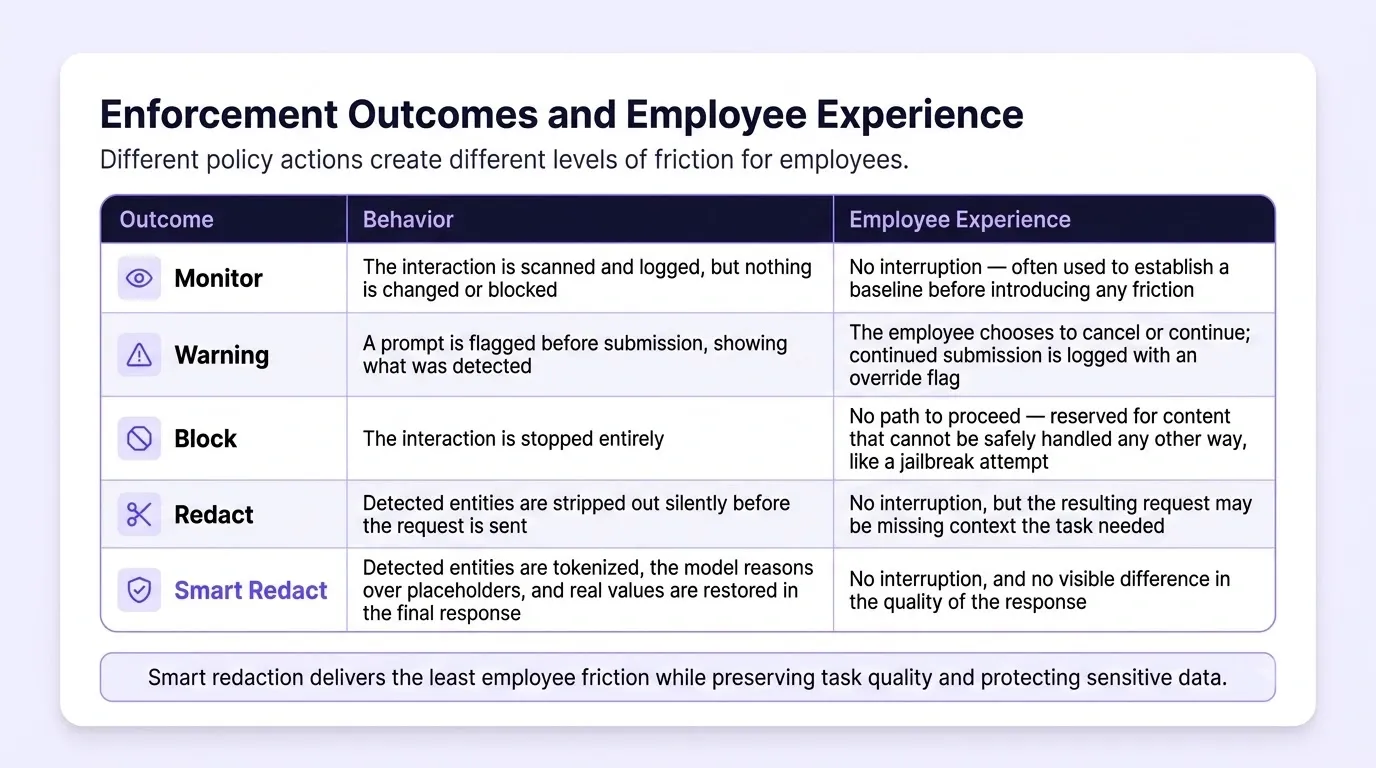
A closely related decision, not just which of these five outcomes to configure, but why organizations frequently get the choice wrong, depends on additional factors like data sensitivity tier and repeat-offense pattern; that decision framework deserves its own dedicated treatment rather than a shortened version here.
How Does the Right Technique Change Across Employee Tools, Applications, and Agents?
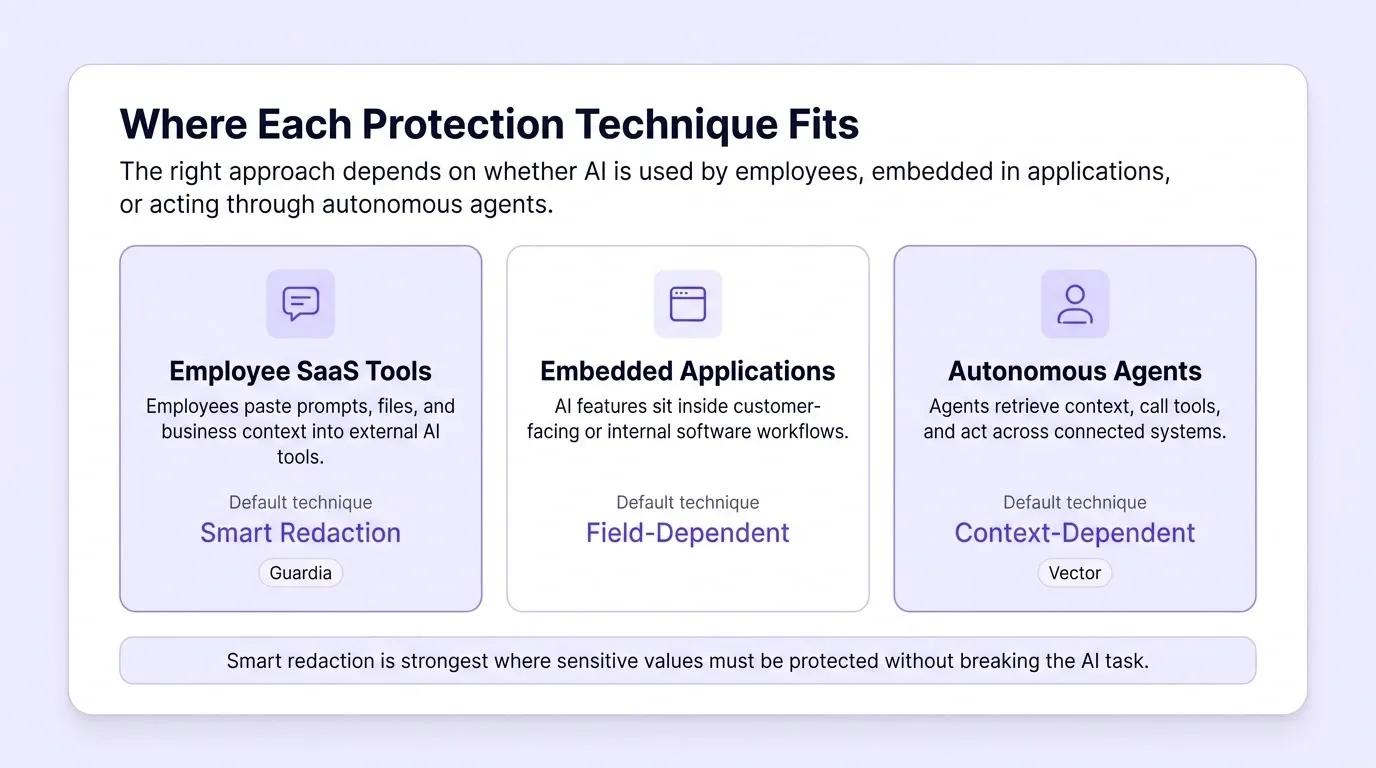
The sanitization/redaction/smart-redaction decision isn't made once for an organization, it needs to be made per deployment surface, because each surface has a different relationship between the sensitive data and the task being performed.
Employee-Facing SaaS AI Tools
This is the browser-based case: employees typing directly into ChatGPT, Claude, Gemini, or another consumer AI tool. Smart redaction is almost always the right default here, because the entire value of these tools is conversational flexibility; an employee asking for help drafting an email, summarizing a document, or troubleshooting a problem needs the AI to understand the full shape of the request. Detection at this layer typically needs the broadest entity coverage, since employees paste an unpredictable range of content types into these tools without warning; real-world deployments monitoring this surface commonly need coverage across 1,500+ distinct AI applications, not just the handful of well-known chat tools, since employees adopt new AI-enabled products faster than any manual review process can track. LangProtect Guardia applies exactly this combination; broad AI-application discovery paired with context-aware redaction at the point a prompt is composed, since that's the only moment the plaintext content is accessible before it leaves the browser.
Embedded and In-House LLM Applications
This is the case where an organization builds or licenses an AI-powered application like a customer support assistant, an internal document-search tool, with a model integrated directly into a product. Here, the right technique often depends on the specific field or data flow within the application, not a single blanket rule: a structured input field (an account number entry box) might tolerate sanitization if the downstream logic never needs to display it back, while a free-text support ticket summarization feature needs smart redaction to remain useful. This deployment type needs product-level runtime enforcement which inspects what a specific application retrieves and returns, rather than one uniform policy applied identically across every AI surface in the company.
Autonomous Agents and Multi-Step Workflows
This is the newest and least standardized case: an AI agent that retrieves data from one system, reasons over it, and takes an action in another. Redaction decisions here have to account for the fact that a single task might pass through several distinct data-handling steps, each with different requirements; an agent retrieving a customer record might need smart redaction applied to what enters its reasoning context, while a separate log of what action it ultimately took needs full detail preserved for audit purposes, not redacted at all. Getting this wrong in either direction either breaks the agent's ability to complete multi-step tasks or leaves an audit trail with no forensic value. LangProtect Vector governs this specific surface like what data an agent is allowed to retrieve and act on, independent of how a given SaaS tool or application might separately handle input redaction.
Treating these three surfaces identically is a common source of the utility-versus-protection mismatch discussed throughout this guide which has a redaction policy tuned for employee chat prompts will often be wrong for an embedded application's structured fields, and a policy tuned for either will typically be wrong for a multi-step agent workflow that needs different handling at different points in a single task.
What Commonly Goes Wrong When Enterprises Implement Redaction?
Beyond the core utility-versus-protection tradeoff, a handful of specific implementation mistakes account for most real-world redaction failures in enterprise AI deployments.
Treating detection accuracy as the only success metric. A redaction system can correctly identify 99% of sensitive entities and still fail in practice if the substitution it applies breaks every task it touches; accuracy and utility are separate measurements, and most vendor benchmarks report only the first one. Real detection systems also aren't a single monolithic check: production implementations typically run dozens of purpose-built detectors across distinct categories like sensitive-data exposure, credential and secret exposure, prompt-attack and jailbreak patterns, unsafe or restricted output content, each with its own confidence threshold, so a detection just below that threshold gets logged as a soft signal without triggering enforcement. An organization that doesn't understand this layering tends to either over-trust a single generic "PII detector" or, worse, assume one high-recall scanner covers categories it was never built to catch.
Applying one policy uniformly across every AI surface. As covered above, the right technique differs across employee tools, embedded applications, and agent workflows which is a single company-wide redaction policy, applied without adjustment for context, is close to guaranteed to be wrong for at least one of those surfaces.
Never testing against adversarial inputs. The decade of public redaction failures covered earlier in this guide happened because no one tested whether the "redacted" output actually protected the data before it went out the door. The same discipline applies to AI redaction: a system tested only against clean, well-formatted example inputs will miss the typos, reformattings, and paraphrased requests that make up a meaningful share of real usage.
Logging redaction events without entity-type detail. A generic "content was modified" log entry provides far less forensic and compliance value than a log recording exactly which entity types triggered redaction, how often, and in which applications; the difference between being able to answer an auditor's question and not.
Assuming reversibility is either always needed or never needed. Some legitimate business processes genuinely require a controlled, audited path back to an original value; most don't. Defaulting to a reversible design everywhere creates unnecessary risk, while defaulting to irreversibility everywhere can block legitimate business processes that had a real need to recover a value under proper authorization.
What Do Regulators Actually Require — Redaction, Sanitization, or Something Else Entirely?
Regulatory language rarely uses "sanitization," "redaction," or "smart redaction" as defined technical terms; most privacy law is written around outcomes like "anonymization," "pseudonymization," and "erasure," which map imperfectly onto the technical distinctions covered in this guide and are worth untangling directly.
GDPR distinguishes anonymization from pseudonymization, and neither maps directly onto "redaction." Under GDPR, truly anonymized data; data that can never be re-linked to an individual, falls outside the regulation's scope entirely, which lines up conceptually with full sanitization more than with reversible redaction. Pseudonymized data, where a value is replaced with a substitute but the original remains recoverable under controlled conditions, is explicitly still considered personal data under GDPR and remains subject to the full regulation. This means a reversible smart-redaction implementation, if it retains any path back to the original value, does not by itself satisfy anonymization requirements; organizations relying on it for that purpose should confirm the specific legal standard with counsel rather than assuming a technical control automatically satisfies a legal one.
HIPAA's Safe Harbor de-identification method specifies a defined list of eighteen identifier categories that must be removed for health information to be considered de-identified, including names, dates more specific than year, and any unique identifying number. This is closer in spirit to sanitization's irreversibility requirement than to redaction's placeholder approach; a generic '[REDACTED]' marker in a health record doesn't obviously meet Safe Harbor's removal standard unless the underlying value is genuinely gone, not just masked.
Neither regulation was written with AI prompts in mind, which is precisely why the distinction this guide covers matters operationally even where it doesn't map cleanly onto legal terminology. Compliance teams evaluating an AI redaction implementation should ask a more specific question than "is this redacted", they should ask which regulatory standard the specific data flow needs to satisfy, and confirm the chosen technique actually meets that standard's technical definition, not just its common-sense one.
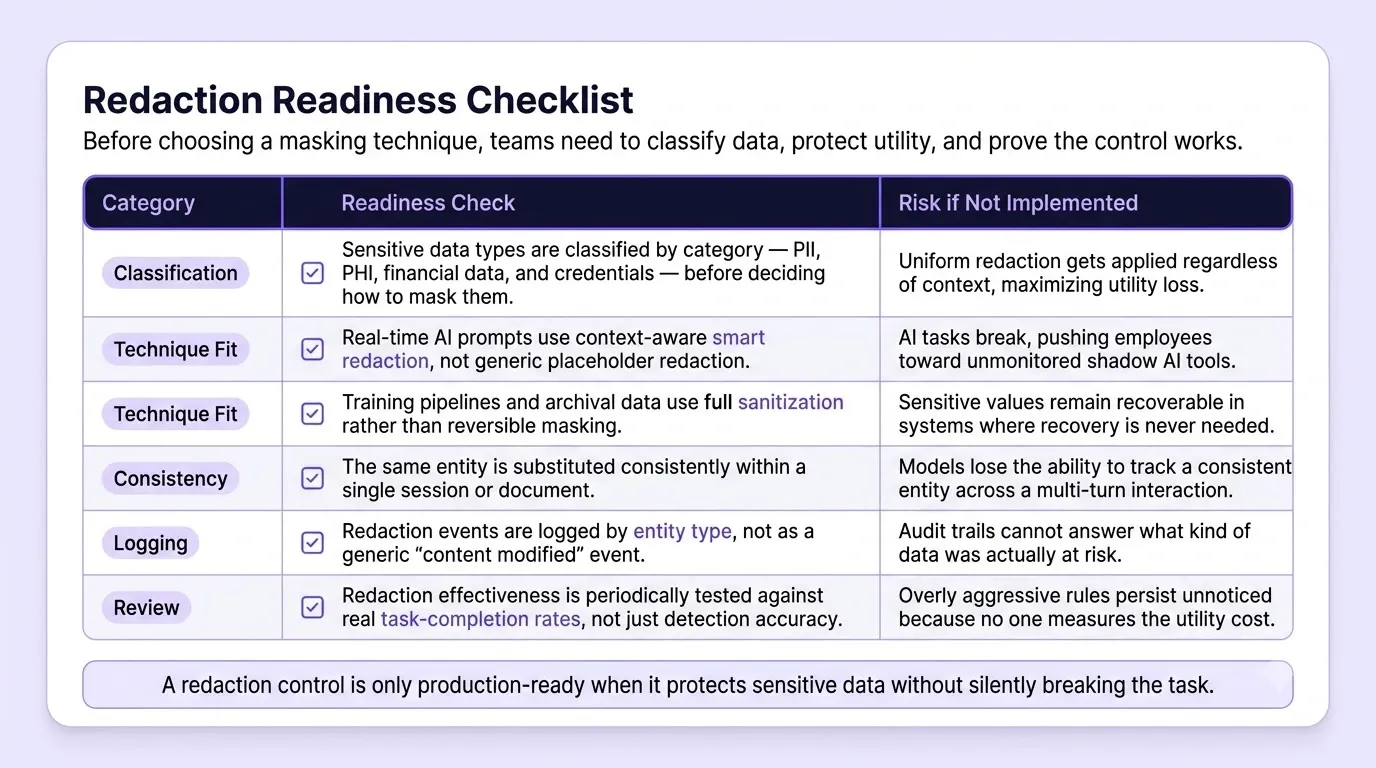
Sanitization, Redaction, and Smart Redaction Readiness Checklist
Frequently Asked Questions
Is smart redaction the same thing as data masking?
They're closely related and often used to describe similar techniques, but "data masking" is a broader term that can include static masking of stored data (like a database column) as well as real-time masking of data in motion. Smart redaction specifically refers to context-aware masking applied to real-time content like AI prompts, where preserving the surrounding structure for a downstream system to process correctly is the defining requirement, not just obscuring the value for a human viewer.
Can smart redaction be reversed to recover the original value?
Usually not by design, and this is a meaningful difference from some redaction implementations. Smart redaction's goal is preserving task usability while removing the sensitive value, not providing a secured path back to the original; if reversibility is a genuine business requirement, that's typically handled through a separate, tightly access-controlled unmasking process rather than being a default property of the redaction technique itself.
Does redaction violate GDPR's "right to erasure," or does it help satisfy it?
Redaction and sanitization can support erasure-related obligations, but they aren't automatically equivalent to legal erasure; irreversible sanitization more closely matches what regulations typically mean by removing personal data, while reversible redaction, by design, retains the original value somewhere in the system. Organizations should treat this as a legal question to confirm with counsel for their specific regulatory obligations rather than assuming any masking technique automatically satisfies erasure requirements.
Why does naive redaction cause employees to use unauthorized AI tools?
Because a broken tool doesn't stop the underlying task, it just makes the sanctioned tool unable to complete it, and employees under time pressure predictably route around a control that prevents them from doing their job, often toward a consumer AI tool with no data protection at all. This is a well-documented pattern: restrictive controls without a usable alternative tend to displace risky behavior rather than eliminate it.
How do you measure whether a redaction implementation is "smart enough"?
Task-completion rate is the most direct measure: run a representative sample of real prompts through the redaction layer and check whether the AI can still complete the request correctly afterward, not just whether the sensitive data was successfully detected and masked. A system with perfect detection accuracy but a high task-failure rate isn't actually working, it's just failing safely instead of failing open.
Does smart redaction work on structured data like credit card numbers the same way it works on free text like names?
The underlying principle is the same i.e. preserve format and semantic role while removing the specific value, but the implementation differs. Structured data like credit card numbers or Social Security numbers can rely on deterministic pattern matching with high confidence, similar to format-preserving tokenization used in payment security. Free-text entities like names or descriptions of sensitive events require more context-aware detection, since there's no fixed pattern to match against.
Should redaction happen before the prompt reaches the AI model, or after the response comes back?
Both, ideally, and they catch different risks. Input-side redaction (sometimes called prompt sanitization) prevents sensitive data from ever reaching the model in the first place, which matters most for data the organization doesn't want a third-party model provider to see at all. Output-side redaction catches sensitive data the model might generate or repeat back, including information the model learned during training rather than anything present in the current prompt, which input-side controls alone can't catch.
What do the famous PDF redaction failures like Manafort, the DOJ Epstein files and the Microsoft-Activision case have to do with AI redaction?
They illustrate a failure mode that applies just as much to AI systems as it does to documents: covering sensitive data visually isn't the same as removing it technically, and no one in any of those cases tested whether the "redacted" version actually protected the content before it went public. The AI-native equivalent is a keyword-blocklist filter that looks like it's catching sensitive data but is easily bypassed by a typo, reformatting, or a paraphrased description of the same information; the underlying lesson (verify the protection actually works against adversarial input, don't assume it from a clean example) is identical.
Does using smart redaction mean an organization can skip having a data classification policy?
No, smart redaction depends on data classification, it doesn't replace it. The system still needs to know which entity types count as sensitive, which categories require which handling, and which downstream systems are trusted to receive which data before it can make any masking decision correctly. Smart redaction is the enforcement mechanism for a classification policy, not a substitute for having defined one.
What's the Actual Business Cost of Getting This Wrong?
The stakes here aren't abstract. DigiCert's July 2026 AI Trust Outlook found that 78% of organizations have already experienced an AI-related security incident or identified an AI vulnerability, a figure that includes the specific pattern this guide has covered: sensitive data reaching a model it shouldn't have reached, often precisely because a redaction control was either too aggressive to use or too weak to catch what it was supposed to catch.
Both directions carry a real, measurable cost, just in different currencies. Redaction that's too aggressive doesn't eliminate risk but it displaces it, pushing employees toward unmonitored consumer AI tools with no protection at all, which is a worse outcome than the one the control was meant to prevent. Redaction that's too weak, or that fails the way the decade of public PDF redaction disasters failed which is looking protected without actually being protected, creates the exposure directly, with the added cost that the failure is often discovered by an outside party (a journalist, a regulator, opposing counsel) rather than caught internally.
Getting the technique-to-use-case match right isn't a minor implementation detail. It's the difference between a control that actually reduces an organization's real exposure and one that either goes unused or provides false assurance while the underlying risk continues unaddressed.
Redaction Only Works If the Task Still Works Afterward
The distinction between sanitization, redaction, and smart redaction isn't academic; it's the difference between a data protection control that actually gets used and one that gets quietly bypassed within weeks of deployment. Naive redaction fails not because it's too strict, but because it's imprecise: a generic placeholder protects the value while destroying the context a model needs to do anything useful with what remains.
Organizations securing real-time AI workflows should default to smart redaction wherever a model needs to process the full shape of a request, reserve plain redaction for human-reviewed static content, and use full sanitization only where the underlying value serves no downstream purpose at all. Getting this match wrong in either direction like too blunt, or not protective enough, undermines the same goal from opposite sides.
Protect Sensitive Data Without Breaking the Workflows Built Around It
See how LangProtect's Guardia tokenizes sensitive data before it reaches a model and restores real values into the final response, protecting what needs protecting without the employee ever noticing a difference in output quality.
Tags
Related articles
What Is Runtime Protection for LLM Applications? How It Works

What Is LLM AI Red Teaming? A Practical Guide for Enterprises