

What Is Runtime Protection for LLM Applications? How It Works

A development team ships a customer support assistant in six weeks. It works well, handles real customer questions, and gets adopted quickly.
Nobody on the team wrote a single line of code to check whether a prompt contains a customer's payment card number, whether a user is trying to manipulate the assistant into ignoring its instructions, or whether the assistant's own response just leaked an internal API key it picked up from earlier context.
The team built a working AI feature. They didn't build a security layer, because building one from scratch for every AI powered feature an organization ships doesn't scale past the first one or two applications.
This gap is common enough to be the norm rather than the exception. Zylo's 2026 SaaS Management Index found that 77% of IT leaders discovered AI powered features or applications operating without their awareness, evidence that most organizations aren't missing a handful of edge cases, they're missing a majority of what's actually shipped.
Runtime protection is built specifically to close that gap: security enforcement that lives inside the application's own execution path, applied automatically to every request and response, without requiring each engineering team to implement detection and redaction logic individually.
This guide covers what that actually means architecturally, how it differs from network level security approaches, and what happens to a request as it passes through a runtime protection pipeline.
See What's Actually Passing Through Your AI Applications Unchecked
Most AI powered applications ship with functional testing, not security testing. The gap between the two is usually wider than teams expect.
What Is Runtime Protection for LLM Applications?
Runtime protection for LLM applications is security enforcement that inspects AI requests and responses as they're actively being processed, evaluating a prompt before it reaches the language model and a response before it reaches the application or end user, rather than reviewing either after the fact.
The term "runtime" specifically distinguishes this from static analysis or code review: the enforcement happens live, on every real interaction, not against test cases or a sampled subset.
What makes this specific to LLM applications rather than a generic security control is what gets inspected. Traditional application security evaluates structured inputs: form fields, API parameters, file uploads, against known attack patterns. Runtime protection for LLM applications evaluates natural language instead.
A prompt that reads as a completely normal request can still contain an embedded instruction attempting to manipulate the model, or can be an entirely benign question that happens to include a customer's medical record number in the process of asking it.
How Is This Different From Gateway or Proxy-Based AI Security?
Runtime protection integrated via SDK operates inside the application's own code, while gateway or proxy based approaches sit in front of traffic at the network or infrastructure layer, inspecting requests as they pass through without necessarily understanding what the request is actually asking the model to do.
Both approaches aim to catch the same categories of risk, but the architectural difference has real practical consequences.
An SDK based integration means the application routes its own request through the security layer as part of its normal code execution. There's no separate network appliance, no traffic redirection, and no additional infrastructure component sitting between the application and the model.
This matters for two reasons: it keeps the deployment model simple, since the security layer ships as a dependency rather than a piece of network infrastructure someone has to provision and maintain, and it gives the security layer access to application level context, such as session state, user identity, and conversation history, that a pure network layer inspection point often can't see as cleanly.
The tradeoff runs the other direction too. SDK integration requires a code change in the application itself, however lightweight, whereas a gateway can sometimes be inserted without touching application code at all.
For organizations building multiple AI applications across different teams, the SDK model's consistency, with every application using the same integration pattern and enforcing the same centrally managed policy, tends to outweigh that initial integration cost.
What Does Runtime Protection Actually Inspect?
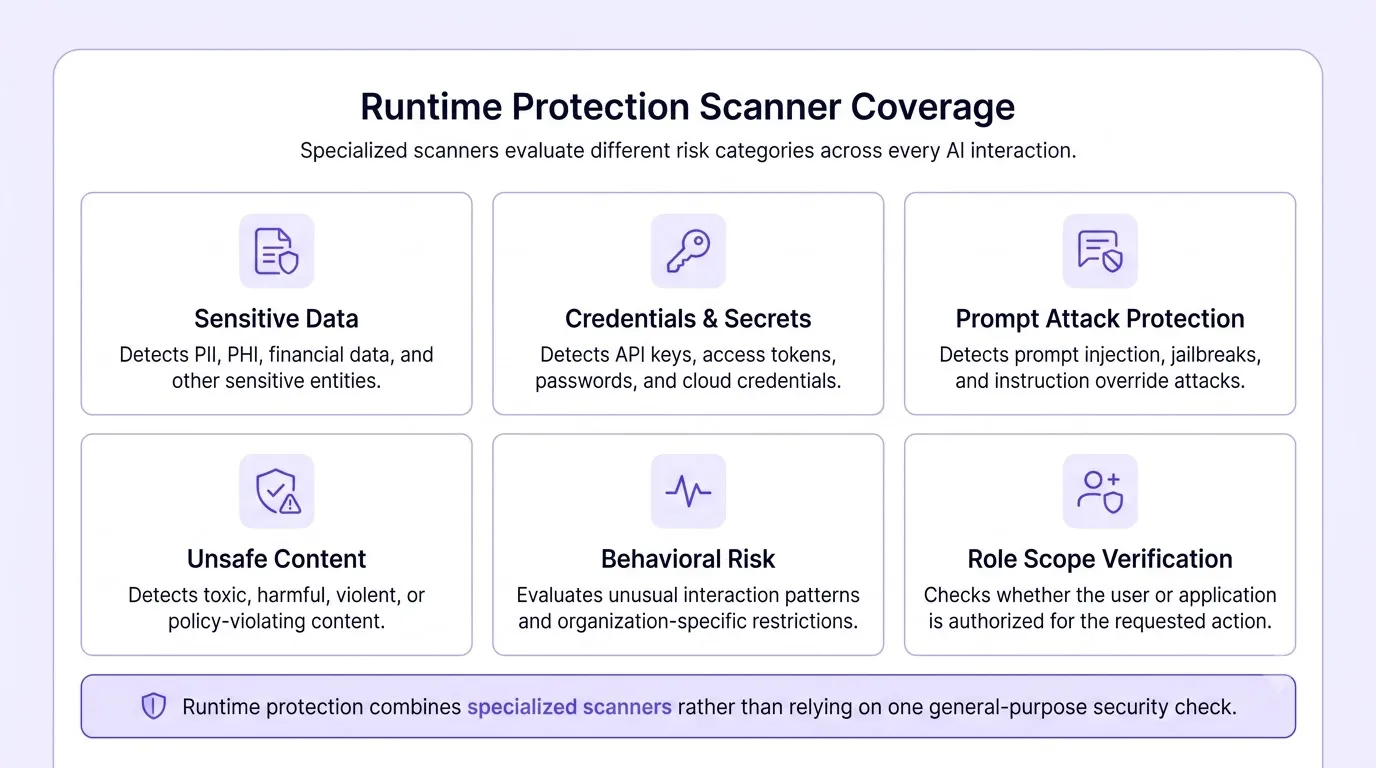
A comprehensive runtime protection layer runs multiple specialized scanners against every interaction, each evaluating a distinct category of risk rather than relying on one general purpose check.
Sensitive data protection detects personally identifiable information, protected health information, financial and payment card data, and organization specific sensitive entities like names, addresses, and government issued identifiers.
LangProtect's guide to how sensitive data actually gets detected covers the underlying detection methodology in depth.
Credential and secret protection catches API keys, access tokens, passwords, OAuth credentials, private keys, database connection strings, and cloud credentials before they're transmitted to a model or echoed back in a response, a risk that's especially relevant for AI coding assistants working directly with source code.
Prompt attack protection identifies prompt injection, jailbreak attempts, instruction override attacks, hidden prompt manipulation, context poisoning, and system prompt extraction attempts. LangProtect's guide to prompt injection covers this attack category in full.
Unsafe content detection evaluates both prompts and responses for toxic language, hate speech, harassment, violent content, and harmful instructions, with enforcement severity configurable by category.
Behavioral risk detection is a distinct category from content scanning, since it evaluates characteristics of an interaction itself, like unusually high emotional intensity, nonsensical prompts, or organization specific behavioral restrictions such as prohibiting AI generated medical advice.
Role scope verification is a fundamentally different kind of check from the others, because it evaluates authorization rather than content: whether the requesting user or application is actually permitted to take the requested action, such as accessing confidential business data, invoking a privileged tool, or reaching a restricted MCP server.
LangProtect's enterprise guide to MCP security covers why this authorization layer matters specifically for agents connected to external tools, where a technically valid request can still be an unauthorized one.
What Happens to a Request as It Flows Through Runtime Protection?
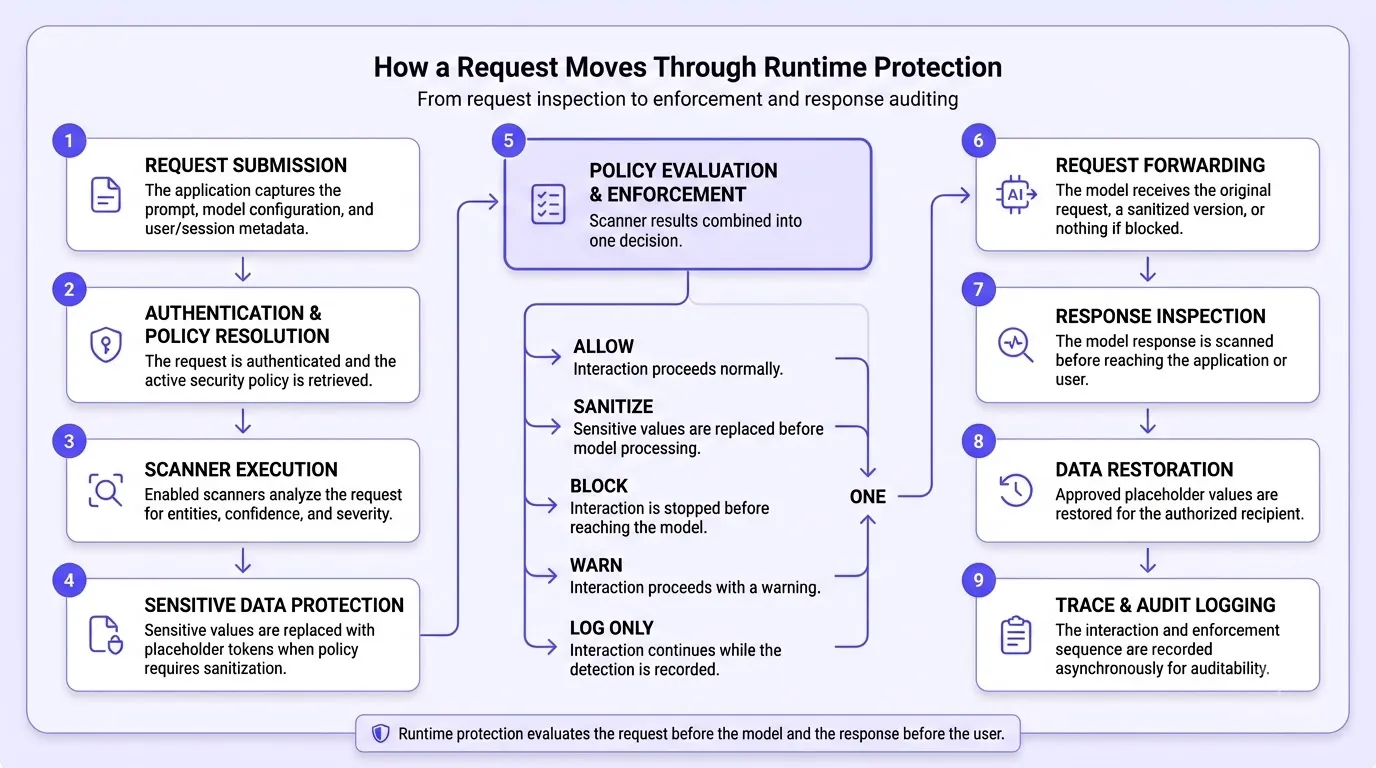
Every AI interaction follows the same logical sequence, regardless of which language model or application framework sits underneath it.
- Request submission. The application captures the complete request context, including the prompt, conversation history, model configuration, and user and session metadata, before it would otherwise be transmitted to the model.
- Authentication and policy resolution. The request is authenticated, the associated tenant is identified, and the currently active security policy is retrieved. This is resolved fresh on every request, so a policy update takes effect immediately without requiring an application redeploy.
- Scanner execution. Every scanner enabled in the active policy runs against the request, each producing a structured result with detected entities, confidence scores, and severity classification.
- Sensitive data protection. If sensitive information is found and the policy calls for sanitization rather than blocking, detected values get replaced with placeholder tokens before the request ever reaches the model.
- Policy evaluation and enforcement. The combined results from every scanner are evaluated together, producing one final decision: allow, sanitize, block, warn, or log.
- Request forwarding. The model receives either the original request, a sanitized version, or nothing at all if the interaction was blocked.
- Response inspection. Once the model replies, its response passes through the same kind of scanning before reaching the application, since a model can generate unsafe content or leak sensitive information even when the original prompt was completely clean.
- Data restoration. If sensitive values were replaced with placeholders earlier, and policy permits it, the real values are substituted back into the final response for the authorized user.
- Trace and audit logging. Every step of this sequence gets recorded asynchronously, so logging doesn't add latency to the interaction itself. LangProtect's guide to AI audit logs and forensic visibility covers what a production grade version of this record needs to capture.
See This Flow Running Inside Your Own Application
Armor integrates through a lightweight SDK, with no gateway and no traffic redirection, inspecting every request and response inside your application's own execution path.
How Does Sensitive Data Get Anonymized Without Breaking the Application?
Runtime protection's sensitive data handling works by replacing a detected value with a descriptive placeholder that preserves the entity's role in the request, rather than a generic tag, so the model can still reason about the request's structure.
A prompt like "Summarize the medical history of John Smith" becomes "Summarize the medical history of [PERSON_001]." The model never receives the actual name, but it still understands it's being asked to summarize information about a specific person.
LangProtect's guide to sanitization, redaction, and smart redaction covers the full technical reasoning behind why this approach outperforms generic placeholder redaction.
The mapping between a placeholder and its real value gets stored in an encrypted, session scoped vault, isolated by tenant, user, and conversation, so the same entity gets the same placeholder consistently across a multi-turn conversation, and the real value can be restored into the final response for an authorized recipient once the model has finished responding.
This is what lets an application anonymize a customer's identity from a model's perspective while still returning a natural, fully personalized answer to the person who actually asked the question.
What Enforcement Actions Are Available?
Runtime protection systems typically support five distinct enforcement actions, each suited to a different situation. Choosing the right one for a given detection, rather than defaulting to the same response for everything, is its own decision that deserves real attention.
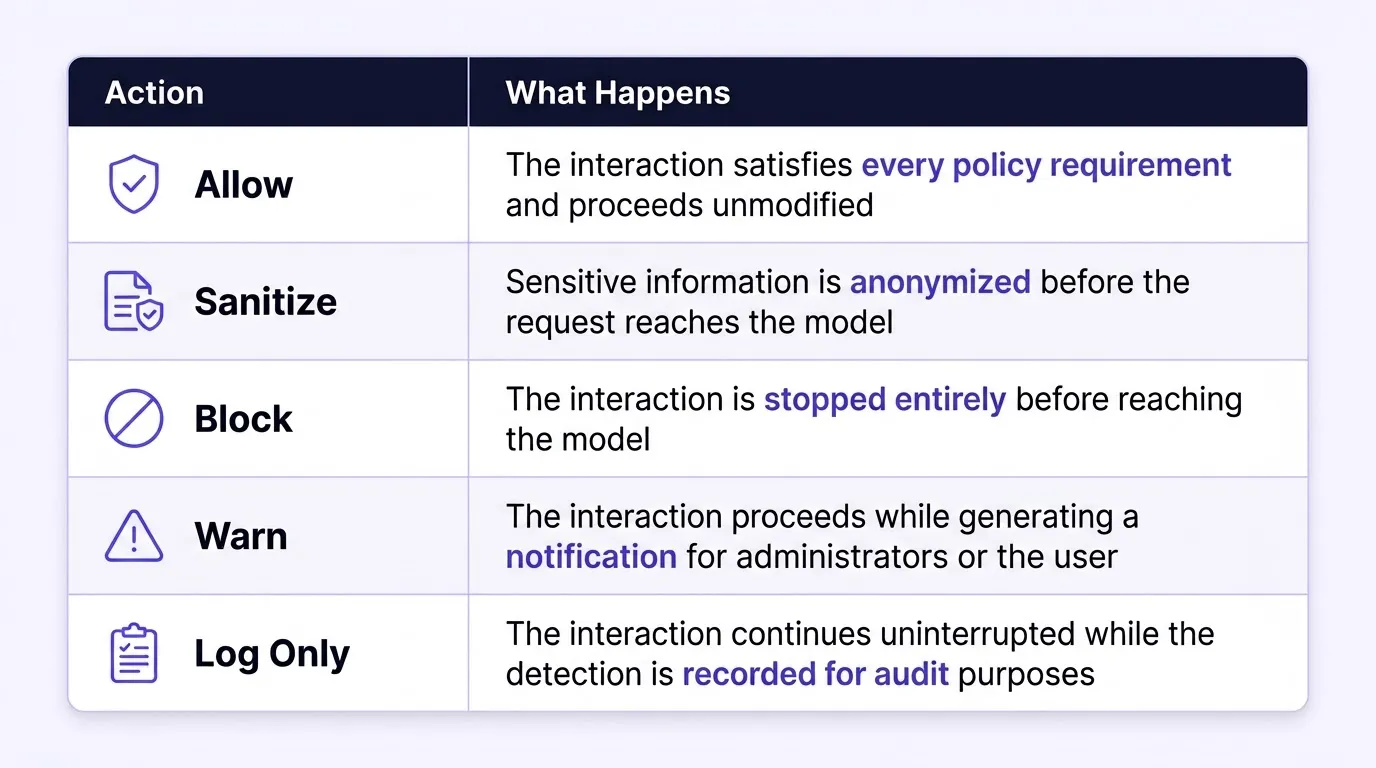
Every detection also carries a risk classification of critical, high, medium, or low, which factors into which enforcement action ultimately applies when multiple scanners trigger on the same interaction, since a request combining a medium severity sensitive data detection with a critical severity prompt injection attempt shouldn't be resolved by averaging the two.
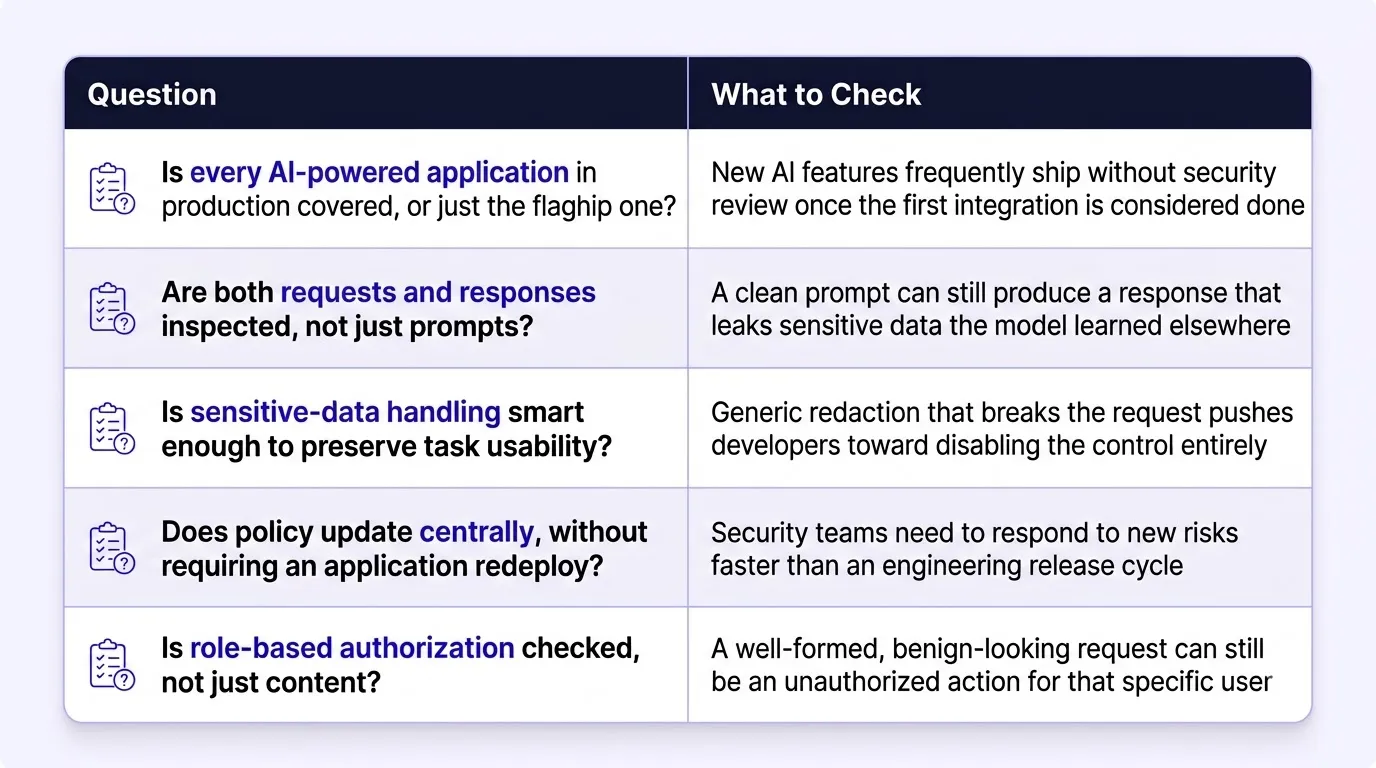
Checklist: Is Your AI Application's Runtime Layer Actually Covered?
How Is This Different From Monitoring Employee AI Tool Usage?
Runtime protection for LLM applications and employee facing AI monitoring solve related but distinct problems, and the difference is about which application boundary is being protected.
Runtime protection secures applications an organization builds, such as a custom copilot, a RAG system, or an internal assistant, by embedding directly into that application's own code via SDK.
Employee facing monitoring secures applications an organization's employees use, such as ChatGPT, Claude, and other third party AI tools accessed through a browser, where there's no application code to embed into at all, since the organization doesn't control that tool's backend.
An enterprise typically needs both, covering two genuinely different surfaces: the AI products it's building for customers or internal use, and the AI products its employees are adopting on their own.
The Zylo finding cited earlier, that most IT leaders discover AI features running without their awareness, applies to both surfaces simultaneously, which is exactly why treating them as one problem, or covering only one, tends to leave a real gap on whichever side goes unaddressed.
Frequently Asked Questions
Does runtime protection add noticeable latency to an AI application?
Well architected implementations minimize this by running only the scanners enabled in the active policy, evaluating policy once per interaction, and performing logging and tracing asynchronously so they don't sit in the critical path of the response. Latency impact scales with how many scanners are active and how deep the inspection goes, which is why policies are typically tuned per application rather than running every available scanner on every request regardless of actual risk.
Can runtime protection work with any language model, or only specific providers?
A well designed runtime protection layer is provider agnostic, since its enforcement logic runs before and after the model call rather than depending on the specific model's own behavior. This means an application can switch model providers, or run multiple providers side by side, without needing to rebuild its security layer for each one.
Does adding runtime protection require rewriting an existing AI application?
Not typically, when integration happens through an SDK. The application routes its existing requests through the SDK rather than restructuring how prompts are constructed or how responses are handled. The scope of the code change is usually limited to where the application currently calls the model directly, redirecting that call through the protection layer instead.
What's the difference between input scanners and output scanners?
Input scanners evaluate a prompt before it reaches the language model, catching things like sensitive data or injection attempts in what the user or application submitted. Output scanners evaluate the model's generated response before it reaches the application or end user, catching risks introduced by the model itself, such as a hallucinated fact stated as certain, sensitive information the model retained from earlier context, or unsafe content the model generated despite a clean input. Comprehensive coverage requires both, since each catches a distinct class of risk the other can't.
Is role scope verification the same thing as standard user authentication?
No. Authentication confirms who is making a request. Role scope verification confirms whether that authenticated identity is actually permitted to take the specific action the request represents, such as reading a particular document, invoking a particular tool, or querying a particular MCP server. A fully authenticated, legitimate user can still submit a request their role doesn't authorize, and content focused scanners alone won't catch that, since there's nothing inherently unsafe about the request's wording.
How does runtime protection handle multi-turn conversations?
A well designed implementation maintains session aware state across a conversation, so a sensitive entity detected and anonymized in an early turn gets consistently represented the same way in later turns, and enforcement decisions can account for the full conversation context rather than evaluating each message as if it arrived with no history. Treating every message in isolation misses attacks specifically designed to unfold gradually across several turns rather than in a single request.
Security Belongs Inside the Application, Not Bolted On After
The gap between shipping a working AI feature and shipping a secured one isn't usually a lack of concern. It's that building detection, redaction, and policy enforcement from scratch for every AI powered application an organization ships doesn't scale past the first one or two. Runtime protection closes that gap by moving the security layer into the application's own execution path, enforced centrally and consistently, without asking every engineering team to solve the same problem independently.
The applications an organization builds and the AI tools its employees adopt on their own are two different surfaces requiring two different approaches. Neither should be left uncovered simply because building the control in house felt like too much for a team focused on shipping the feature itself.
See Runtime Protection Running Inside Your Own AI Applications
Armor inspects every request and response inside your application's execution path, including sensitive data, credentials, prompt injection, and unauthorized actions, without a gateway or infrastructure change.
Not ready to talk yet? Read the Solution Brief
Tags
Related articles
What Is LLM AI Red Teaming? A Practical Guide for Enterprises
How Guardia's AI Policy Engine Decides Monitor, Warn, or Block