

Redact, Warn, or Block? Choosing the Right Enforcement Outcome for Sensitive Data in Prompts

A security team rolls out AI data protection with a single policy: block anything that looks like PII. Within two weeks, employees are complaining that the tool constantly interrupts routine work like drafting a customer email, summarizing a support ticket etc. because any prompt mentioning a name or an account number gets stopped outright. Adoption of the sanctioned tool drops. Usage of unmonitored AI tools, the ones with no protection at all, quietly increases. The security team technically "solved" data exposure in the tool they controlled and made the actual problem worse everywhere else.
This is what happens when an enforcement policy treats "detected something sensitive" as a single event requiring a single response. LangProtect's guide to sanitization, redaction, and smart redaction covers how to mask data once you've decided masking is the right response. This guide covers the decision that comes before that: whether the right response to a given detection is to log it quietly, ask the employee, redact it, or refuse the request outright.
See Which Enforcement Outcome Fits Your Actual Risk Profile
Most AI data protection deployments start with one blunt setting and never revisit it. That's usually where adoption problems start.
What Are the Five Enforcement Outcomes for Sensitive AI Prompts?
Production AI data protection systems typically support five distinct enforcement outcomes, and treating them as one dial ("strict" vs. "lenient") rather than five separate tools is the single most common design mistake.
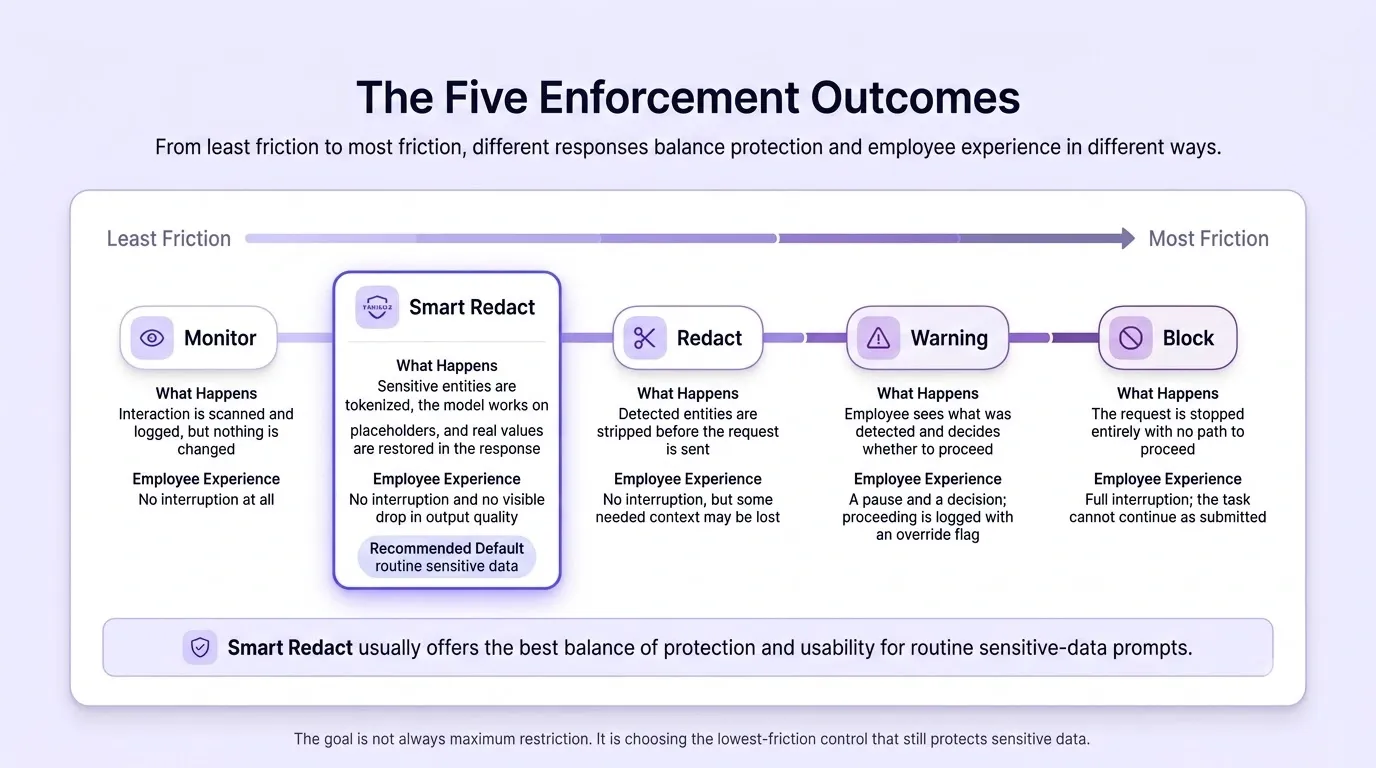
Two of these, Redact and Smart Redact, are about how to handle data that's staying in the request in some form; the full technical distinction between them, including why naive redaction breaks AI tasks, is covered in LangProtect's guide to sanitization, redaction, and smart redaction. The other three i.e. Monitor, Warning, and Block are about a different question entirely: how much friction should this specific detection introduce, independent of whether the data itself gets masked. Conflating these two decisions is what produces the all-or-nothing policies that push employees toward shadow AI.
How Do You Decide Which Outcome Fits a Given Detection?
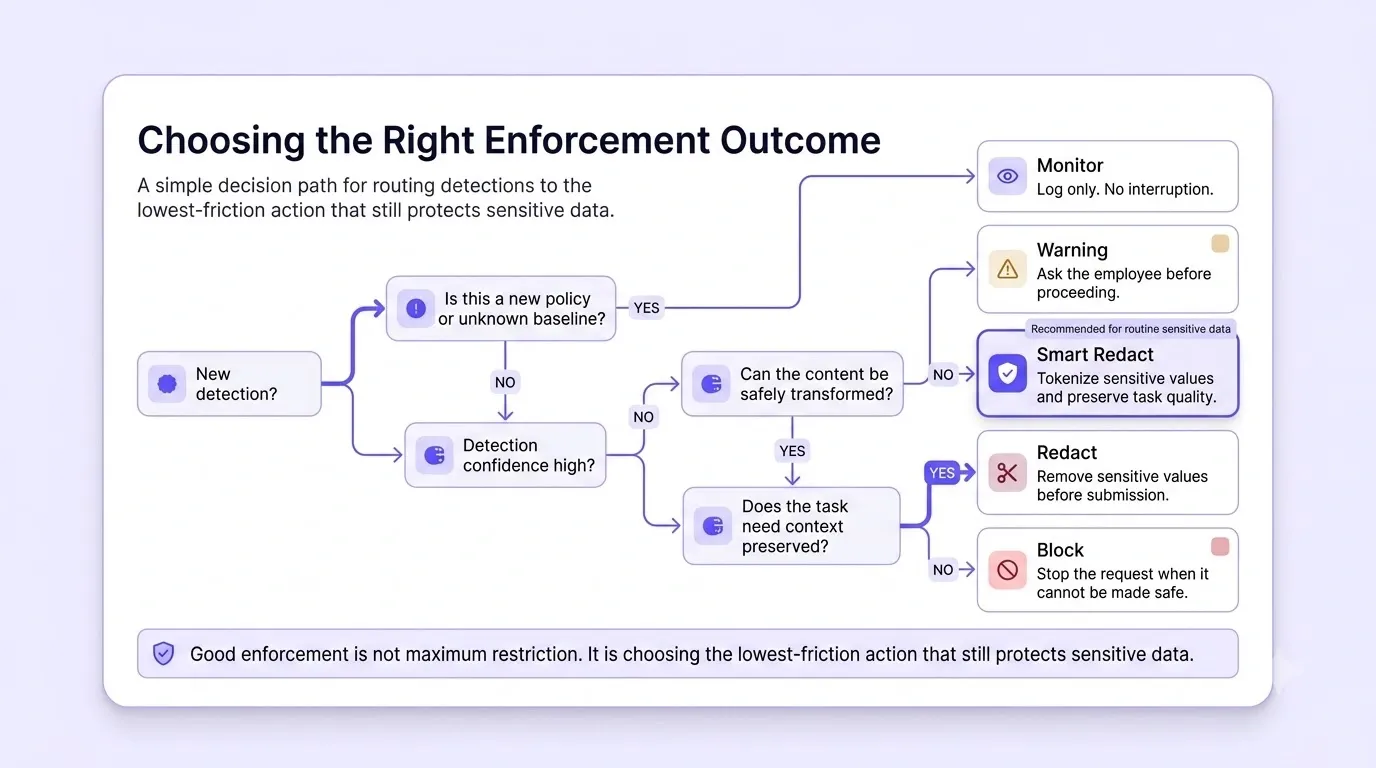
The right outcome depends on three questions, evaluated in order: can this content be made safe through redaction without destroying the request's usefulness, how confident is the detection, and how mature is this specific policy's rollout.
Can the content be made safe by removing part of it, or is the entire request the problem? This is the question that separates redaction-family outcomes from a hard block. A prompt containing a customer's name and account number is safe to redact, the sensitive entities are incidental to an otherwise legitimate task. A jailbreak attempt, a request to bypass safety instructions, or a prompt containing live source code with embedded credentials isn't something redaction can fix, because the violation isn't a removable entity sitting inside an otherwise fine request, it's the structure of the request itself.
How confident is the detection? Every scanner produces a confidence score, and a detection near the threshold carries real uncertainty a hard enforcement action shouldn't be built on. A high-confidence match against a well-defined pattern like a Social Security number, a credit card number, can support automatic redaction with little risk of a false positive disrupting legitimate work. A lower-confidence, more contextual detection, something that might be a name, or might be describing sensitive behavior, is a better fit for a warning, which puts the judgment call in front of a human rather than committing to an automated decision on ambiguous evidence.
How mature is this policy? A newly deployed scanner or a newly rolled-out policy category shouldn't jump straight to blocking. Monitor-only is the right starting point for any new detection capability, it establishes what a category of traffic actually looks like in the organization's real usage before anyone decides how much friction it deserves. Moving from Monitor to an active enforcement outcome should happen only after that baseline data shows the detection is accurate enough to trust.
See How Policy Design Actually Plays Out in Production
Guardia applies exactly this layered model by default; Smart Redact for routine sensitive data, hard blocking reserved for jailbreak attempts and credential exposure.
When Should You Use Monitor-Only?
Monitor is the right outcome any time a policy or scanner is new, or any time an organization needs visibility into a category of activity before deciding how strictly to govern it, not as a permanent setting, but as a deliberate first phase.
This matters more than it sounds like it should, because the alternative enabling active enforcement on day one for every category at once, routinely produces enough false positives and unexpected friction that the whole rollout loses credibility before anyone has real data to tune it with. A monitor-only phase generates exactly the evidence needed to answer the questions that matter: how often does this category actually appear in real usage, what does a true positive look like versus a false one, and which teams or workflows generate the most detections. LangProtect's guide to AI audit logs and forensic visibility covers what a log needs to capture to make this baselining phase actually useful rather than just a pile of unstructured events.
The mistake organizations make in the other direction like leaving a policy on Monitor indefinitely because moving to enforcement feels risky, defeats the purpose entirely. Monitor without a planned transition to an active outcome is visibility with no governance behind it, which satisfies neither the security team's risk-reduction goal nor a regulator's expectation of demonstrated controls.
When Should You Use a Warning Instead of Silent Redaction?
A warning is the right outcome when a detection is ambiguous enough that an automated decision, redact, or don't, carries real risk of being wrong in either direction, and a human's context can resolve the ambiguity faster and more accurately than more detection engineering can.
Some categories are inherently well suited to this: behavioral or contextual detections, where a scanner is evaluating something closer to intent or tone than a discrete matchable entity, tend to have lower precision than pattern-based detections and benefit from a human check before anything gets stopped or silently altered. A warning also serves a purpose beyond the individual decision, it's a visible signal to the employee that the system is watching, which plain silent redaction doesn't provide. That visibility has a secondary effect worth planning for deliberately: it reinforces awareness of the organization's AI usage policy at the exact moment it's relevant, rather than only during onboarding training months earlier.
The tradeoff is real, though: every warning is friction, and warnings that fire too often for genuinely low-risk detections risk the same effect researchers found in the largest field study of browser security warnings to date; a 2013 study of over 25 million warning impressions found click-through rates varied enormously by warning type, from under 10% for well-designed, infrequent warnings to over 70% for one frequently-seen SSL warning category, with frequency and design quality driving the difference more than the underlying risk did. The lesson generalizes directly: a warning employees see constantly for routine, low-severity detections gets the 70% treatment, reflexive dismissal, while a warning reserved for genuinely rare, high-stakes cases retains the attention it needs to actually change behavior. A policy relying heavily on warnings for high-volume, low-severity categories is usually better served by moving those categories to automatic smart redaction instead, reserving warnings for the smaller set of genuinely ambiguous cases where a human's judgment adds real value.
When Should You Hard Block Instead of Redacting?
A hard block is the right outcome specifically when the violation is the structure of the request itself, not a removable entity within it, which means blocking should be reserved for a deliberately narrow set of categories, not treated as the default response to any high-severity detection.
The clearest cases: a prompt attempting to override the AI system's instructions or bypass its safety guidelines isn't improved by redacting part of it, the entire request is the problem. Live source code containing embedded credentials or connection strings similarly resists redaction, since stripping or tokenizing an API key inside a code block that's meant to run correctly usually breaks the code's syntax entirely, unlike stripping a name out of a sentence. LangProtect's guide to prompt injection covers why this category specifically resists the kind of graceful handling that works for routine PII.
Over-applying blocking to categories that could have been safely redacted is the direct cause of the shadow AI displacement problem described in this guide's opening. LangProtect's guide to why banning ChatGPT creates shadow AI risk covers this dynamic in more depth: restriction without a usable alternative doesn't eliminate the underlying task, it just relocates it somewhere the security team can no longer see it. Blocking should feel like a deliberately reserved, narrow tool; not the default response to seeing something sensitive.
Don't Let Over-Blocking Push Employees Toward Unmonitored AI Tools
A policy that blocks too broadly doesn't reduce risk, it just moves it somewhere you can't see.
What Does a Mature Enforcement Policy Actually Look Like?
A mature policy doesn't apply one outcome uniformly, it maps each detection category to the outcome that fits its specific risk profile, and different categories in the same policy legitimately land on different outcomes.
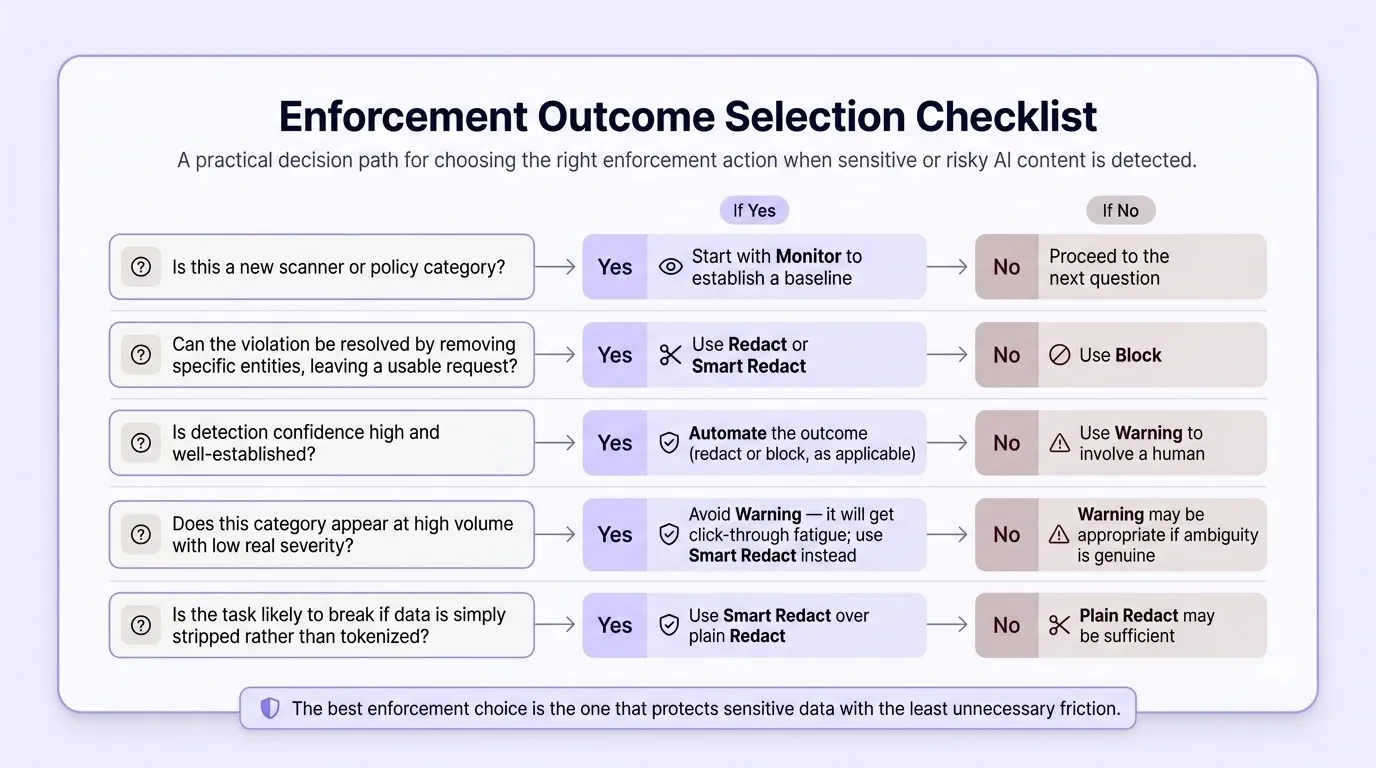
In practice, this typically looks like: Smart Redact as the default for routine, high-confidence sensitive-data categories like standard PII and PHI, since it protects the data with essentially no friction and no loss of task quality. Block reserved narrowly for categories where redaction genuinely can't produce a safe outcome like jailbreak attempts, credential and secret exposure inside code, malicious payloads. Warning used sparingly, for the smaller set of detections that are too ambiguous for automated handling but not severe enough to justify a hard stop. Monitor applied to every new scanner or policy category before it graduates to one of the active outcomes above, so the transition to enforcement is based on real data rather than a guess.
This layered structure is also what makes audit evidence meaningful rather than just voluminous: a log that records which specific outcome applied to which specific category, not just "something happened," is what lets a security team or an auditor later reconstruct not just what was detected, but whether the response was proportionate to it.
Enforcement Outcome Selection Checklist
Frequently Asked Questions
What's the difference between Redact and Block?
Redact removes specific sensitive entities from a request while leaving the rest intact, so the task can generally still be completed. Block stops the entire request, with no path to proceed. Redact is the right choice when the sensitive content is incidental to an otherwise legitimate task; Block is the right choice when the violation is the request's structure itself, not a removable piece of it.
Should every organization use the same enforcement outcome for the same data type?
No, the right outcome depends on context, not just the data type in isolation. A Social Security number in a routine customer service request is a strong candidate for automatic Smart Redact. The same Social Security number inside a prompt that's also attempting to jailbreak the model is part of a request that should be blocked outright, because the presence of an otherwise-redactable entity doesn't make an unsafe request safe.
Why shouldn't every high-severity detection just be blocked to be safe?
Because blocking is the outcome employees are most likely to work around, and working around it usually means moving the same task to an unmonitored AI tool with no protection at all which is a worse outcome than a well-handled redaction. Reserving Block for categories that genuinely can't be made safe any other way keeps it credible and keeps adoption of the sanctioned tool intact.
How long should a policy stay on Monitor before moving to active enforcement?
There's no fixed universal window, the right length depends on how much traffic the category sees and how much confidence the security team needs before trusting automated action. The practical signal to watch for isn't time elapsed, it's whether the monitoring data shows a consistent, well-understood pattern of true versus false positives. Moving to enforcement before that pattern is clear tends to produce a rocky rollout that undermines trust in the policy.
Do warnings actually change employee behavior, or do people just click through them?
It depends heavily on frequency and design, this isn't a settled "warnings don't work" question. The largest field study of browser security warnings ever conducted, analyzing over 25 million real warning impressions, found click-through rates ranging from under 10% for infrequent, well-designed warnings to over 70% for one frequently-seen warning type, the researchers concluded that warnings genuinely can be effective, but frequency and quality of design determine whether they are. Used sparingly, for genuinely ambiguous cases, warnings prompt real reconsideration. Used constantly, for high-volume low-severity detections, they trend toward the reflexive dismissal end of that range, which is why a mature policy limits warnings to cases that actually need human judgment rather than using them as a default middle ground.
Can an enforcement outcome change automatically based on how often an employee triggers a detection?
This is a reasonable policy design goal, escalating from a lighter outcome to a stricter one for a user or category with a repeated pattern of violations, but it's not something every platform supports out of the box, and organizations considering it should confirm the specific enforcement engine they're using can evaluate historical pattern, not just the current request in isolation, before designing a policy around that assumption.
The Right Outcome Depends on the Detection, Not a Single Company-Wide Setting
Choosing between Monitor, Warning, Block, Redact, and Smart Redact isn't a one-time decision applied uniformly, it's a per-category judgment based on whether content can be safely redacted, how confident the detection is, and how mature the policy is. Organizations that collapse this into a single strict-or-lenient dial end up either blocking too much, pushing employees toward unmonitored tools, or blocking too little, leaving real exposure unaddressed.
The goal isn't finding the single correct setting, it's building a policy where each category lands on the outcome actually suited to it, with block reserved for what redaction genuinely can't fix.
Design an Enforcement Policy That Matches Your Actual Risk
See how LangProtect maps detection categories to the right enforcement outcome by default, so protection doesn't come at the cost of adoption.
Tags
Related articles
What Is Runtime Protection for LLM Applications? How It Works
What Is LLM AI Red Teaming? A Practical Guide for Enterprises