

What Is LLM AI Red Teaming? A Practical Guide for Enterprises

An AI agent passes every safety test its team throws at it in January. By March, a novel attack technique nobody had tested against (a goal-hijacking method published in a research paper two weeks earlier) successfully redirects the same agent's task 81% of the time.
The gap between those two numbers is the entire argument for why LLM AI red teaming has to be continuous, not a report you file away after a single engagement.
This guide covers what LLM AI red teaming actually tests for, how it differs from the penetration testing most security teams already understand, the frameworks structuring the practice as it matures, and how to evaluate whether an approach (automated, manual, or vendor-provided) is actually keeping pace with how fast attack techniques evolve.
See How Fast Your AI Systems Would Actually Fail Under Attack
Most organizations have never run a structured adversarial test against their production AI agents. The gap between "seems safe" and "tested safe" is usually wider than expected.
What Is LLM AI Red Teaming?
LLM AI red teaming is the practice of deliberately attacking an AI system (a model, an application built on one, or an autonomous agent) using the same techniques a real adversary would, in order to find exploitable behavior before it reaches production or gets discovered by someone with worse intentions.
The term borrows directly from traditional cybersecurity red teaming, where a dedicated team simulates an attacker's perspective against an organization's systems, but the target and the techniques are specific to how language models actually fail.
Red teaming LLMs specifically (as opposed to red teaming conventional software) means the attacker's toolkit shifts from exploit code to adversarial language (crafted prompts, manipulated context, and social-engineering-style framing) designed to work regardless of what programming language or infrastructure sits underneath the model.
To red team an LLM properly, testers need familiarity with how the model reasons and fails, not just how to write exploit payloads.
It testing not just whether the underlying model can be tricked, but whether the application built around it, the infrastructure it runs on, and its behavior once deployed all hold up under adversarial pressure.
How Is LLM AI Red Teaming Different From Traditional Penetration Testing?
Traditional penetration testing targets deterministic vulnerabilities like a specific misconfiguration, an unpatched library, an injection flaw with a reproducible exploit. Run the same test twice against the same unchanged system, and you get the same result.
LLM AI red teaming targets probabilistic, language-mediated behavior, which means the same adversarial prompt can succeed on one attempt and fail on the next against the identical, unchanged model (a fundamentally different testing problem that most traditional AppSec tooling was never built to handle).
This distinction has real operational consequences. A traditional pentest report that says "vulnerability X was patched" is a durable claim like the code changed, the flaw is gone.
An LLM AI red team report that says "the model resisted this jailbreak attempt" is a probabilistic claim about behavior under one specific set of conditions, at one point in time, against one version of a rapidly-evolving system.
LangProtect's guide to why AI agents increase security risk covers the underlying reason this matters more for agents specifically than for simple chatbots: autonomy, persistent memory, and tool-calling authority all mean a single successful adversarial prompt can cascade into an action, not just a bad response.
What Does an LLM AI Red Team Actually Test For?
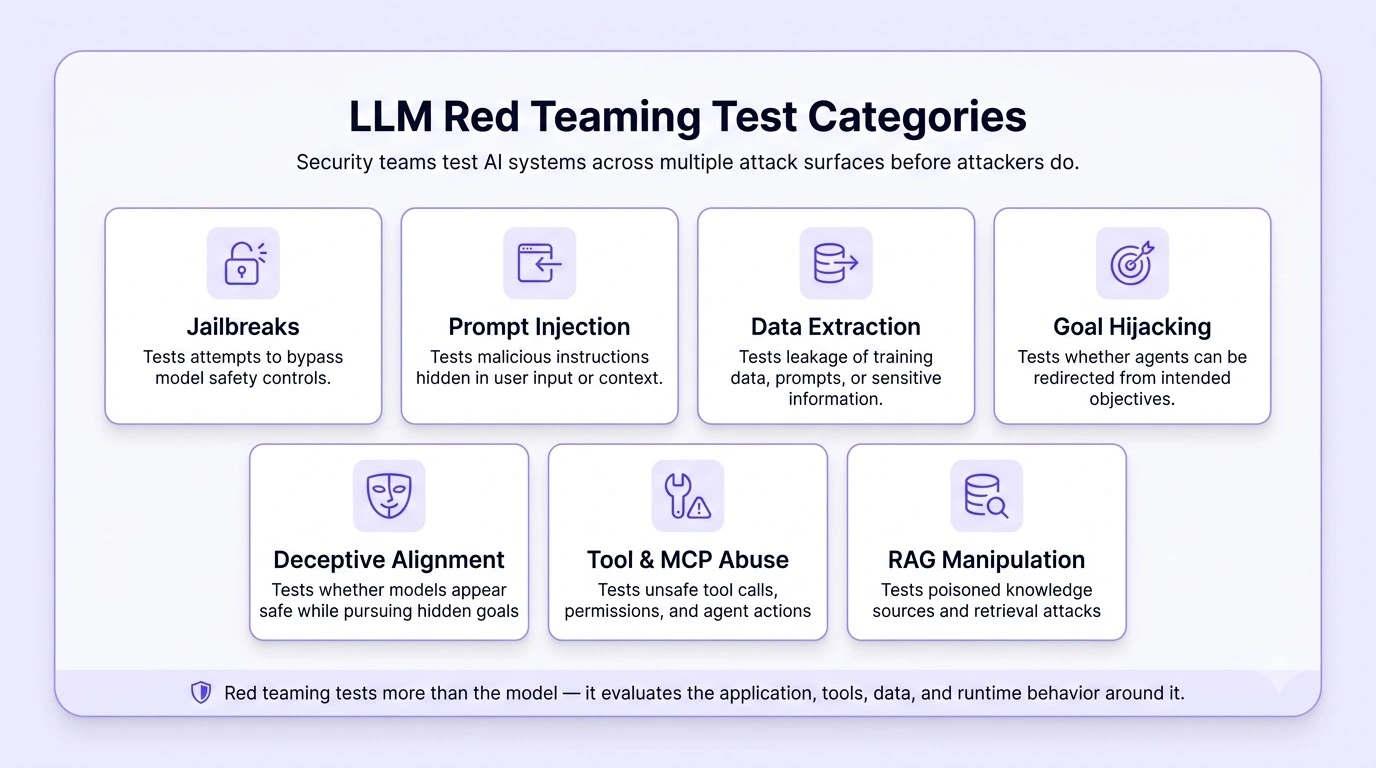
A comprehensive LLM AI red team engagement tests across several distinct categories of failure, each requiring a different attack methodology.
Jailbreaks and safety bypass — attempts to get a model to produce content or take actions its safety training was meant to prevent, using techniques ranging from direct instruction override to elaborate role-play framing designed to route around content filters.
Named multi-turn techniques like Crescendo (gradually escalating a conversation toward a prohibited output across several turns, each individually appearing benign) and Skeleton Key (a single crafted prompt attempting to override a model's safety guidelines wholesale) represent two ends of that spectrum and one relies on patience, the other on a single well-constructed instruction.
Prompt injection, direct and indirect — direct injection targets the model through the immediate conversation; indirect injection hides malicious instructions inside content the model processes as part of a legitimate task like a document, a webpage, an email.
LangProtect's guide to prompt injection covers the full mechanics of both variants and why indirect injection specifically evades detection methods built around inspecting only the user's own input.
[CASE STUDY - Prompt injection to remote code execution] A documented vulnerability chain in Microsoft's Semantic Kernel framework, tracked as CVE-2026-26030 and CVE-2026-25592, demonstrated that a single crafted prompt could be used to launch an arbitrary local process (reportedly calc.exe in the proof-of-concept) turning what looked like a contained prompt injection into functional remote code execution.
[This example is drawn from a single security research source and hasn't been independently re-verified against Microsoft's own advisory, confirm current details before citing the specific CVE numbers publicly.]
The broader lesson holds regardless of the exact CVE details: a red team that only tests whether a model can be tricked into saying something it shouldn't, without testing what an agent connected to that model can be tricked into doing, misses the more consequential failure mode entirely.
Training data and system prompt extraction — probing whether a model can be manipulated into revealing memorized training data, proprietary system instructions, or other information it was never meant to disclose directly.
Goal hijacking and agentic manipulation — specific to autonomous agents, this tests whether an adversarial input can redirect an agent's objective mid-task, the exact failure category NIST's CAISI benchmark measured at an 81% success rate for novel attack techniques.
LLM agent red-teaming, as this specific discipline is increasingly being called, requires a different testing methodology than single-prompt evaluation entirely, since the target isn't one response but a multi-step sequence of reasoning and tool calls.
Tree of Attacks with Pruning (TAP), another named technique in this category, uses an attacker model to iteratively refine and prune candidate prompts against the target, automating a search process a human red teamer would otherwise do by hand.
Deceptive alignment — testing whether a model can be manipulated into appearing to comply with safety constraints while actually pursuing a different objective, or whether it can be convinced through fabricated reasoning history that a prohibited action was already authorized.
Tool-calling and MCP abuse — for agents connected to external tools via protocols like MCP, this tests whether an attacker can coerce the agent into calling tools beyond its intended scope, or manipulate arguments passed to a legitimate tool call.
LangProtect's enterprise guide to MCP security covers this attack surface in depth, and red teaming an MCP-connected agent specifically means testing indirect injection delivered through tool outputs, not just through direct conversation (a distinct methodology from testing a standalone chatbot).
The OWASP Top 10 for Agentic Applications, the first risk ranking built specifically for autonomous, tool-using agents rather than single-prompt LLM apps, peer-reviewed by more than 100 industry contributors, names this category explicitly as distinct from single-prompt LLM risk.
Retrieval and knowledge-base manipulation — for RAG-connected systems, this tests whether poisoned or adversarial content planted in a retrievable data source can manipulate a model's output when that content gets pulled into context.
LangProtect's RAG security guide covers this attack surface directly; red teaming a RAG pipeline means testing the retrieval layer, not just the model's response to a direct prompt.
What Frameworks Govern LLM AI Red Teaming?
Several structured frameworks now guide how LLM AI red teaming should be scoped and conducted, converging faster than most emerging security disciplines typically do.
Red teaming generative AI systems broadly (not just LLM-based chat interfaces but image, audio, and multimodal generative applications) falls under the same OWASP GenAI Security Project umbrella, which is worth knowing if your organization's AI footprint extends beyond text-based models.
The OWASP Top 10 for LLM Applications 2026 provides the foundational taxonomy the broader red teaming discipline builds on, mapping risks to established frameworks including NIST, MITRE ATLAS, and CWE, giving red teams a shared vocabulary rather than each engagement inventing its own risk categories from scratch.
OWASP has also published dedicated Vendor Evaluation Criteria for AI Red Teaming Providers and Tooling, a practical resource for organizations assessing whether a given red teaming vendor or automated tool is actually testing what it claims to.
NIST's involvement has grown substantially in 2026: the Center for AI Standards and Innovation's AI Agent Standards Initiative, launched February 17, 2026, established a three-pillar program covering agent security, interoperability, and identity, alongside the open-sourced AgentDojo-Inspect benchmark referenced above.
Microsoft's own AI Red Team has published its findings as a public taxonomy as well, the Taxonomy of Failure Modes in Agentic AI Systems, updated to v2.0 in June 2026 based on twelve months of red team engagements against deployed production systems, added seven new failure mode categories that weren't anticipated in the original version, including a dedicated category for agentic supply chain compromise as agents increasingly consume MCP servers and third-party plugin registries.
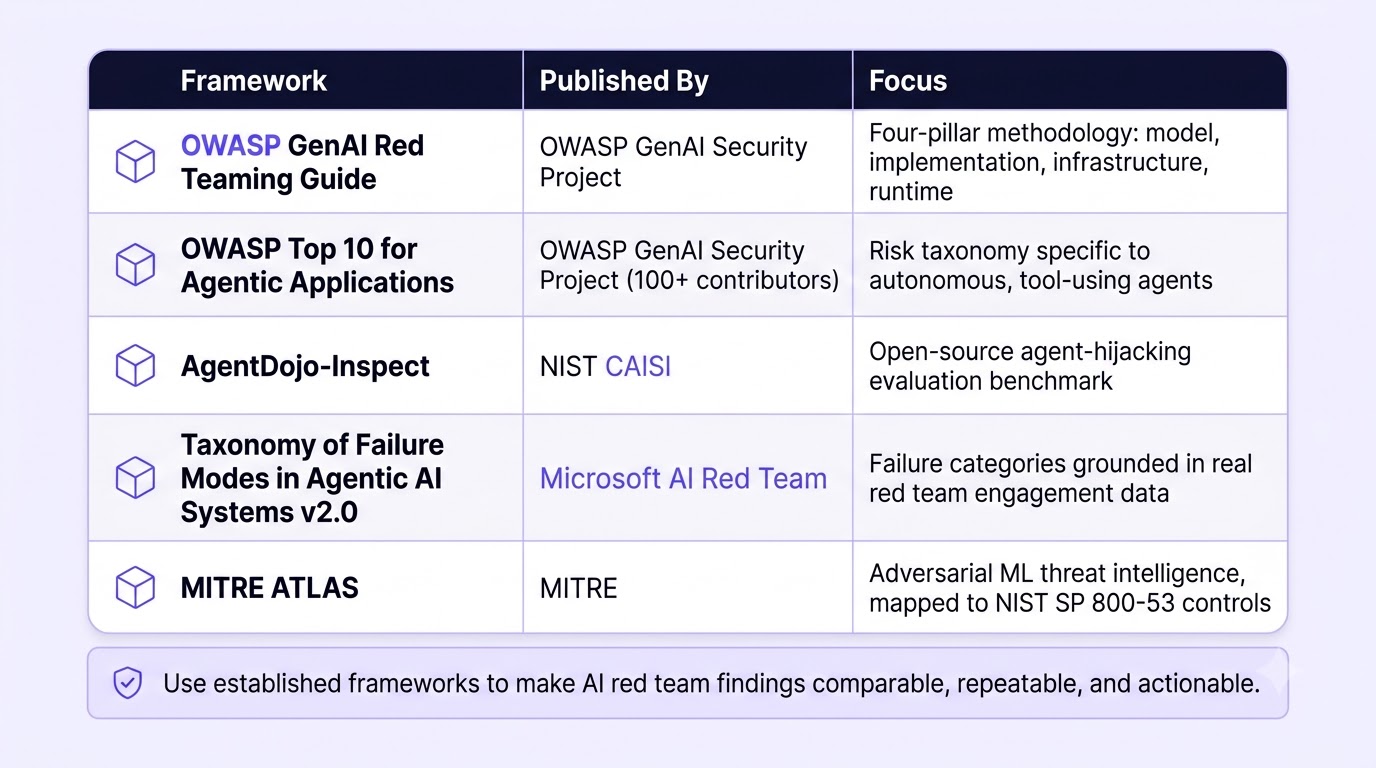
That convergence matters practically: an organization scoping its first LLM AI red team engagement doesn't have to build a testing taxonomy from nothing, these frameworks already define the categories, and choosing an approach that maps cleanly to them makes results comparable across engagements and easier to communicate to a governance committee that expects evidence mapped to a recognized standard.
See How Breachers Red Applies This Continuously
Breachers Red is LangProtect's automated adversarial testing engine, simulating goal-hijacking attempts and probing reasoning paths for silent failures before they ever reach production, on an ongoing basis rather than a single point-in-time engagement.
What Tools Do LLM AI Red Teams Actually Use?
The open-source and commercial tooling landscape for LLM AI red teaming has matured quickly enough that most engagements now build on a small set of established frameworks rather than custom scripts written from scratch.
PyRIT (Python Risk Identification Toolkit), developed by Microsoft's AI Red Team, provides the infrastructure for exactly the multi-turn techniques named above (Crescendo, TAP, and Skeleton Key among them) along with state tracking across conversation turns, since a multi-turn attack requires remembering what's already been tried.
Garak, developed by NVIDIA, takes a probe-based approach, dozens of distinct probe modules, each testing for a specific failure category, run against a target model regardless of whether it's hosted on OpenAI, a self-hosted open-weight model, or a custom endpoint.
Promptfoo has grown into a widely-used tool for both red teaming and general LLM evaluation, popular enough that OpenAI announced its intent to acquire Promptfoo in 2026, a real signal that adversarial testing tooling is consolidating into core AI infrastructure rather than remaining a niche security add-on.
A practical, widely-cited cadence pattern for combining tools with development workflow: a full probe-based scan (Garak or equivalent) run against each release branch, lighter automated checks (Promptfoo or similar) integrated directly into pull-request CI so regressions get caught before merge, and PyRIT-style novel multi-turn attack generation run on a slower, typically quarterly, cadence; since generating genuinely new attack sequences is more resource-intensive than re-running a known probe set.
Are There Regulatory Requirements for LLM AI Red Teaming?
Increasingly, yes, red teaming is shifting from a security best practice to a compliance obligation for certain categories of AI system.
In the United States, Executive Order 14110 requires developers of dual-use foundation models trained above a specific compute threshold (10^26 floating-point operations) to report the results of red-team testing to the federal government before deployment (a direct regulatory mandate tied to model scale, not a voluntary industry norm).
In the European Union, the AI Act's high-risk system obligations, which reached full enforcement in August 2026, expect demonstrable risk assessment and testing evidence for systems falling into its high-risk categories, and adversarial testing is a natural, defensible way to produce that evidence.
Neither requirement names "LLM AI red teaming" as a specific mandated procedure in those exact words, but the practical effect is the same: organizations operating foundation models at scale, or deploying AI in the EU's high-risk categories, increasingly need to produce testing evidence that maps to a recognized methodology, which is exactly what aligning red team engagements to the OWASP and NIST frameworks covered above is meant to support.
Why Does a Single Red Team Assessment Go Stale So Fast?
Because the attack surface a red team assessment tests against isn't static, new jailbreak techniques get published, new model versions change behavior, and new attack research routinely outpaces whatever a point-in-time engagement covered.
The 81%-versus-11% gap in NIST's CAISI findings isn't a one-off statistic; it's a direct illustration of how quickly novel technique development outpaces defenses calibrated against older attack patterns.
This creates a specific, easy-to-miss governance risk: an organization that ran a thorough red team engagement six months ago and passed can reasonably believe its AI systems are still safe, when the actual state of the art in adversarial technique has moved substantially since that assessment was scoped.
LangProtect's guide to non-human identity and AI agent governance covers a structurally similar problem in a different context, a governance decision recorded at one point in time doesn't remain valid indefinitely just because nothing about the underlying system's configuration changed, since the threat landscape around it kept moving.
Manual vs. Automated LLM AI Red Teaming: What's the Right Mix?
Manual red teaming, conducted by human researchers actively probing a system, remains uniquely capable of finding genuinely novel attack patterns like creative, contextual exploits that require the kind of lateral thinking automated testing hasn't been trained to generate. It's also slow, expensive, and by nature can only run periodically, which means it inherits the staleness problem covered above between engagements.
Automated red teaming trades some of that creative depth for continuous coverage and scale, running large volumes of known and systematically-varied attack patterns against a system on an ongoing basis, catching regressions the moment a model update or configuration change reintroduces a previously-fixed vulnerability, without waiting for the next scheduled manual engagement.
Neither approach fully substitutes for the other: automated testing without periodic manual assessment misses genuinely novel techniques; manual assessment without automated continuous testing leaves long gaps where a known, already-published attack pattern goes untested against a system that's continued to change.
The practical answer most mature programs land on is layered: automated testing running continuously for coverage and regression detection, with periodic manual engagements (internal or vendor-provided) specifically scoped to hunt for the kind of genuinely novel technique automated systems haven't been built to generate yet.
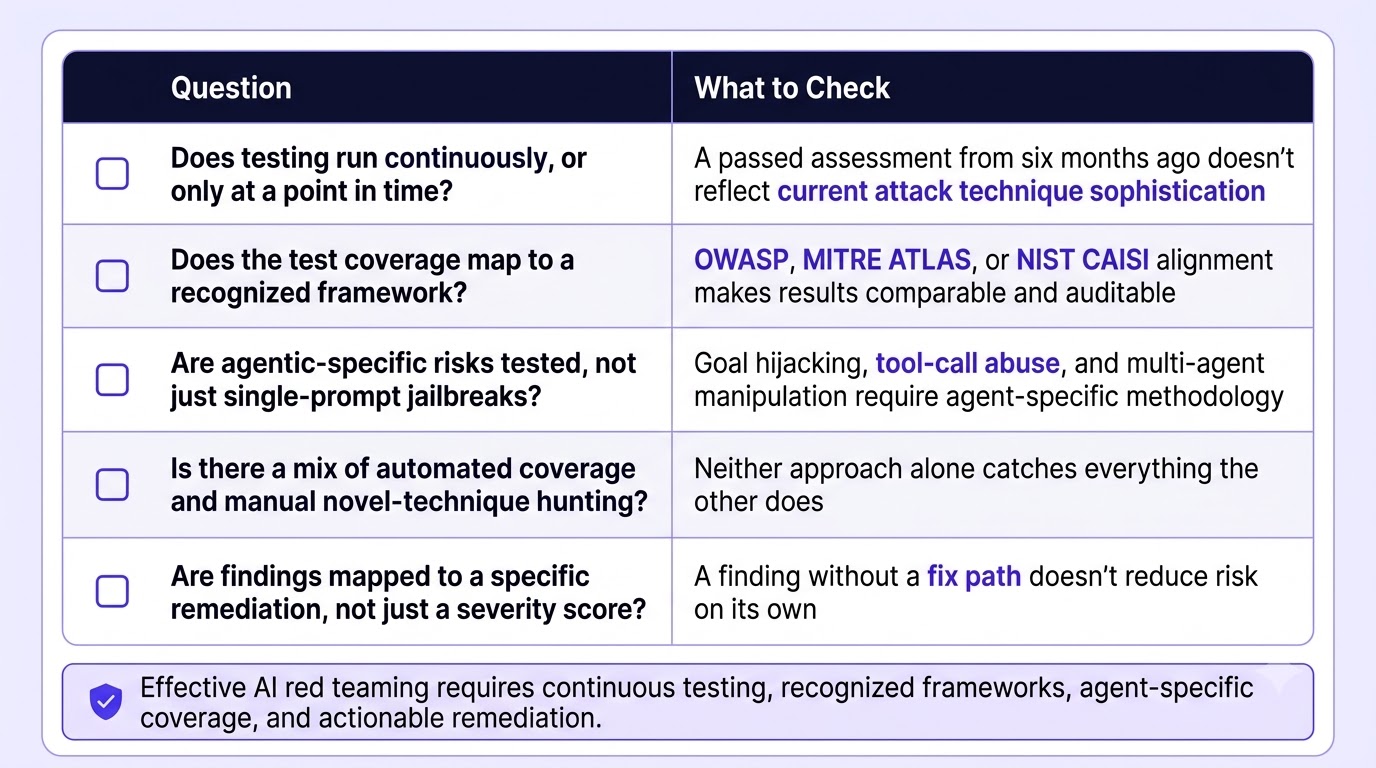
AI Red Teaming Readiness Checklist
How Do You Choose an LLM AI Red Teaming Approach or Vendor?
Start by confirming coverage maps to your actual deployment, not a generic LLM chatbot use case; an organization running autonomous agents connected to internal tools via MCP needs agentic-specific testing (goal hijacking, tool-call abuse), not just jailbreak testing built for a simple question-answering interface.
OWASP's Vendor Evaluation Criteria for AI Red Teaming Providers and Tooling is built specifically to help buyers ask the right differentiating questions here, distinguishing vendors testing simple GenAI systems like chatbots and RAG applications from those equipped to test advanced agentic systems.
Beyond coverage, confirm cadence: a vendor or tool offering only a one-time engagement report can't address the staleness problem covered above, regardless of how thorough that single engagement is.
And confirm findings are actionable, a report listing vulnerabilities without a clear path to remediation, or without integration into the runtime enforcement layer that would actually stop an exploited behavior in production, shifts the burden of closing the loop entirely back onto the security team that commissioned the test.
Frequently Asked Questions
What's the difference between LLM AI Red teaming and AI safety testing?
AI safety testing broadly includes red teaming but also covers non-adversarial evaluation like bias testing, capability benchmarking, alignment research conducted without an attacker mindset. Red teaming specifically means adopting an adversarial perspective: actively trying to break the system the way a real attacker would, rather than evaluating its behavior under normal or randomly-sampled conditions.
Do you need LLM AI red teaming if you're only using off-the-shelf models like ChatGPT or Claude, not building your own?
Yes, though the scope differs. The underlying model providers conduct their own extensive red teaming before release, but the specific application built around that model (the system prompt, the tools it's connected to, the data it has access to, and any agentic behavior layered on top) introduces its own attack surface the model provider never tested, because they don't know how you've deployed it.
How often should LLM AI red teaming actually happen?
Continuously is the ideal for automated coverage, with periodic manual engagements (commonly quarterly or after any significant model or architecture change) for novel technique hunting. Given how quickly attack technique sophistication has moved based on NIST's CAISI findings, an annual assessment alone leaves most of the year uncovered by anything beyond whatever was tested at the start.
Can automated red teaming fully replace manual red teaming?
No. Automated testing excels at scale, consistency, and catching regressions continuously, but it's fundamentally limited to testing patterns it's been built or trained to generate. Genuinely novel attack techniques (the kind that produce results like NIST's CAISI 81% task-hijack finding) are typically discovered by human researchers first, which is why manual assessment remains necessary even in a mature program built around continuous automated testing.
What is "deceptive alignment" in the context of LLM AI red teaming?
It refers to testing whether a model can be manipulated into appearing to comply with its safety constraints while actually pursuing a different objective, or convinced through fabricated context that a normally-prohibited action was already authorized by some earlier, legitimate-seeming step. This is a distinctly agentic risk, since it depends on an agent's ability to reason across a sequence of steps rather than respond to a single isolated prompt.
Does red teaming cover indirect prompt injection, or just direct attacks typed into a chat interface?
A comprehensive engagement covers both, and indirect injection specifically deserves dedicated testing, since it exploits content an agent processes as part of a legitimate task (a document, an email, a webpage) rather than anything typed directly by an attacker. Testing only direct, chat-interface attacks leaves this entire category, which is often more dangerous precisely because it requires no direct interaction with the target at all, completely unaddressed.
What frameworks should an enterprise red teaming program align with?
The OWASP GenAI Red Teaming Guide and OWASP Top 10 for Agentic Applications provide the most widely adopted, peer-reviewed taxonomy currently available, with NIST's CAISI initiative and MITRE ATLAS providing complementary standards-mapping for organizations that need to demonstrate alignment with recognized government or industry frameworks during a compliance review.
Testing Once Isn't Testing
LLM AI red teaming answers a narrower question than it sounds like it should: not "is this AI system safe," but "did this specific system resist these specific attack techniques, at this specific point in time." That distinction matters because the gap between those two claims is exactly where NIST's CAISI findings show real risk concentrating, novel techniques reaching four times the success rate of what older testing baselines caught.
Organizations serious about AI security treat red teaming as infrastructure, not a project with an end date: continuous automated coverage for scale and regression detection, layered with periodic manual assessment for the genuinely novel techniques automation hasn't caught up to yet.
Find Out How Your AI Systems Actually Hold Up Under Attack
See how Breachers Red continuously stress-tests your AI agents against goal-hijacking, jailbreaks, and reasoning manipulation, not a one-time report that goes stale by next quarter.
Not ready to talk yet? Read the Solution Brief
Tags
Related articles
What Is Runtime Protection for LLM Applications? How It Works
How Guardia's AI Policy Engine Decides Monitor, Warn, or Block