

Are You Using More Tokens Than Your Prompt Needs?

An AI prompt can be perfectly reasonable and still be more expensive than it needs to be. A simple request to summarize a document, rewrite an email, extract information, or classify text doesn't require the same level of model capability as a complex reasoning or coding task; yet in many enterprise environments, both requests are sent to the same model by default.
Token prices themselves fell roughly 80% between 2025 and 2026, and enterprise AI bills went up anyway, a gap that isn't really a pricing problem. It's a governance problem: an organization can be paying dramatically less per token and still spending more overall, because the number of tokens routed through an unnecessarily capable model grew faster than the price per token fell. As AI usage scales across teams, that mismatch compounds. Organizations tend to focus on reducing prompt length, limiting unnecessary output, or monitoring token consumption, but there's a more fundamental question worth asking first: does every prompt actually need the model that's handling it?
This is where AI model optimization comes in. Instead of treating the most capable model as the default choice for every task, organizations can analyze their actual AI usage and identify prompts where a different model may be capable of handling the work more efficiently. The objective isn't simply to spend less. It's to make sure the level of model capability being paid for is appropriate to the task.
See Where Your AI Usage Can Be More Efficient
Discover opportunities to reduce unnecessary model and token usage across your organization's actual workloads.
Why Isn't Token Usage the Only AI Efficiency Problem?
When organizations start looking for ways to control AI costs, tokens are usually the first thing they measure. How many tokens are employees sending? How long are the responses? Which teams are generating the most usage? Those numbers matter, but viewed in isolation they can create a misleading picture. A prompt consuming 1,000 tokens isn't inherently inefficient, what matters is whether the model processing those 1,000 tokens is providing enough additional capability to justify what the organization is paying for.
This is why AI token optimization has to mean more than simply shortening prompts. The aim is to understand whether the tokens being consumed are being processed by the right level of model capability for the task. When that relationship is visible, organizations can identify opportunities to make individual AI interactions more efficient and extend those gains across larger workloads.
Consider two employees working with roughly the same amount of text. One asks an AI model to extract customer names and dates from a document. Another asks it to analyze a complex technical problem, compare several possible approaches, and explain the reasoning behind its recommendation. Their prompts might have similar token footprints, but treating them as equivalent workloads makes little sense, the second task may genuinely benefit from a more capable model, while the first may not.
The distinction matters even more at enterprise scale. When hundreds or thousands of employees use AI throughout the day, a model choice that seems insignificant for one prompt becomes a meaningful source of unnecessary consumption when repeated across an organization's entire workload. One analysis of production AI cost architecture found that routing 70% of requests to a model roughly 17 times cheaper, while preserving quality for the harder 30%, cut total API spend by approximately 65% without users noticing a difference. The challenge, then, isn't making every AI interaction as cheap as possible; it's identifying where model capability, token usage, and task requirements are out of proportion.
Before organizations can optimize that usage, they first need to understand what's happening across their AI environment in the first place. LangProtect's guide to AI audit logs and forensic visibility covers the visibility layer that gives teams the context to see which models and workloads are actually driving consumption before any optimization decision can be made responsibly.
What Is LLM Model Routing?
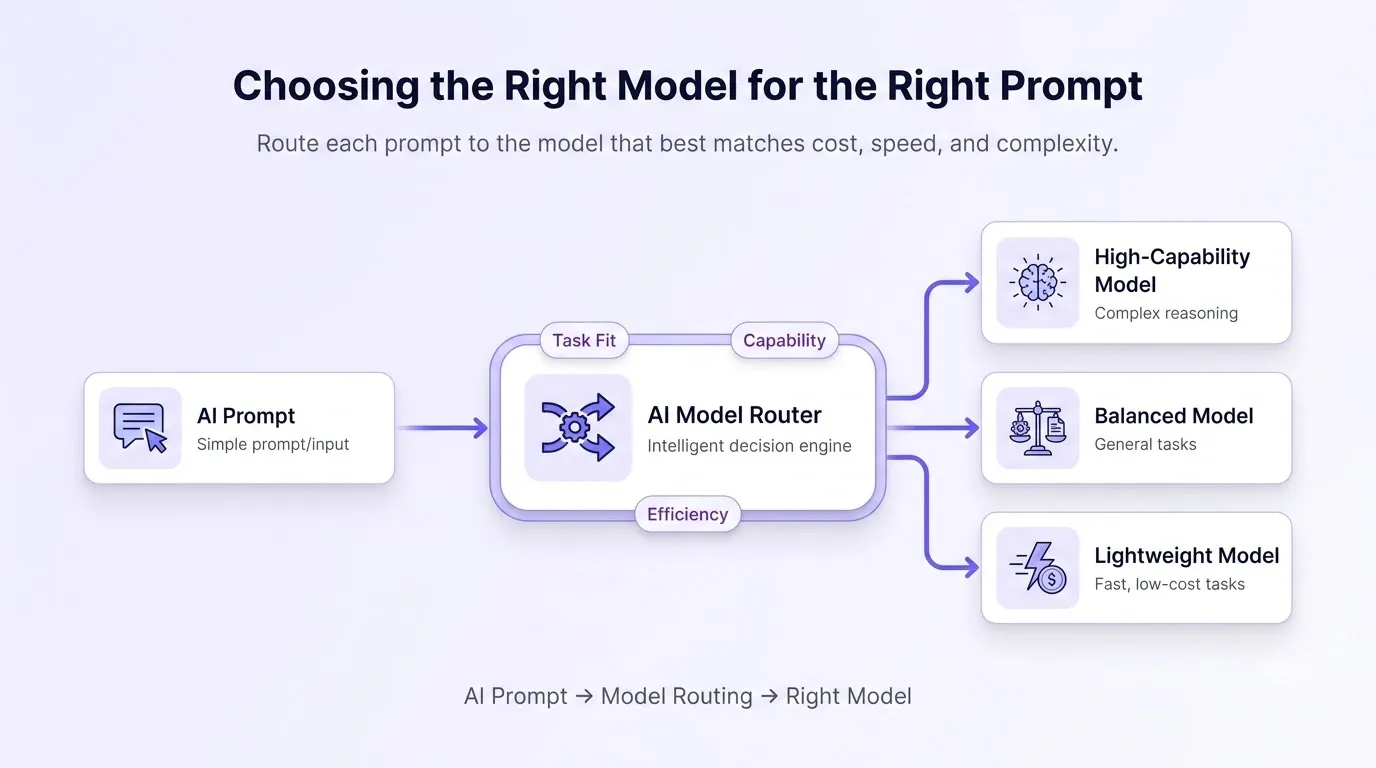
LLM model routing is the practice of evaluating an incoming request and directing it to the model best suited to handle it, rather than sending every prompt to one fixed default. At a high level, the process looks something like this: a prompt comes in and is analyzed for the kind of task it represents; potential models are evaluated against that task's requirements; a model is selected based on the routing system's quality, cost, or performance criteria; and the request is processed without requiring the user to manually decide which model should handle it.
The mechanics behind a production routing system have gotten considerably more sophisticated recently. OpenRouter's Auto Router, relaunched in a major update in August 2026, now classifies each incoming prompt into one of roughly 30 fine-grained task types like code debugging, multi-step agent planning, knowledge Q&A, math, customer support, and others which then routes based on which models the platform's own user community has actually been spending on for that specific task type over a trailing 7-day window, an approach OpenRouter describes as routing on the "wisdom of the market" rather than a fixed, static ranking. This matters as a real-world example because it illustrates that model-to-task matching isn't a one-time classification problem, the right model for a given task type shifts as new models launch and usage patterns change, which is exactly why routing needs to be continuous rather than a decision made once and left alone.
This sounds straightforward in principle, but the difficult part is deciding what makes one model appropriate for a particular prompt. The cheapest model isn't automatically the right choice, and the most capable model isn't automatically necessary; OpenRouter's own Auto Router documentation is explicit that the system aims to select a model suited to the task and cost tier a developer specifies, not simply the lowest-priced option available. That distinction is central to understanding AI model optimization generally: the goal isn't to move every request toward cheaper models, it's to identify where the capability being paid for exceeds what the task requires, while recognizing that changing models can also change the resulting output.
Why Isn't the Cheapest Model Always the Best Model?
Once organizations start looking at model choice as an efficiency lever, the obvious instinct is to simply use the cheapest model available. But lower cost doesn't automatically mean equivalent output, two models can receive the same prompt and produce answers that differ in accuracy, reasoning depth, context handling, formatting, or consistency.
The price spread involved is larger than most teams realize. The gap between the cheapest usable model and the most capable frontier model runs to roughly 100x in per-token price, a difference large enough that misapplying either direction carries real consequences, not just marginal waste. Sending a routine extraction task to a frontier-tier model wastes most of that 100x premium on capability the task never touches; sending a complex reasoning task to the cheapest available model risks a wrong or unusable answer that costs more in downstream correction than the model savings were ever worth.
This is also why raw cost-per-token is an incomplete metric on its own. The FinOps Foundation has named cost per token the foundational metric for AI cost management, but explicitly cautions that foundational doesn't mean sufficient, the metric that actually reflects business value is cost per successful output, since a cheaper model with a high failure or retry rate can end up costing more per usable answer than a pricier model that gets it right the first time.
There are several factors enterprises need to weigh when considering a less expensive model for a given workload:
- Accuracy — does the alternative produce a result that's good enough for the intended use?
- Reasoning capability — can it handle the complexity of the task?
- Consistency — does it reliably follow the required instructions and output format?
- Latency — is the response fast enough for the workflow?
- Downstream effort — will employees or other systems have to spend more time correcting the output?
This is why AI model optimization shouldn't be treated as a race toward the lowest possible model cost. The objective is to identify where a less expensive model is genuinely sufficient, while recognizing where paying for a more capable model is justified by the outcome it produces.
Read the Full Platform Overview
Model optimization is one piece of a larger picture; how visibility, enforcement, and cost efficiency work together across an AI deployment. The Solution Brief covers all of it in about five minutes.
How Does LangProtect Optimizer Identify More Efficient Models?
Most enterprises already have a model strategy in place. Teams may have standardized on a particular model for consistency, procurement, integrations, or simply because it works well for most of their day-to-day tasks. The problem is that "works well for most tasks" doesn't necessarily mean "is the most efficient choice for every task." A model appropriate for complex reasoning may be unnecessarily expensive for a routine prompt that doesn't require the same level of capability.
LangProtect Optimizer is designed to identify those potential inefficiencies at the prompt level. Rather than asking teams to manually compare model pricing or decide which model should handle every type of request, Optimizer analyzes the prompts being used, examines their token consumption, and evaluates whether the current model may be more than the task requires. It then suggests a potentially more efficient model for that particular prompt.
The process starts with the prompt itself. Every interaction provides useful signals about the workload like what the user is asking, how much context is being supplied, and how many tokens are being consumed. Optimizer uses this information to identify prompts where the current model may not be the most efficient fit, shifting the question from "which model is cheapest" to "which model is appropriate for this request." At a high level, Optimizer looks at three connected pieces of information: the prompt itself (what is the user actually asking the AI to accomplish), token usage (how much input and output consumption the interaction involves), and model choice (whether the current model's level of capability is proportionate to the requirements of the task).
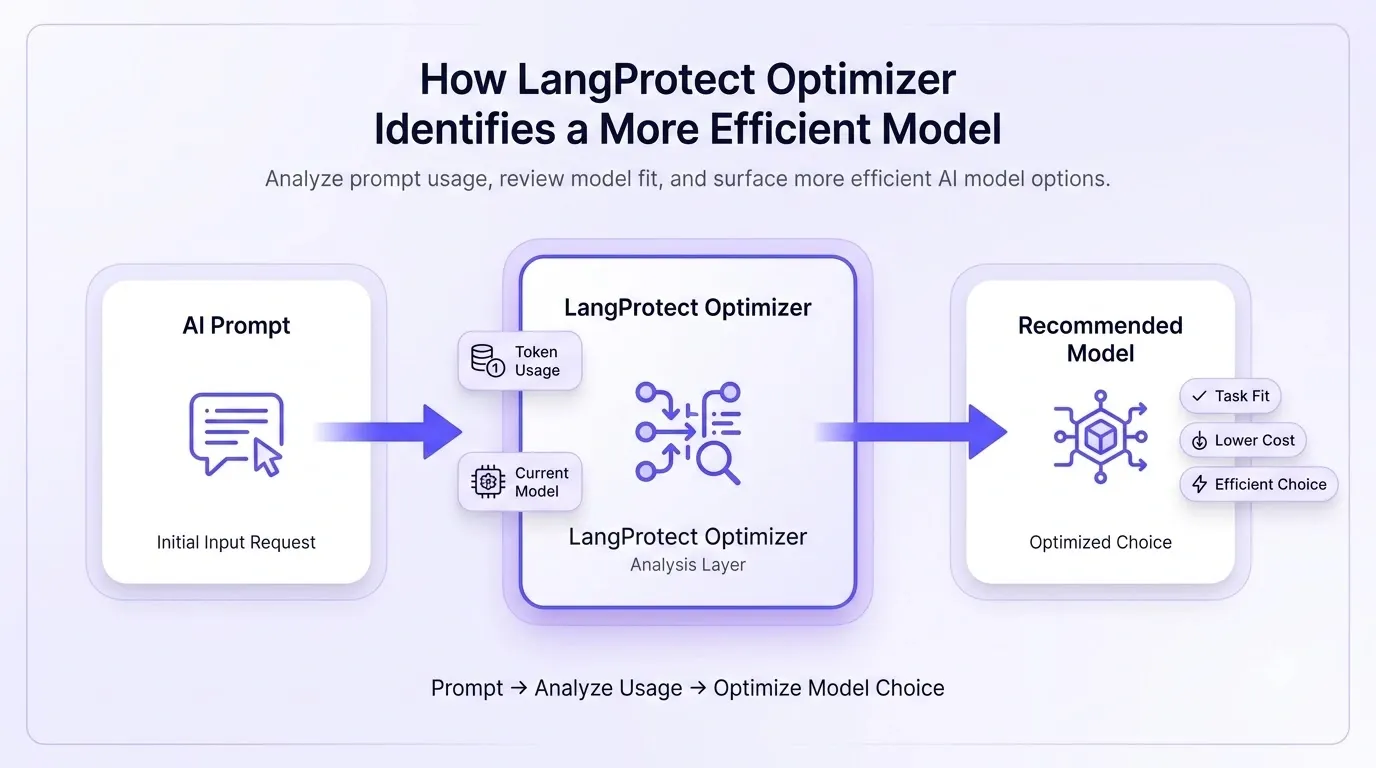
That distinction is important because a lower-cost model isn't automatically a better recommendation. A model may consume fewer resources but produce an answer that's less accurate, less complete, or otherwise unsuitable for the user's needs. Optimizer therefore doesn't treat efficiency as simply replacing powerful models with cheaper ones, but it surfaces potential alternatives so organizations can make more informed decisions about where model usage can be optimized.
This approach matters because enterprise AI usage is rarely uniform. One employee might use an AI model for straightforward summarization throughout the day, while another relies on it for code generation or complex analysis. Applying the same model to both workloads can be convenient, but it can also mean paying for capabilities that only some requests actually need, a pattern that becomes increasingly costly as enterprise AI adoption expands across more teams and use cases, and the harder it becomes to identify these opportunities manually rather than systematically.
By analyzing usage at the prompt level, model optimization becomes something enterprises can approach based on their real workloads rather than assumptions about how employees use AI. The result is a clearer view of where a more efficient model may be sufficient, while preserving the option to use more capable models when the task genuinely calls for it.
Find Your AI Efficiency Opportunities
See which prompts may be using more model capability and tokens than they need.
AI Model Optimization Without Sacrificing Output Quality
Using the same model for every AI interaction can be convenient, but it isn't always the most efficient approach. Different prompts place different demands on an AI model, and many everyday tasks don't require the highest level of model capability available. When organizations can identify those workloads, they can make better use of their AI infrastructure without changing how teams actually work.
Instead of treating every prompt as if it requires the same amount of compute and model capability, organizations can look at actual usage patterns and identify where a more efficient model may be suitable. The result is a more deliberate approach to model selection, where higher-capability models get reserved for the workloads that genuinely need them, which reflects the same principle documented across independent routing research: teams that implement a tuned routing layer report bill reductions in the 40-85% range, achieved specifically because most production traffic never needed frontier-model capability in the first place.
LangProtect Optimizer makes this process easier by analyzing prompts and their token consumption and recommending a model that may be better suited to the request, giving teams a practical way to discover efficiency opportunities that would otherwise be difficult to identify across thousands of AI interactions. The benefits extend beyond individual prompts: as AI usage grows across an organization, even small improvements in model selection become meaningful at scale, without requiring employees to manually track token usage or constantly rethink which model to use for each task.
Smarter Model Choices, More Efficient AI Usage
As AI becomes part of more enterprise workflows, efficiency can no longer be measured by token consumption alone, the model handling a request matters just as much. Using the same high-capability model for every task can make AI usage unnecessarily expensive, even when many everyday prompts could be handled efficiently by other models. This makes LLM cost optimization a practical part of AI management: when thousands of prompts are processed every day, identifying workloads that can be handled more efficiently helps organizations make better use of their AI budgets while continuing to support growing AI adoption.
AI model optimization gives enterprises a way to identify those opportunities. By analyzing prompts and token usage, LangProtect Optimizer helps teams understand where their current model choices may exceed what a workload requires and surfaces potentially more efficient alternatives.
Model selection is also becoming part of broader AI governance, as organizations look beyond simply controlling access to AI and begin managing how efficiently their AI resources are actually being used. The goal isn't to use less AI, it's to get more value from the AI an organization is already using. By making model selection more informed and usage more efficient, organizations can control unnecessary consumption while continuing to scale AI across their teams and workflows.
Frequently Asked Questions
What is AI model optimization?
It's the process of matching AI prompts with models appropriate for the task, using resources efficiently rather than defaulting every request to the same model regardless of complexity. It helps organizations identify where a different model may be able to handle a request without requiring the same level of model capability or token consumption.
How does LangProtect Optimizer work?
LangProtect Optimizer analyzes AI prompts and their token usage to identify potential opportunities for more efficient model selection. It evaluates the request and recommends a model that may be better suited to handling that particular prompt.
Why should enterprises optimize AI model usage?
As AI usage grows, small inefficiencies across individual interactions become significant at scale, token prices have fallen sharply, but overall enterprise AI spend keeps rising because more tokens are being routed through more capable, more expensive models than most tasks actually require. Optimizing model usage helps organizations make more informed choices about which models are being used for different workloads.
Does AI model optimization mean always using a cheaper model?
No. The objective isn't simply choosing the least expensive model, but a cheaper model with a high failure or retry rate can cost more per usable answer than a pricier model that gets the task right the first time. Different workloads require different levels of capability, so optimization is about identifying where a more efficient model is genuinely appropriate while continuing to use higher-capability models for tasks that require them.
Can model optimization help reduce token consumption?
Yes. By analyzing prompt and token usage, organizations can identify interactions where the current model and consumption exceed what the task requires, uncovering opportunities to make AI usage more efficient across larger workloads.
Does LangProtect Optimizer require employees to change their AI workflows?
Optimizer is designed to work with existing AI usage rather than requiring employees to change how they work. It surfaces model optimization opportunities so organizations can make more informed decisions without turning model selection into a manual task for every user.
What's the difference between model optimization and model routing?
Model routing automatically determines which model processes a request in real time, often based on factors like cost, capability, or task complexity (the way OpenRouter's Auto Router classifies and routes prompts on the fly). Optimization focuses on analyzing actual historical AI usage and identifying opportunities where the model currently being used may not be the most efficient fit for a given type of prompt, which can then inform routing decisions, policy choices, or manual model selection going forward.
How large is the price difference between cheap and expensive models in practice?
Substantial, independent industry analysis puts the gap between the cheapest usable model and the most capable frontier model at roughly 100x in per-token price. That spread is exactly why misrouted requests carry real cost either direction: overusing a frontier model wastes most of that premium on unused capability, while underusing capability on a task that needed it can cost more in downstream correction than any model savings were worth.
Getting More Value From the AI You're Already Using
The goal isn't to use less AI, it's to get more value from the AI an organization is already paying for. Token prices have fallen sharply, and enterprise AI bills have risen anyway, which is a clear signal that the real lever isn't per-token pricing, it's whether the model capability behind each request actually matches what that request needs.
By making model selection more informed and usage more efficient, organizations can control unnecessary consumption while continuing to scale AI across their teams and workflows, without asking employees to change how they work, and without defaulting every task to the most expensive model available just because it's the safest guess.
Make Every AI Interaction Count
Identify opportunities to use the right model for every prompt and make your AI usage more efficient.