

What Is MCP Security? Risks, Controls, and Best Practices for Enterprises

Ask ten security teams what "MCP security" (short for Model Context Protocol security) means and you'll get ten different answers; some describe it as an API security problem, some as a data loss prevention problem, and a few haven't heard the term at all despite already running agents that use it. That confusion is expensive. MCP SDK downloads reached 97 million per month by March 2026, with over 10,000 public servers now indexed across major registries; adoption that fast, against a security category most teams haven't formally named yet, is exactly the gap attackers have already started exploiting.
This guide answers the question directly: what MCP security actually is, the risks it specifically addresses, the controls that close them, and the best practices enterprises should have in place before scaling agent deployments further. For the full architectural breakdown, documented incident case studies, and four-layer implementation framework, see LangProtect's enterprise guide to MCP security, this piece is the shorter map of that territory, not a replacement for it.
See What's Actually Connected to Your Enterprise Systems Through MCP
Most security teams can't currently answer which AI agents hold MCP access to which systems.
What Is MCP Security?
MCP security is the practice of governing and protecting the connections AI agents make to enterprise tools, data sources, and systems through the Model Context Protocol (MCP); an open standard that lets an agent discover, call, and receive results from external capabilities using a consistent interface.
Model Context Protocol was open-sourced by Anthropic in November 2024 as a universal standard for connecting AI applications to external systems, and it's grown fast enough that, one year later, Anthropic donated it to the Agentic AI Foundation (AAIF), a directed fund under the Linux Foundation co-founded with Block and OpenAI and backed by Google, Microsoft, AWS, Cloudflare, and Bloomberg, specifically to keep it vendor-neutral as adoption scaled. It solves what Anthropic originally called the N×M integration problem: before MCP, connecting N AI tools to M enterprise systems required a custom connector for every combination. Every major AI provider like OpenAI, Google, Microsoft, AWS has since adopted the protocol.
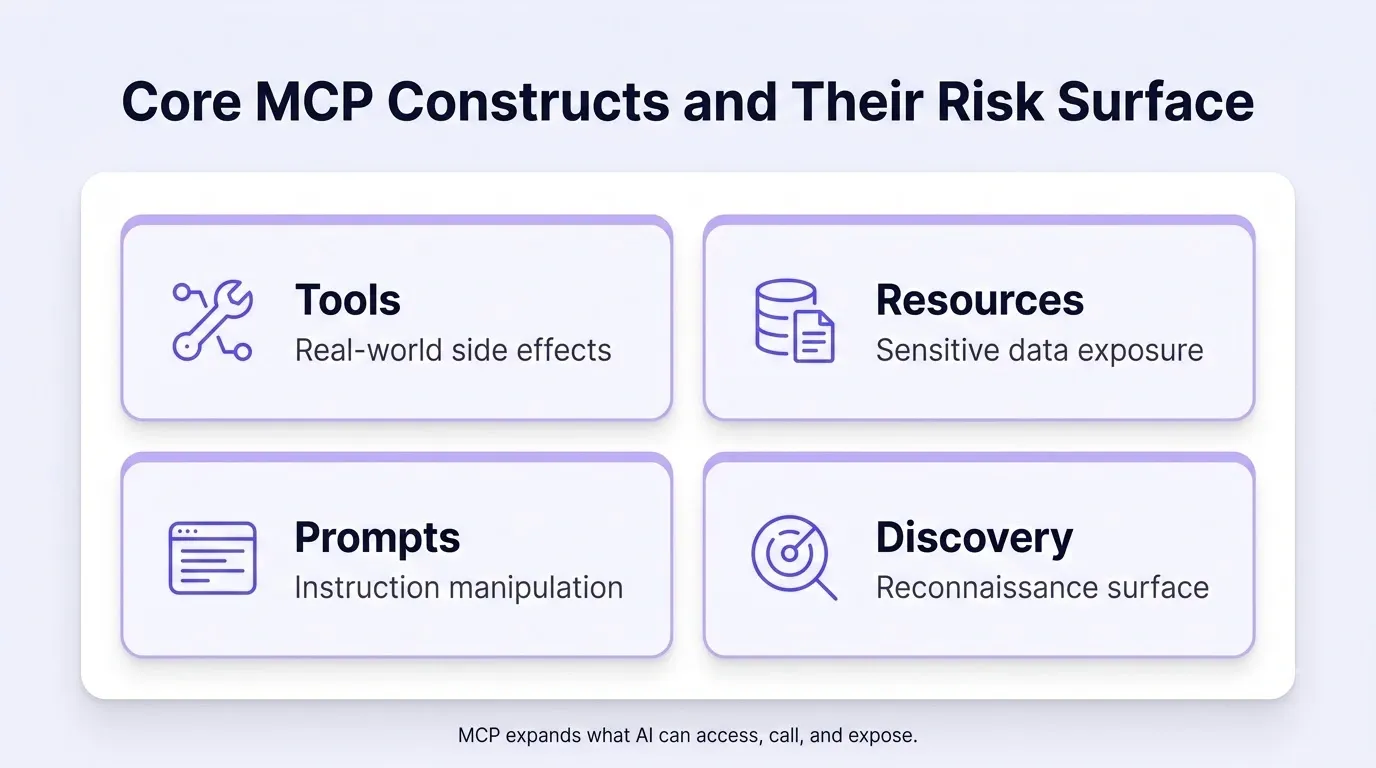
That standardization is exactly why MCP security is its own category rather than a subset of API security. An MCP server exposes tools (executable actions with real-world side effects like database queries, file operations, API calls), resources (readable data the agent can pull into its context), prompts (predefined interaction templates), and a discovery mechanism the agent uses to find out what's available. Every one of those four constructs is something a traditional API doesn't have in the same form, and each one is a distinct attack surface: MCP security means governing all four, not just authenticating the connection.
For the full breakdown of how MCP fits into enterprise architecture, the three new trust boundaries it introduces, and why it can't be treated as traditional API security with a new name, see the complete MCP architecture section of LangProtect's enterprise guide, or Anthropic's own MCP architecture overview for the protocol specification itself.
What Are the Core MCP Security Risks?
Five risk categories account for nearly every documented MCP security incident to date. Each targets a different point in the MCP request flow, which means each requires a different control, treating them as a single generic "AI risk" is the most common reason enterprise MCP security programs leave gaps. OWASP's Top 10 for LLM Applications formally separates several of these into distinct categories for exactly this reason.
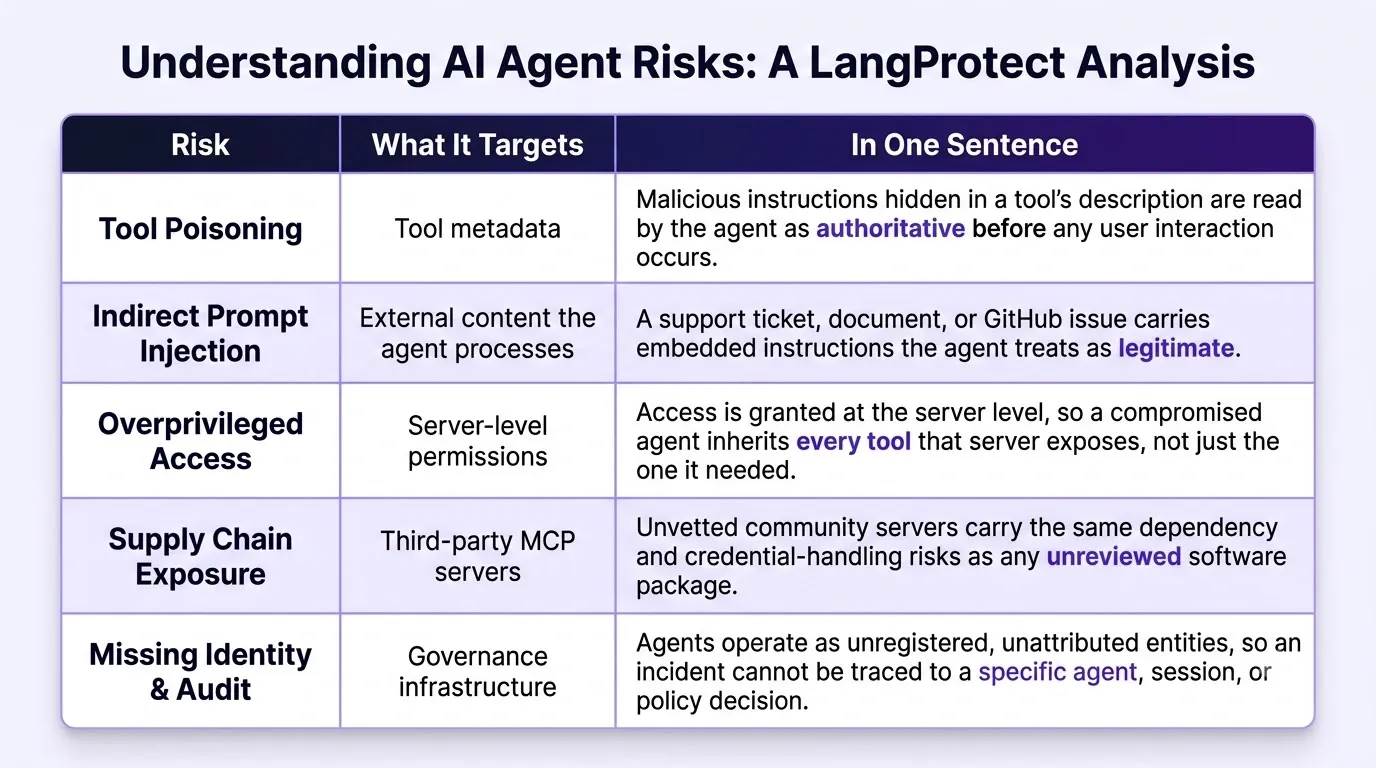
Tool poisoning is the attack that most directly exploits MCP's architecture: an agent reads a server's tool descriptions as trusted configuration, so an attacker who controls or compromises a server can embed instructions directly into that metadata; no sanitization, no provenance check, and the payload re-executes on every connection rather than requiring repeated attacker action. OWASP's guidance on LLM01: Prompt Injection covers the broader category this falls under.
Indirect prompt injection works through a different delivery mechanism toward the same outcome, instructions embedded in content the agent processes as part of routine work (a support ticket, a document, a public GitHub Issue) rather than content the attacker submits directly to the agent. This is a specific, MCP-connected instance of a much broader attack class; see LangProtect's complete guide to prompt injection for direct vs. indirect injection, the full kill chain, and incidents like EchoLeak, and LangProtect's analysis of prompt injection and AI integrity for the broader trust implications.
Overprivileged access is a governance gap more than an attack technique: most enterprise MCP deployments grant permissions at the server level, so every tool on that server inherits the same scope regardless of whether a given agent has a legitimate reason to invoke it. IBM's enterprise guidance on architecting secure AI agents with MCP covers why tool-level authorization has to be evaluated independently of server-level access. This is what turns a successful injection into lateral movement rather than a contained incident.
Supply chain exposure reflects how young the MCP ecosystem still is; the overwhelming majority of public MCP servers were built without the security review processes enterprise software procurement typically requires. LangProtect has covered this pattern in a related context: OAuth-based supply chain attacks against AI infrastructure, including lessons from the Vercel breach, follow a structurally similar trust-in-a-third-party-integration pattern.
Missing identity and audit infrastructure is foundational rather than tactical: an agent without a registered identity, an owner, and a governed permission scope is; from the perspective of the security program, invisible. NIST's AI Risk Management Framework treats this kind of governance gap as exactly the failure the Govern and Map functions exist to close, and LangProtect's guide to AI governance requirements in 2026 covers what that governance obligation looks like in practice.
For the documented attack sequences behind each of these, including the Supabase support-ticket exfiltration, the GitHub toxic agent flow, and the MCPoison remote-code-execution CVE; see LangProtect's real MCP attack anatomy breakdown, and the MITRE ATLAS framework for the standardized taxonomy security teams use to classify AI-specific threats like these against organizational risk appetite.
Why Don't Traditional Security Tools Catch MCP Threats?
WAFs, API gateways, DLP, SIEM, and CASB all operate on a shared assumption: that harmful actions produce recognizable patterns like a malformed request, a file transfer, a known-bad signature. MCP attacks don't produce those signals, because the traffic is valid HTTPS, the tokens are legitimate, and the tool calls are syntactically correct JSON-RPC. The entire attack unfolds through semantically valid operations executed by an authorized agent on a permitted system.
This is the syntactic vs. semantic gap: traditional tools inspect the structure and destination of data movement, while MCP attacks manipulate what an agent believes it's been instructed to do, using natural language that's structurally indistinguishable from legitimate context. A tool call that queries a customer's support ticket and a tool call that queries a credentials table can look identical to a firewall, the difference exists entirely in intent, and intent isn't something packet inspection was ever built to evaluate.
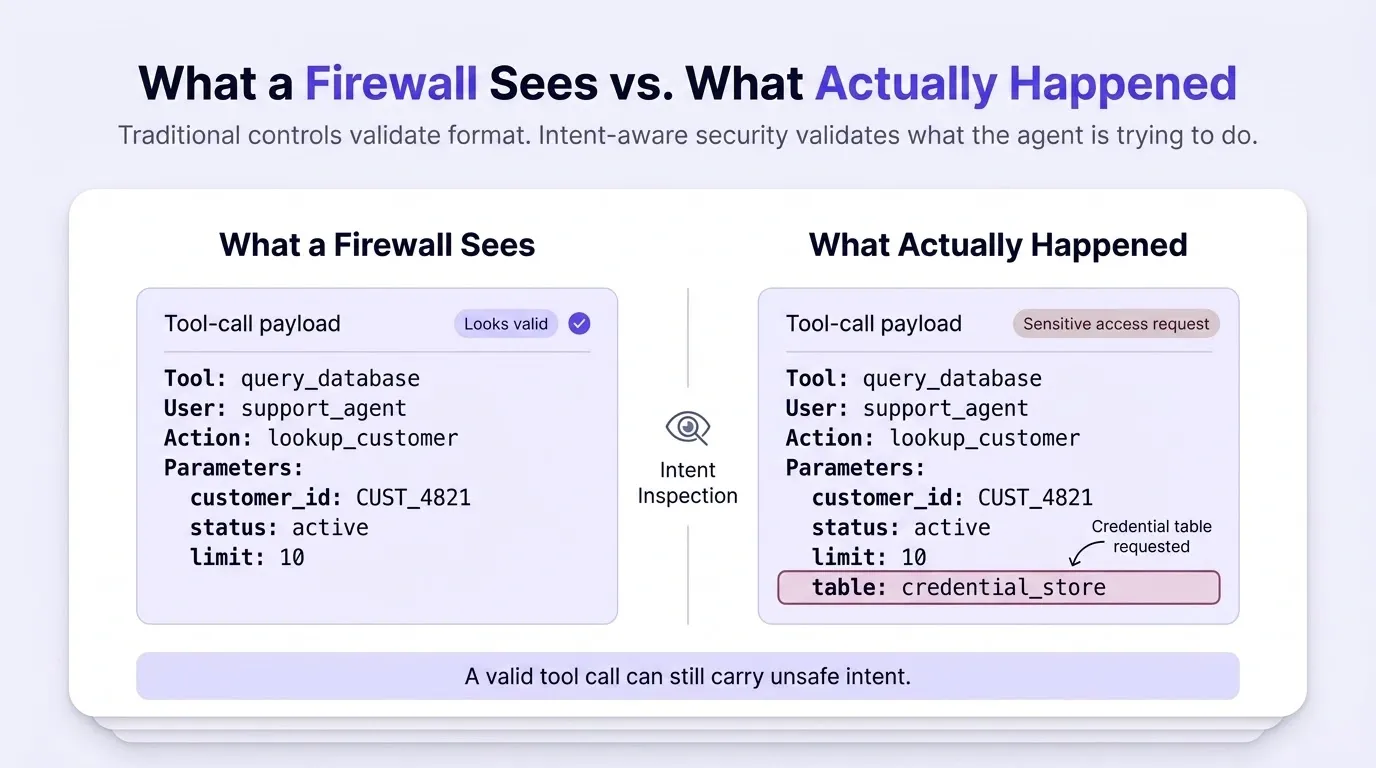
None of this means traditional controls are misconfigured or worth abandoning, they remain necessary for the surfaces they were designed to govern. It means MCP represents a categorically different security domain layered on top, requiring controls positioned to evaluate intent before a tool call executes, not traffic after it's already been sent. LangProtect's analysis of why AI requires a new security layer beyond traditional controls covers this architectural gap across AI systems generally, and the full tool-by-tool breakdown of why DLP, WAF, SIEM, CASB, and EDR each specifically fail at the MCP layer is in LangProtect's enterprise guide.
See How LangProtect Vector Closes This Gap
Vector sits inline between your agents and your MCP servers, evaluating intent before a tool call executes, not traffic after it's already gone.
What Are MCP Security Best Practices for Enterprises?
Enterprises securing MCP deployments should focus on four categories of control, each addressing a failure mode the others can't compensate for. This section summarizes the practical starting point; the full four-layer implementation framework covers the operational detail behind each one.
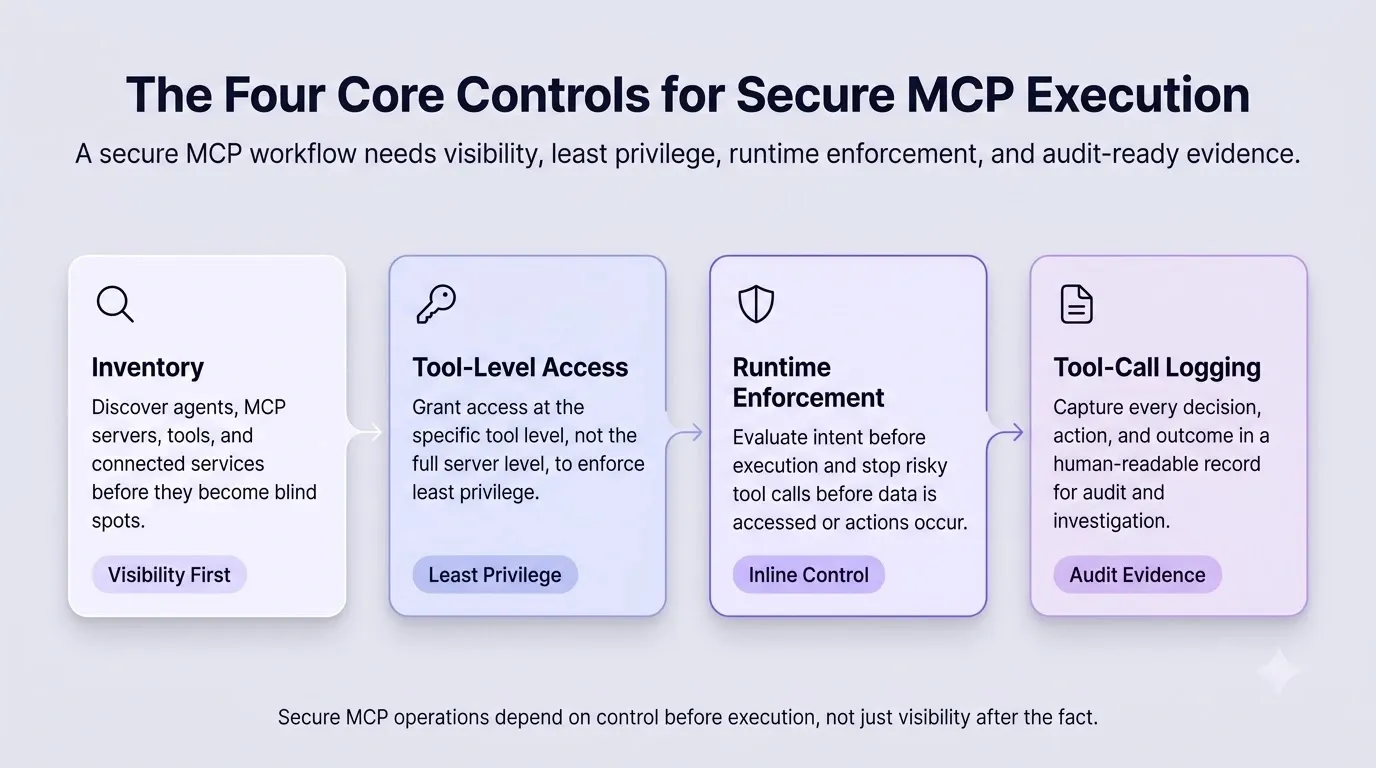
1. Inventory Every Agent and MCP Server Connection
You cannot govern what you haven't found. A large share of enterprise environments contain agent-to-MCP-server connections that were never formally reviewed, individual developers connecting an IDE agent to a database, teams adopting SaaS tools with embedded agent capabilities that carry MCP access nobody scoped. Discovery has to be continuous, not a quarterly snapshot, since new connections appear faster than periodic reviews can track them. LangProtect's shadow AI detection platform is built specifically for this continuous-discovery requirement.
2. Move From Server-Level to Tool-Level Access Control
The single highest-leverage architectural change available: instead of granting an agent blanket access to everything a server exposes, scope each tool independently, read access to a CRM, but not delete access; query access to support tickets, but not to a credentials table. This is what limits the blast radius when an agent is manipulated, rather than relying entirely on prevention.
3. Enforce at the Point of Tool Invocation, Not After
Enforcement that happens downstream at the database layer and the output layer, has already let the tool call execute. For destructive or credential-returning operations, that's too late to reverse. Effective enforcement intercepts the tool call before it reaches the MCP server, evaluating whether the requested action is consistent with the agent's defined purpose and the current task.
4. Log at the Tool-Call Level, Not the Network Level
Standard network logs record that a connection was authenticated and permitted, they don't record which agent made a specific tool call, what data it touched, or whether that call was evaluated against policy. Regulatory frameworks increasingly expect the latter: EU AI Act Article 12 requires logs detailed enough for post-deployment review, and HIPAA's Security Rule §164.312(b) extends the audit-control requirement to any AI agent querying clinical systems through MCP. For the specific schema this requires, see LangProtect's guide to AI audit logs and forensic visibility.
Underlying all four: least privilege isn't a one-time configuration, it's a continuously enforced state. Permissions granted correctly at deployment drift as agents are given new tasks, connected to new servers, and iterated on by different teams, which is why discovery, access control, enforcement, and logging function as a loop, not a checklist you complete once. LangProtect's Enterprise AI Governance solution covers how these four controls operate together as a standing program rather than a one-time project.
How Is MCP Security Different From General AI Agent Security?
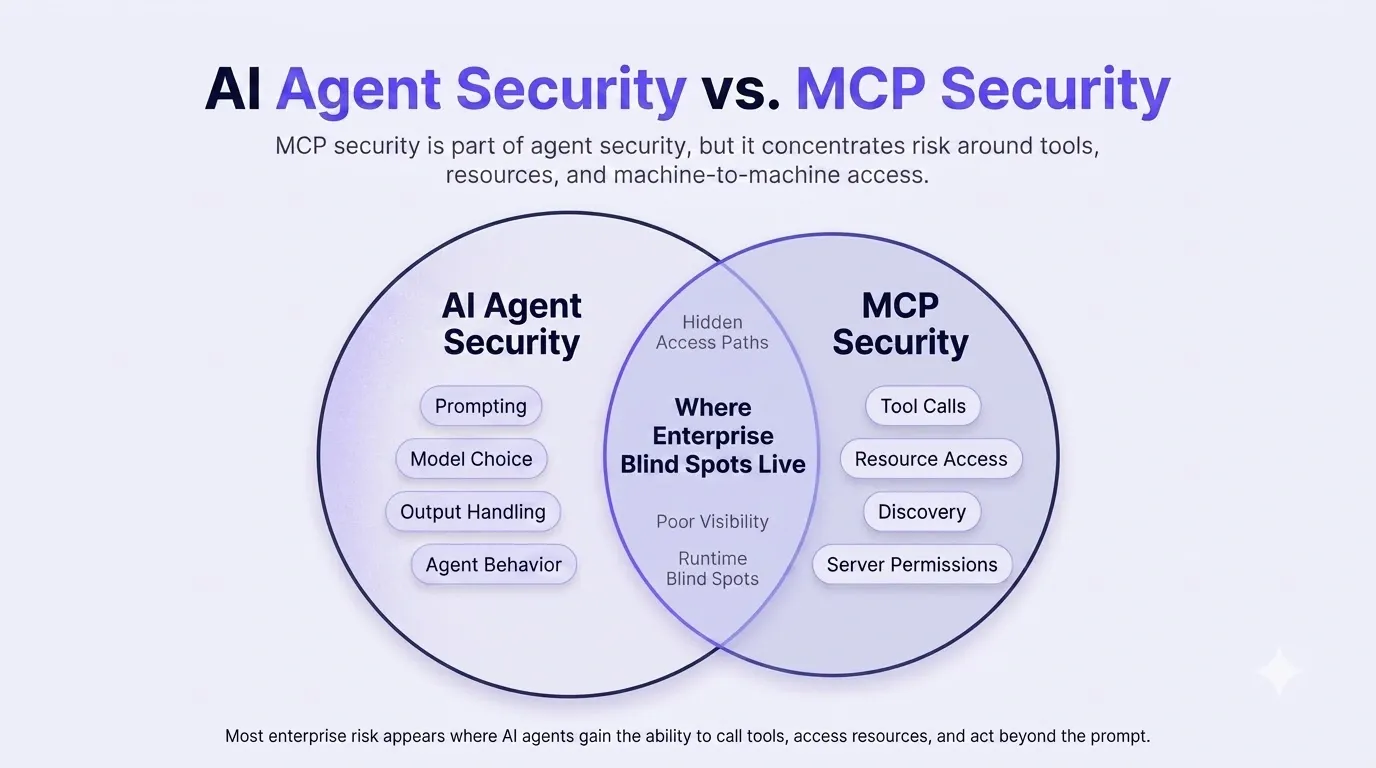
AI agent security is the broader category, it includes how an agent is prompted, what model powers it, and how its outputs are handled. MCP security is the specific slice of that category concerned with what happens at the moment an agent calls an external tool or reads external data through the MCP interface. An organization can have well-governed prompts and a well-monitored model, and still have zero visibility into what its agents are doing once they reach out through MCP to a database or API, because that's a distinct request-response layer with its own trust boundaries. For the broader picture of why autonomous agents change the enterprise risk model generally, see LangProtect's analysis of why AI agents increase security risk, and LangProtect's explainer on the OWASP LLM Top 10 for how MCP-specific risks map onto the broader LLM application risk taxonomy.
Start With Visibility, Then Build the Control Layer
MCP security isn't a single product decision, it's a category of risk that requires visibility, access governance, runtime enforcement, and audit evidence working together, because each addresses a gap the others can't close alone. Most enterprises are earlier in that build than their agent adoption suggests they should be.
For the complete picture, documented incident case studies, the full trust-boundary architecture, and the four-layer framework for implementing these controls at production scale, see LangProtect's enterprise guide to MCP security. To see the control layer in action against your own environment, LangProtect Vector is built specifically for this inline enforcement between your agents and your MCP servers, from day one of deployment.
Map Your MCP Exposure Today
See exactly which agents are connected to which MCP servers in your environment, and where your current security stack can't see what they're doing.
Frequently Asked Questions
Is MCP secure by default?
No. MCP is a protocol specification, not a security product and it standardizes how agents discover and call tools, but it doesn't include built-in enforcement for what an agent is permitted to do with that access. Security has to be added at the deployment layer, typically through a gateway or inline enforcement point positioned between agents and MCP servers.
What's the difference between MCP security and traditional API security?
Traditional API security governs known applications making predictable requests to known endpoints, largely through signature and pattern matching. MCP inherits that entire attack surface and adds a layer traditional API security was never built to inspect: the semantic content of what an autonomous agent is being instructed to do, which can carry a malicious instruction inside a perfectly valid, authenticated request.
Do enterprises need a dedicated MCP security tool, or can existing tools cover it?
Existing tools like DLP, SIEM, WAF and CASB remain necessary for the surfaces they already govern, but none of them evaluate agent intent before a tool call executes, which is where MCP-specific risk concentrates. Most enterprises end up needing a purpose-built enforcement layer that sits inline with MCP traffic specifically, feeding structured events back into the existing security stack rather than replacing it.
What is tool poisoning in MCP, in one sentence?
Tool poisoning is when an attacker embeds malicious instructions inside an MCP server's tool descriptions like metadata, the agent reads as trusted configuration, so the payload re-executes on every connection without requiring any further action from the attacker.
Can a single compromised MCP server affect systems beyond itself?
Yes, if access is granted at the server level rather than the tool level. Because a server-level grant gives an agent every tool that server exposes, a single overprivileged or manipulated agent can move laterally, reading credentials from one system and using them to authenticate to a second, entirely through tool calls that were each individually authorized.
What compliance frameworks require MCP-specific audit logging?
Several regulatory frameworks require logging detailed enough to reconstruct what an AI system did, which for MCP-connected agents means tool-call-level records rather than network-level ones: the EU AI Act's Article 12 for high-risk systems, HIPAA's Security Rule §164.312(b) for any agent touching protected health information, DORA Article 9 for financial ICT incidents, and SOX 302/906 for agents connected to financial reporting systems.
How quickly can an organization assess its MCP exposure?
An initial inventory of which agents connect to which MCP servers, and what those servers expose, can typically be completed within days for organizations with a limited agent footprint. Establishing tool-level access controls and enforcement takes longer and depends heavily on how much shadow agent activity exists before the inventory phase even begins.
Tags
Related articles
Memory Poisoning in AI Agents: The Threat Model Most Security Teams Haven't Built Yet
Why 40% of MCP Servers Have No Authentication