

OAuth Supply Chain Attacks on AI: Lessons from the Vercel Breach

In February 2026, a developer at Context.ai (a small AI analytics startup) downloaded a Roblox auto-farm script onto their work laptop. The script was carrying Lumma Stealer, a commodity infostealer that sells for a few hundred dollars on underground marketplaces.
That single download set off a chain of events that would take ten weeks to complete and end with Vercel, the platform hosting production infrastructure for OpenAI, Stripe, Pinterest, Mistral, and tens of thousands of development teams worldwide , publishing a breach disclosure on April 19, 2026. A threat actor posting as ShinyHunters listed stolen source code, NPM tokens, GitHub tokens, and 580 employee records on BreachForums for $2 million.
No zero-day. No malware on Vercel's systems. No phishing email targeting a Vercel employee directly.
The entry point was a Google Workspace OAuth token, one granted by a Vercel employee who had connected their corporate account to Context.ai's AI Office Suite and clicked "Allow All."
Vercel CEO Guillermo Rauch assessed the attacker as "highly sophisticated and, I strongly suspect, significantly accelerated by AI."
Their incident responders, working with Google Mandiant and law enforcement, traced the attacker through three trust boundaries, from a compromised AI vendor, to a Google Workspace account, to Vercel's internal environment, using nothing but valid, authenticated tokens at every step.

Here is what makes this incident matter beyond Vercel specifically
According to Grip Security's analysis of 23,000 SaaS environments published in March 2026, AI-related supply chain attacks increased by 490% year-over-year.
The conditions that made Vercel vulnerable, an employee connecting a third-party AI tool with broad OAuth permissions, no behavioral monitoring of what that tool did with access, and environment variables classified as "non-sensitive" that contained live credentials for downstream systems, exist in almost every enterprise running AI tools today.
We have spent the past two weeks analyzing the full attack chain, the forensic timeline, and the structural gaps that allowed this breach to stay undetected for at least nine days after credentials started appearing in the wild.
This post breaks down exactly how it happened, why your current security stack would not have caught it, and what a CISO-level response framework looks like in practice.
Is your AI stack connected to third-party tools via OAuth?
LangProtect's AI Interaction Scanner maps every active AI integration and its permission scope across your environment in minutes, before an attacker maps it for you.
What exactly Happened in the Vercel OAuth Breach?
The Vercel breach originated from a compromised Context.ai OAuth token that gave attackers authenticated access to a Vercel employee's Google Workspace account, and from there, a clear path into Vercel's internal environment and customer credential stores, with no alarms firing at any stage of the pivot.
The attack unfolded across ten weeks. Here is the chain, step by step.
Step 1 — February 2026: The infostealer lands. A Context.ai employee downloads a Roblox auto-farm script on a work laptop. The script is carrying Lumma Stealer, a commodity credential harvester. It exfiltrates the employee's browser-stored credentials silently, including authentication material for Context.ai's own internal systems.
Step 2 — March 2026: Context.ai is breached but the scope is underestimated. Context.ai detects and blocks unauthorized access to its AWS environment. It notifies one customer and publishes a limited disclosure.
What it does not yet know: the attacker has also harvested OAuth tokens for consumer users of its AI Office Suite product. Google removed Context.ai's Chrome extension from the Chrome Web Store on March 27, 2026.
The extension embedded a second OAuth grant, separate from the Office Suite, enabling read access to users' Google Drive files.
Step 3 — Early April 2026: The OAuth token crosses the trust boundary. The attacker uses a compromised Context.ai OAuth token tied to a Vercel employee who had signed up for the AI Office Suite using their Vercel enterprise Google Workspace account.
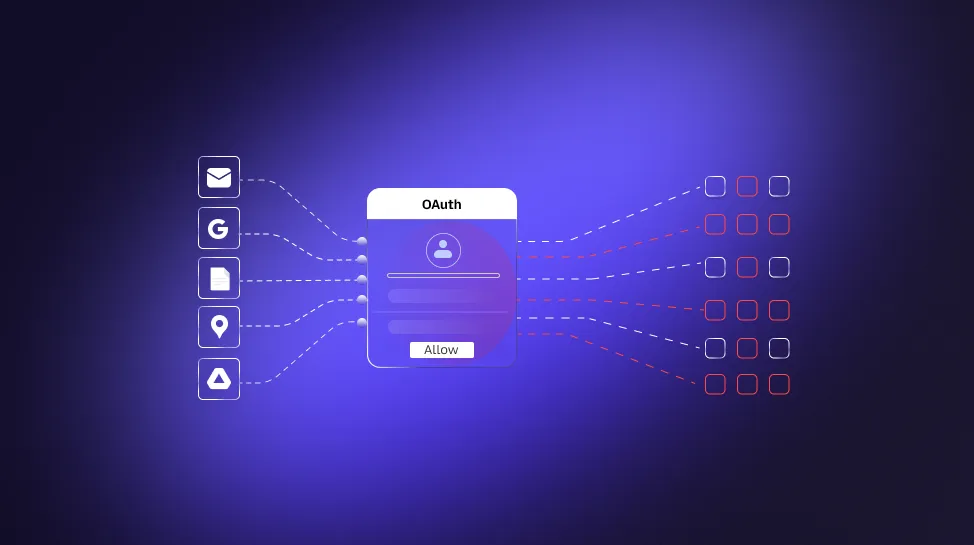
Critically, that employee had clicked "Allow All" during the OAuth consent flow,granting Context.ai unrestricted read access across their Google Workspace environment. Two OAuth client IDs were involved:
Office Suite:
110671459871-30f1spbu0hptbs60cb4vsmv79i7bbvqj.apps.googleusercontent.com
Chrome Extension:
110671459871-f3cq3okebd3jcg1lllmroqejdbka8cqq.apps.googleusercontent.com
Step 4 — The Google Workspace account is taken over. With a valid OAuth token in hand, the attacker accesses the employee's Google Workspace account. No password required. No MFA challenge triggered. The token is legitimate, Google's authentication layer sees a recognized client presenting a valid grant.
Step 5 — Pivot into Vercel. Google Workspace access gives the attacker a foothold in the employee's Vercel account via the trusted SSO relationship between Vercel's enterprise tier and Google Workspace. From there, they move laterally through Vercel's internal environment.
Step 6 — Environment variable enumeration and decryption. The attacker systematically enumerates and decrypts customer environment variables, specifically those Vercel classifies as "non-sensitive," meaning they decrypt to plaintext through the dashboard and API without requiring customer-managed keys.
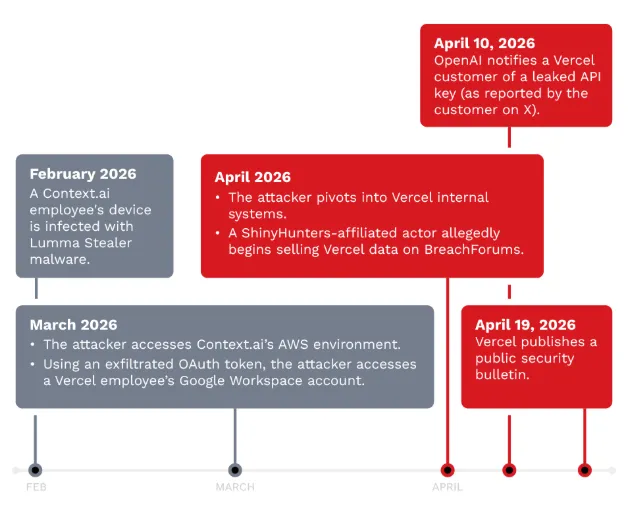
Three trust boundaries crossed. Zero Vercel credentials directly stolen. Zero malware deployed on Vercel infrastructure.
Vercel's own incident response team, working with Google Mandiant, assessed the attacker as operating with a level of familiarity with Vercel's internal product API surface that points to deliberate pre-breach reconnaissance, not opportunistic scanning. They knew which endpoints enumerate environment variables. They knew which ones decrypt them. The breach was targeted, and the AI tool was the chosen entry vector.
What "Non-Sensitive" Actually Means for Your Stack
This is the expert insight that every other post-breach analysis has missed.
Vercel classifies environment variables as "non-sensitive" when they decrypt to plaintext without customer-managed encryption, a platform-level designation that describes how the variable is stored, not what the variable contains. In practice, environment variables labeled non-sensitive across Vercel's customer base routinely hold:
- Third-party API keys for payment processors, communication platforms, and data services
- Database connection strings with embedded credentials
- Internal service authentication tokens
- AI model API keys; OpenAI, Anthropic, Cohere, Mistral
The 9-day gap in the public record makes the downstream risk concrete.
On April 10, 2026, nine days before Vercel's public disclosure , a customer named Andrey Zagoruiko received a leaked-key notification from OpenAI for an API key that, according to the customer, had never existed outside Vercel.
OpenAI's leaked-credential detection triggers when a key appears somewhere it should not, a public repository, a paste site, or a threat actor's scanning infrastructure.
That means at least one exposed environment variable was already live in the wild before Vercel's own security team had finished scoping the incident.
The impact Radius: Bigger Than the Headline
Vercel publicly confirmed a "limited subset" of affected customers, a description that is technically accurate but strategically incomplete for understanding your own exposure.
Vercel's infrastructure hosts production deployments for OpenAI, Stripe, Pinterest, Mistral, McDonald's, Under Armour, and Cursor, among an estimated 4 million projects across its Hobby, Pro, and Enterprise tiers.
Third-party estimates from Halborn and Varonis place the directly affected customer pool in the low thousands, but that figure captures only the accounts Vercel's investigation positively identified.
The expanded investigation, disclosed on April 23, surfaced a second cluster of compromised accounts showing signs of breach that appeared separate from the April 2026 incident entirely, suggesting Vercel's customer base had been under pressure from at least two distinct threat actors simultaneously.
Vercel worked with GitHub, Microsoft, npm, and Socket to confirm that no npm packages were compromised. The fact that confirming npm integrity required coordination across four major platforms tells you what Vercel's incident response team feared the blast radius could reach.
The data posted to BreachForums by the ShinyHunters persona ,$2 million for source code, NPM tokens, GitHub tokens, and 580 employee records, represents the attacker's claimed scope.
Vercel has not confirmed those specifics.
What is confirmed: environment variables decrypted, internal systems accessed, customer credentials exposed.
That is enough to treat any secret stored on Vercel before April 19, 2026 as potentially compromised, and to ask the harder question of how many similar conditions exist across the rest of your AI SaaS stack right now.
Why Are AI Platforms More Vulnerable to OAuth Supply Chain Attacks?
AI platforms carry significantly more OAuth risk than traditional SaaS applications because they connect more third-party tools, request broader permissions by design, generate more persistent long-lived tokens, and operate in an environment where 86.8% of security teams admit they cannot see what data AI tools exchange with other systems after access is granted
— according to Vorlon's 2026 CISO Report, which surveyed 500 U.S. security leaders.
The Vercel breach is not an isolated incident. It is the clearest public demonstration of a structural exposure that exists across nearly every enterprise running AI tools today.
What Is the OAuth Supply Chain Attack Surface in an Enterprise AI Environment?
Definition: An OAuth supply chain attack surface is the total set of third-party applications that have been granted OAuth access to your enterprise identity environment, and by extension, to any internal system those applications can reach using that access.
In 2019, the average enterprise connected to roughly 80 SaaS applications. By 2026, that number has grown to an average of 4,406 SaaS-to-SaaS integrations per organization, according to compiled industry data from Okta, Zylo, and AppOmni. AI tools are the fastest-growing category driving that expansion, entering organizations the same way SaaS always has, through browser-based apps, OAuth flows, and user-driven adoption that outpaces centralized IT review.
What this means in practice: every time an employee connects an AI tool to their Google Workspace, Microsoft 365, or Slack account, they add a new node to your OAuth trust graph.
Each node is a potential entry point into your environment if the tool is compromised upstream. And 31% of SaaS breaches in 2025 exploited exactly these SaaS-to-SaaS connections directly, not traditional perimeter vulnerabilities.
Why Do AI Tools Require Broader OAuth Permissions Than Standard SaaS?
AI tools request broader OAuth scopes than traditional SaaS for a fundamental architectural reason: they need to observe data to be useful.
A project management tool needs access to your tasks. A calendar tool needs access to your schedule. An AI analytics tool, like Context.ai, needs access to your API call patterns, interaction logs, file structures, and communication metadata to generate the insights it is selling. That design requirement is entirely legitimate. The security problem is that "broad read access across your workspace" in an AI observability context means access to the same data streams your most sensitive systems authenticate against.
The Vercel employee who connected to Context.ai did not make an unusual decision. They made a standard one: during the OAuth consent flow, they clicked "Allow All." That choice granted Context.ai unrestricted read access across their entire Google Workspace, every file, every drive, every application that authenticated through that account.
Context.ai's own bulletin confirmed this framing. Most enterprise AI tools present OAuth consent screens that default to maximum scope, because restricting scope creates friction during onboarding. Your security team is not present at the moment of that click.
What Is the NHI Visibility Gap and Why Does It Create Undetected Risk?
A Non-Human Identity (NHI) is any system, service, AI agent, or automated process granted access to resources through a token or API key rather than a human credential. NHIs do not log in, they present tokens. And most enterprise identity systems were not built to monitor what NHIs do with access after the token is issued.
This is the NHI visibility gap, and it is the precise architectural reason the Vercel breach produced no alerts.
When a Vercel employee connected Context.ai via Google Workspace OAuth, your identity management system recorded a grant that looked like this:
Client ID:      110671459871-30f1spbu0hptbs60cb4vsmv79i7bbvqj.apps.googleusercontent.com
App name:       Context.ai Office Suite
Granted scopes: gmail.readonly / drive.readonly / userinfo.email
Token type:     Bearer, long-lived refresh token
Grant date:     [employee onboarding timestamp]
Last used:      [timestamp of last legitimate API call]
What your identity system did not record, and cannot record under the standard OAuth 2.0 specification (RFC 6749):
What the app read between sessions
- Whether the app's upstream infrastructure was compromised
- Whether the token is being used from Context.ai's servers or an attacker's
- What data was logged, transmitted, or stored by the AI tool
- Whether the behavioral pattern of API calls has changed
The OAuth 2.0 specification governs the grant, the moment access is authorized. Token introspection under RFC 7662 can tell you whether a specific token is currently valid. What neither standard addresses is continuous behavioral monitoring of what an authorized client does with access over time.
Most enterprise SaaS platforms do not implement runtime introspection on third-party AI tool integrations.** The gap between "token issued" and "token revoked"** is a behavioral blind spot, and in the Vercel case, that blind spot lasted weeks.
How Does AI Tool Proliferation Create OAuth Credential Sprawl?
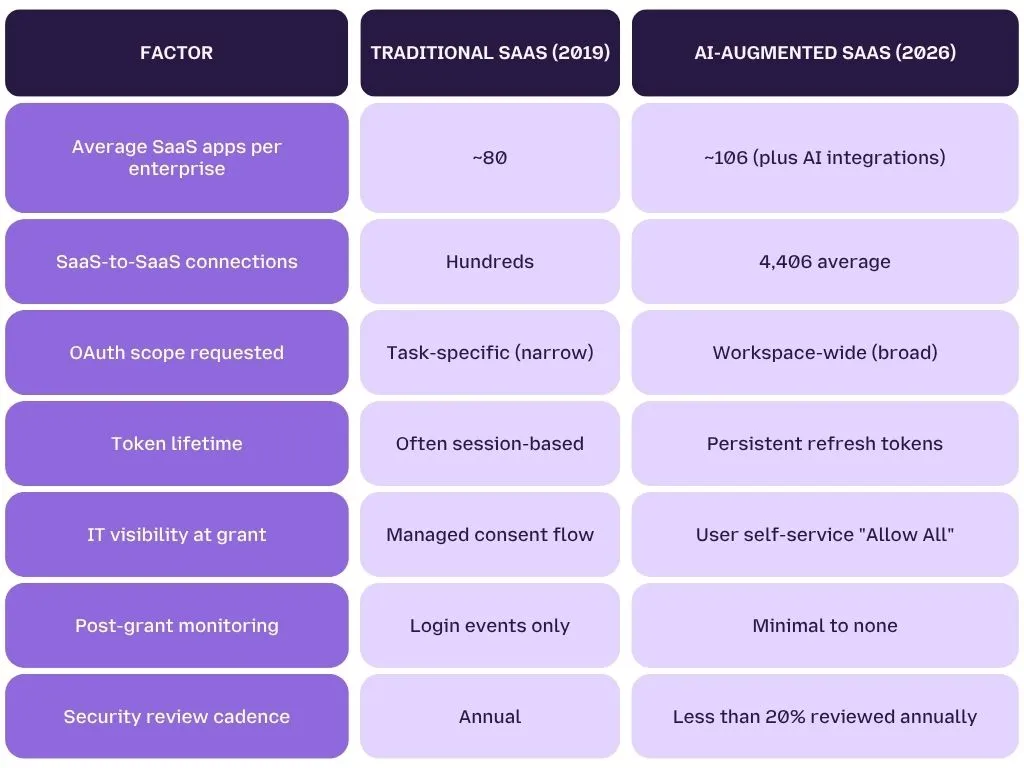
The data makes the structural problem clear. AI tools did not create OAuth credential sprawl, they dramatically accelerated it.
According to Vorlon's 2026 CISO Report, 89.2% of the 500 CISOs surveyed claim strong or comprehensive OAuth token governance. Yet 27.4% of those same organizations were still breached through compromised OAuth tokens or API keys in 2025. And 30% experienced a supply chain attack involving a SaaS vendor or integration partner that same year.
The confidence gap is the real finding. Security teams believe they are governing OAuth. The breach data says otherwise. The disconnect is not awareness, it is architecture. Existing tools monitor user access at the perimeter. The threat has moved to the runtime layer: where AI tools move data between systems, where tokens grant persistent cross-platform access, and where a single compromised integration cascades silently across a supply chain.
One in three enterprises experienced a security incident involving AI agents in 2025, the first year of serious enterprise AI deployment at scale. That number will not decrease as AI tool adoption accelerates in 2026.
Why Is the "Allow All" Permission Pattern Specifically Dangerous for AI Tools?
The "Allow All" consent pattern is the single most common OAuth misconfiguration in enterprise AI deployments, and the one that made the Vercel breach possible.
When a Vercel employee granted Context.ai "Allow All" permissions on their enterprise Google Workspace account, they effectively created an unrestricted delegation of their entire identity surface to a third-party AI vendor. That delegation is invisible to most security tools because it registers as a single OAuth grant, not as a new user with elevated access.
From the perspective of your IAM, one event occurred: an employee authorized an application. From the perspective of your attack surface, everything that an employee could access, every Google Drive file, every email thread, every connected application, became accessible to a third party whose own security posture you had not evaluated, and whose upstream dependencies you had no visibility into.
CrowdStrike CTO Elia Zaitsev made the principle explicit at RSAC 2026:
"Don't give an agent access to everything just because you're lazy. Give it access to only what it needs to get the job done."
The same principle applies to every AI tool in your stack, not just agents.
How Does the AI Tool OAuth Risk Compare to Previous Supply Chain Attacks?
The Vercel breach follows a pattern established across multiple high-profile 2025 incidents , each one using OAuth tokens rather than exploited vulnerabilities as the entry vector.
In August 2025, threat actor UNC6395 used stolen OAuth tokens from Drift's Salesforce integration to access customer environments across more than 700 organizations. The attacker needed no exploit.
They used legitimate third-party access that looked routine in every monitoring tool the affected organizations had deployed. The attack chain was nearly identical to Vercel:
Compromised integration → stolen token → authenticated access → lateral movement into customer data.
The ShinyHunters Salesforce campaign and the Gainsight supply chain compromise followed the same pattern. In each case, a limited initial compromise at a third-party vendor enabled broad downstream access across that vendor's customer base. The AI tool is new. The OAuth exploitation pattern is not.
What is new in 2026 is scale. AI tools connect to more systems, with broader permissions, on shorter review cycles, at a speed that outpaces every governance framework most enterprises have in place.
According to Grip Security's analysis of 23,000 SaaS environments
AI-related supply chain attacks increased 490% year-over-year in 2025. The attack surface grew faster than the security tooling built to monitor it.
The enterprises that treat their AI tool OAuth grants the same way they treat admin credentials, as privileged access requiring continuous monitoring, not a one-time approval, are the ones that will avoid being the next Vercel.
For a deeper look at how this risk propagates through AI-specific environments and what it means for your non-human identity governance model, see our analysis of why AI agents increase security risk and how to govern them.
See What Happens After the Token is Granted
LangProtect monitors AI tool behavior post-authorization, the exact layer that was missing in the Vercel breach.
Why Traditional Controls Missed This
The reason none of those six pivot steps triggered a single alert comes down to one architectural reality: your SIEM authenticates at the door. Your DLP watches for files leaving through known channels. Your IAM records the grant and then stops watching. None of them were built to monitor what an authorized AI tool does with access between the moment the token is issued and the moment it is revoked.
That is not a configuration problem. It is a design boundary, and we have covered exactly where that boundary breaks down, what it looks like in a live SIEM log, and why DLP is structurally blind to this attack class in our detailed breakdown of why interaction-layer controls catch what DLP misses.
What matters here is what you do after you understand the gap. That starts with three actions your team can execute right no, before the next AI tool in your stack becomes someone else's entry point.
What Should CISOs Do After the Vercel Breach?
A CISO-level response to OAuth supply chain risk on AI platforms requires three things your current stack almost certainly cannot do right now: a complete inventory of AI tool OAuth grants across your identity environment, runtime behavioral monitoring of what authorized tools do with access after the grant, and a vendor risk process that treats every AI SaaS integration as a third-party security dependency, not a productivity tool your team approved with a consent click.
According to the 2026 CISO AI Risk Report, a structured survey of 235 CISOs and senior security leaders across large enterprises
92% of organizations lack full visibility into their AI identities. 71% say AI systems have access to core business platforms including ERP, CRM, and financial systems. Only 16% govern that access effectively. And 95% doubt they could detect AI identity misuse if it happened.
You cannot govern what you cannot see. The three steps below fix that, in order of execution priority.
Step 1: How Do You Build a Complete AI OAuth Inventory?
The first action is the one most teams have never completed: pull every active OAuth grant across your entire identity environment and filter specifically for AI tool connections.
Where to run this audit:
- Google Workspace Admin Console: Security → API Controls → Manage Third-Party App Access. Filter for applications with broad scopes, drive.readonly, gmail.readonly, admin; granted by enterprise accounts.
- Microsoft Entra ID: Enterprise Applications → All Applications → filter by "User consent" grants. Review any AI tool with Graph API permissions or Mail.Read scopes.
- Okta: Applications → filter by OAuth 2.0 grants. Cross-reference against your approved AI tool registry.
What to record for each AI tool connection:
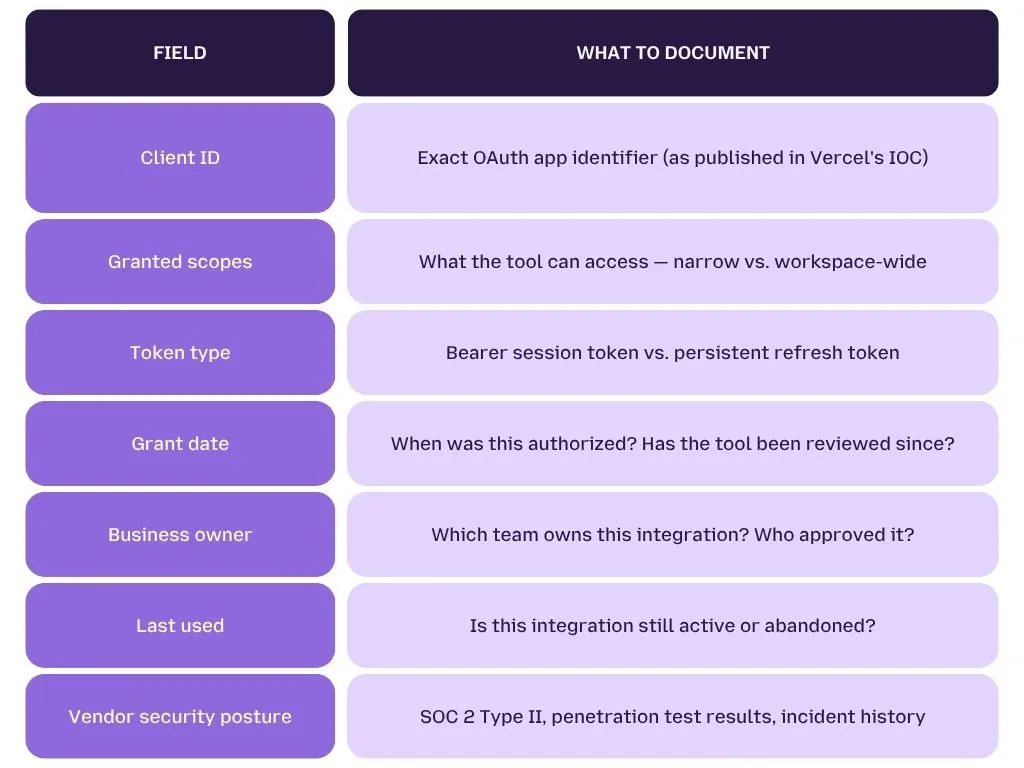
Flag every integration that holds a persistent refresh token with access to environment variables, secrets managers, file systems, or email. For most teams, this audit surfaces 30 to 50 percent more active AI integrations than anyone expected, including tools connected by employees who have since left the organization.
For a deeper look at how credential sprawl accumulates across AI environments in regulated industries, see our analysis of AI risks in fintech and how to govern them.
Step 2: How Do You Monitor AI Tool Behavior After Authorization?
Completing the inventory tells you what access exists. Step 2 answers the question your SIEM cannot: is that access being used the way it should be?
The behavioral monitoring gap is measurable and damaging. Vorlon's 2026 CISO Report found that 86.8% of security leaders say seeing what data AI tools exchange with other systems is a direct limitation of their current tooling.
86% do not enforce access policies for AI identities at all. The Vercel breach was undetected for at least nine days precisely because no tool in Vercel's stack was monitoring what Context.ai was doing with its tokens between legitimate use sessions.
What behavioral monitoring for AI tools looks like in practice:
Define a baseline for each AI integration. For an analytics tool like Context.ai, that baseline includes: which API endpoints it calls, at what volume, at what times, from which IP ranges, and against which resource types. Any deviation from that baseline is a detection signal, not proof of compromise, but grounds for investigation.
Specific anomalies to monitor across AI integrations:
Spike in read events above baseline volume         → Investigate
Access to resource types not seen in prior sessions → Investigate
API calls to endpoints outside normal operational scope → Investigate
Calls originating from unfamiliar IP ranges     → Isolate and review
Token used outside normal operating hours          → Alert immediately
Sudden enumeration of environment variable endpoints → Treat as active incident
The NCCoE's February 2026 concept paper on AI agent identity and authorization
Applying OAuth 2.0 extensions, NIST SP 800-207 Zero Trust Architecture, and SP 800-63-4 Digital Identity Guidelines to AI agent scenarios, explicitly identifies behavioral monitoring as a foundational control that current standards have not yet addressed.
That guidance gap is real. It means enterprises cannot wait for a completed framework. They need to build this monitoring layer now, with whatever tooling they can extend to cover AI interactions.
This is the control layer that was absent in the Vercel breach and the layer LangProtect operates at, monitoring AI tool interactions and behavioral patterns post-authorization, not just logging the access grant event.
Step 3: How Do You Apply Least-Privilege OAuth Scopes to AI Tool Integrations?
The "Allow All" permission pattern that made the Vercel breach possible is not unique to Context.ai. It is the default in most AI tool onboarding flows, because broad scope means fewer setup steps for the end user.
Your job is to push back at the grant level before a breach makes the decision for you.
Least-privilege OAuth principles applied to AI tools:
-
Scope minimization at authorization.
Every AI tool should request only the scopes its core function requires, not the maximum scopes its OAuth flow will accept. Context.ai needed to observe API call patterns. It did not need drive.readonly access to every file in a user's Google Drive.
If a vendor's OAuth flow requests more than the documented task requires, treat that as a vendor risk flag requiring review before approval.
-
Short-lived tokens for sensitive integrations.
For any AI tool with access to environment variables, secrets, financial data, or administrative APIs, enforce short-lived token lifetimes, 24-hour TTL where technically feasible. Following NIST SP 800-63B guidance on token lifetime minimization significantly reduces the window of exposure if an upstream vendor is compromised.
Vercel's post-breach product updates now default to treating environment variables as sensitive, requiring explicit declassification. Apply the same logic to your OAuth grants, treat refresh tokens as privileged credentials requiring active lifecycle management.
-
Admin consent enforcement for broad scopes.
Disable user self-service consent for OAuth applications requesting workspace-wide scopes. In Google Workspace, this is configurable under Security → API Controls → Google services → restrict which apps users can grant access to.
In Microsoft Entra ID, set the user consent policy to require admin approval for apps requesting permissions beyond a defined baseline. One employee's "Allow All" click should not be able to expand your entire organization's attack surface.
-
Mandatory vendor security review for AI tool integrations.
Every AI tool requesting OAuth access to enterprise systems should clear a minimum vendor security bar before the grant is approved:
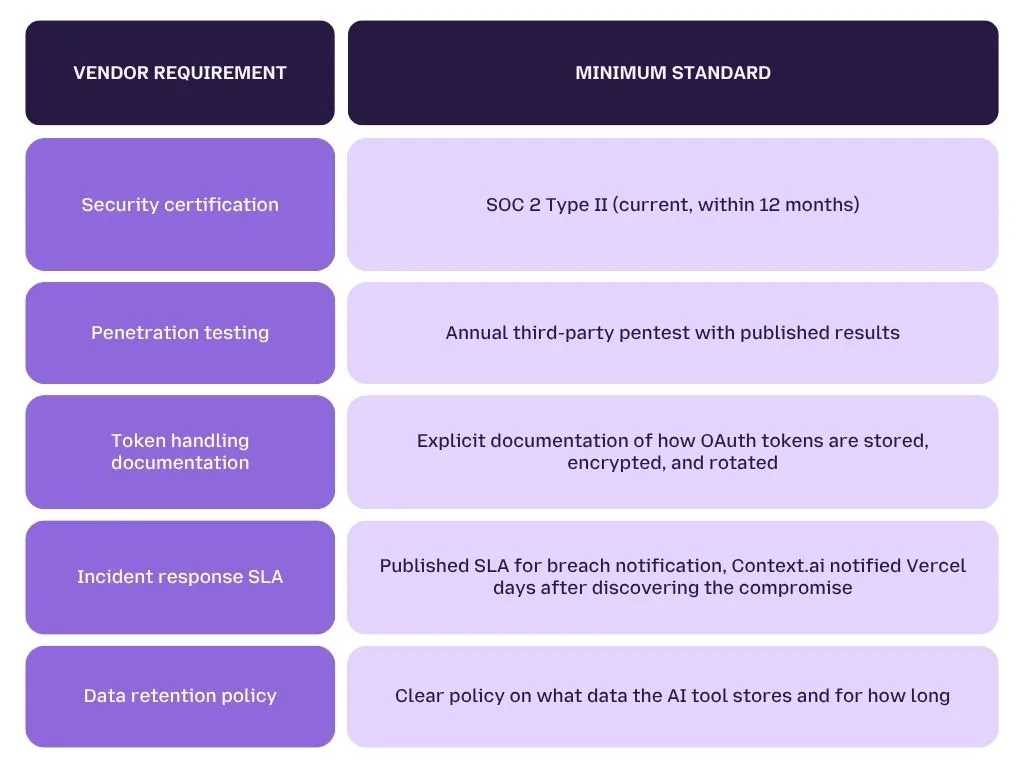
Three out of four CISOs have already discovered unsanctioned AI tools running in their environments, according to the 2026 CISO AI Risk Report. Each of those tools likely holds an OAuth grant that bypassed every control in this list. Vendor review for AI tools is not overhead, it is the control that would have required Context.ai to demonstrate how it protects OAuth tokens before a Vercel employee granted it workspace-wide access.
For the governance architecture that governs AI agent identities beyond the OAuth grant level, covering tool call monitoring, non-human identity lifecycle management, and runtime enforcement, see our detailed breakdown of why AI agents need non-human identity governance, not just access controls.
CISO Response Priority Matrix
| Action | Time to Execute | Risk Reduced | Difficulty |
|---|---|---|---|
| Run OAuth inventory across identity providers | 1–2 days | Critical, baseline visibility | Low |
| Revoke orphaned tokens from departed employees | Same day | High, eliminates dead credentials | Low |
| Enforce admin consent for broad OAuth scopes | 1 week | High, prevents future "Allow All" grants | Medium |
| Define behavioral baselines for active AI tools | 2–4 weeks | Critical, enables anomaly detection | Medium |
| Build AI vendor security review process | 30 days | High, closes supply chain entry vector | Medium |
| Implement short-lived token policy for sensitive integrations | 30–60 days | Medium, reduces exposure window | High |
Only 51.2% of organizations have an automated incident response playbook for an active SaaS exfiltration event, according to Vorlon's 2026 CISO Report. If an AI tool in your stack were compromised today, how long would it take your team to identify which tokens are exposed, which downstream systems are at risk, and what credentials need rotating? That time gap is your actual blast radius. The inventory and monitoring steps above close it before a threat actor maps it for you.
Conclusion: What the Vercel Breach Actually Tells CISOs
The Vercel breach was not a failure of Vercel's engineering. It was a failure of the security model most enterprises still rely on for every AI tool integration in their stack, one that authenticates at entry, approves with a consent click, and then trusts indefinitely.
The attacker did not exploit a vulnerability in Vercel's code. They exploited the gap between when access was granted and the last time anyone checked what that access was being used for. That gap, between token issuance and token revocation, is a behavioral blind spot that exists in almost every enterprise running AI tools today.
The incident fits a broader 2026 convergence pattern in which attackers consistently target developer-stored credentials across OAuth integrations and deployment platforms. Context.ai was the entry point this time. Next time it will be a different AI observability tool, a different AI code reviewer, a different AI productivity suite, each one connected to your identity environment with a persistent refresh token that your security stack treats as trusted until told otherwise.
The supply chain vulnerability rankings confirm what the Vercel incident made visible: inheritance risk, the inability to assure the integrity of third-party services, is now the top supply chain concern for CISOs globally, according to the World Economic Forum's Global Cybersecurity Outlook 2026. AI tools have made that risk systemic. They are not the exception to your vendor risk model. They are the fastest-growing category within it.
What needs to change is not which AI tools you use. It is the assumption that granting access is the same as governing it.
The OAuth trust chain in your environment just got longer. Every AI tool your team connected last quarter added a node to it. The question is not whether one of those nodes will be compromised upstream. The question is whether you will know when it happens, before your credentials appear on BreachForums or an OpenAI leaked-key notification reaches a customer nine days before you do.
Don't Wait for Your Own Incident Bulletin
Get full visibility into your AI OAuth exposure, behavioral anomalies, and forensic audit trail, in 48 hours.
Frequently Asked Questions
Q: We use Vercel. Do we need to rotate every environment variable or just the non-sensitive ones?
Rotate everything stored as a non-sensitive variable before April 19, 2026. Vercel confirmed attackers enumerated and decrypted non-sensitive variables during the exposure window. Use April 1, 2026 as your conservative lower bound. Then rotate any downstream service credential, Stripe keys, database URIs, OpenAI API keys, internal tokens that lived in those variables. Do not wait for Vercel to tell you which projects were affected. Assume exposure and rotate first.
Q: How do I know which AI tools in our stack have OAuth access to sensitive systems?
Pull an OAuth grant report from your identity provider. In Google Workspace: Security → API Controls → Manage Third-Party App Access. In Microsoft Entra ID: Enterprise Applications → filter by user consent grants. In Okta: Applications → OAuth 2.0 grants. Filter for any AI tool with scopes that include mail, drive, environment variables, or admin APIs. Most teams find significantly more active connections than their IT asset inventory shows, including tools connected by employees who have since left.
Q: An AI tool we use is asking for "Allow All" permissions. Should we approve it?
No, not without a security review first. "Allow All" during an OAuth consent flow grants the AI tool workspace-wide read access across every connected application. That is the exact permission pattern that enabled the Vercel breach. Require the vendor to justify each requested scope in writing. If the tool's core function does not require access to email, drive, or environment variables, reject those scopes before approving. If the vendor's onboarding requires broad scope to function, treat that as a vendor risk flag.
Q: Can SIEM detect an OAuth supply chain attack in real time?
Standard SIEM cannot, because there is nothing anomalous to detect at the authentication layer. The attacker presents a valid token from a recognized client. No failed logins. No privilege escalation. No unusual IP alert. SIEM fires on authentication anomalies. OAuth supply chain attacks operate entirely within pre-authorized permissions. The detection layer you need is behavioral, monitoring what an AI tool does with access between sessions, not whether its token is valid at login. That is the architectural gap the Vercel breach exposed.
Q: Does this breach mean we should stop using third-party AI tools?
No. It means you need to govern them the same way you govern privileged human access, with continuous monitoring, least-privilege scopes, short-lived tokens, and vendor risk assessment. The Vercel breach was not caused by AI tools being inherently insecure. It was caused by treating an AI tool's OAuth grant as a one-time approval decision rather than an ongoing governance responsibility. The tools are not the problem. The assumption that granting access is the same as governing it is.
Q: Is this a GDPR issue for European customers whose data was stored on Vercel?
Yes, and it is underreported. Any AI platform with OAuth access to email, calendar, documents, or CRM data is processing personal data on your behalf and qualifies as a data processor under GDPR Article 28. If that platform is compromised and personal data is exposed, your organization carries the notification obligation, not the vendor. Only 36% of organizations currently have visibility into how their partner AI tools handle personal data, according to Kiteworks' 2026 Data Security and Compliance Risk Forecast. If you use Vercel and store EU personal data in environment variables, that is a reportable incident under Article 33.
Q: What does LangProtect do that my existing IAM and SIEM don't?
Your IAM governs the OAuth grant. Your SIEM monitors authentication events. Neither monitors what an AI tool does with access after the token is issued, which is exactly where the Vercel breach happened. LangProtect operates at the interaction layer: it maps every AI tool integration in your environment, baselines its normal behavioral pattern, and alerts on deviations in real time, spikes in read events, access to new resource types, calls to unfamiliar endpoints. It also gives you the forensic audit trail needed to scope an incident when a third-party AI vendor discloses a breach. That is the layer that was missing on April 19, 2026. [See how it works in a live environment →]
Q: How fast can we get visibility into our AI OAuth exposure with LangProtect?
Most teams complete their initial AI integration inventory and behavioral baseline setup within 48 hours of deployment. LangProtect connects directly to your Google Workspace, Microsoft Entra ID, and Okta environments to pull active OAuth grants, no manual audit required. From there, behavioral monitoring begins immediately. If a connected AI tool shows anomalous activity, volume spikes, new endpoint access, off-hours token use, LangProtect surfaces it with full context before it becomes an incident. [Start your free scan →]
Tags
Related articles
Why 40% of MCP Servers Have No Authentication
What Is MCP Security? Risks, Controls, and Best Practices for Enterprises