

The Ethics of AI Security: Balancing Privacy and Protection in 2026

In 2026, Artificial Intelligence has transitioned from a peripheral digital assistant to the cognitive core of our global infrastructure. It is the engine behind autonomous clinical diagnostics, the arbiter of high-frequency financial markets, and the gatekeeper of national security protocols. Yet, as we deepen this integration, a high-stakes paradox is emerging: the very tools we deploy to protect these systems—the "shields" of AI security—can inadvertently become instruments of surveillance that violate our fundamental privacy.
This is the era of socio-technical friction. We are no longer just defending servers; we are defending the boundaries of human autonomy.
The Central Tension: System Integrity vs. Individual Autonomy
The conflict at the heart of AI ethics is a zero-sum game played with data. On one side of the scale, we have System Integrity (Security). To protect an LLM from sophisticated prompt injections or "data poisoning," security teams must monitor every interaction, scan every intent, and log every reasoning trace.
On the other side, we have Individual Autonomy (Privacy). This is the right of the person to interact with an AI without their identity being "reverse-engineered" or their private thoughts being archived in a permanent training set. When a security tool becomes too "perceptive" in its quest to protect, it risks eroding the very human dignity it was meant to safeguard.
The Mission: Ethics as a Prerequisite for AI Resilience
For the modern CISO and AI Architect, "Ethics" is no longer just a boardroom buzzword or a secondary compliance check; it is the new prerequisite for AI Resilience.
A system that is technically "secure" but ethically "toxic" will eventually fail. Whether it is through a multi-billion euro fine under the EU AI Act or a total loss of user trust, an ungoverned AI is a fragile AI. To build a truly defensible future, organizations must move beyond the "break-fix" mentality and adopt a framework of Responsible AI Security.
This mission requires us to navigate the "Privacy-Utility Trade-off" with mathematical precision. It requires us to understand that in an world of autonomous agentic risks, the most powerful defense isn't just a stronger lock—it's a more transparent interaction.
To architect a defensible AI strategy, leadership must first dismantle a common misconception: Privacy is not the same as Security. While they are conceptually linked, they represent distinct operational domains. Failing to differentiate them leads to the "Privacy Paradox," where a system’s technical robustness is prioritized at the expense of individual agency.
The Vocabulary of Defense: A 4-Component Analysis
When we evaluate the "Ethics of Defense," we use four key markers to separate the signal from the noise: the Target, the Nature of the Cost, the Trade-offs, and the Role of Consent.
- Privacy (Individual/Group Target): Privacy is about Control. The cost of failure is a loss of human autonomy. It requires a high trade-off between "Utility" (making the AI useful) and "Anonymity." Under GDPR standards, privacy requires affirmative, informed consent.
- Security (System Target): Security is about Integrity. The target is the infrastructure, and the cost of failure is a compromised system or a data breach. The trade-off is usually between "Latency" and "Protection." Consent here is often implicit; you expect the system to be secure by default.
- Data Safety (Substance Target): Safety is about Alignment. It ensures the AI doesn't produce toxic content or harmful medical hallucinations. The cost of failure is societal harm (e.g., deepfakes or discriminatory lending).
Privacy vs. Security vs. Data Safety
| Component | Privacy | Security | Data Safety |
|---|---|---|---|
| Primary Target | The Individual / Person | The System / Infrastructure | The Content / Output |
| Failure Cost | Loss of Autonomy | Compromised Integrity | Societal Harm (Bias/Toxicity) |
| Core Trade-off | Utility vs. Anonymity | Performance vs. Defense | Alignment vs. Creativity |
| Consent Model | Affirmative (Opt-in) | Systemic (Implicit) | Normative (Regulatory) |
The Hierarchical Taxonomy of Control
To operationalize these concepts, LangProtect utilizes a hierarchy of control. This framework allows CISOs and Data Protection Officers (DPOs) to decide exactly where their data sits on the spectrum of "Usability vs. Protection."
Level 1: Non-usability (Absolute Encryption)
This is the "Zero-Trust" baseline. It involves techniques like Homomorphic Encryption (HE), which allows AI to process data while it remains encrypted.
The Ethical Win: It preserves total autonomy.
The Reality: It currently has high computational costs. This is the primary focus of LangProtect Armor, which creates a "Secure Interaction Boundary" to prevent injections even when data is being processed.
Level 2: Privacy-preservation (Differential Privacy)
This seeks a mathematical balance. By injecting calibrated "noise" into the training process—a technique known as Differential Privacy—we can protect individual identities while still gaining the collective benefit of the data. This is essential when analyzing enterprise LLM leaks to ensure no single user’s prompt can be reverse-engineered.
Level 3: Traceability (The Surveillance Paradox)
Traceability ensures that every AI interaction is auditable. However, this creates the Surveillance Paradox: to prove an AI is behaving ethically, we must monitor it constantly. This increased level of systematic monitoring can feel like a violation of privacy if not managed correctly. LangProtect solves this via Guardia’s interaction logs, which provide forensic traceability without storing raw, identifiable PII.
Level 4: Deletability (The Right to be Forgotten)
The ultimate ethical frontier is the GDPR "Right to Erasure" (Article 17). The challenge in 2026 is that data isn't just stored in a database; it is "baked" into the neural weights of the AI model. Machine Unlearning is the emerging field that attempts to "untrain" a model on specific data without rebuilding the entire system from scratch.

Practitioner Insight: The Ethics of Interaction
The Problem: 75% of technology leaders fear that Shadow AI usage will lead to permanent "Privacy Debt" that cannot be deleted.
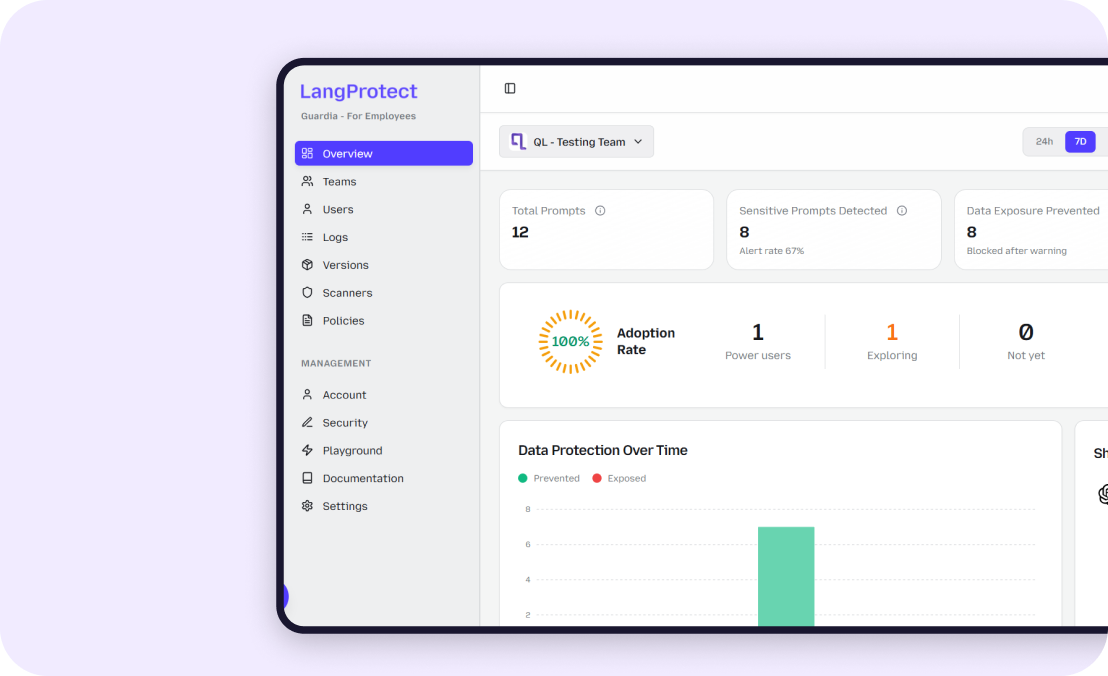
The Action: Move security from the Storage Layer to the Interaction Layer. By redacting sensitive data before it enters the model’s memory, you eliminate the need for complex "Machine Unlearning" later. Use LangProtect Guardia to enforce "Privacy-by-Design" at the prompt level.
In the era of Generative AI, we are faced with a fundamental "Security Paradox": To make a model smarter and more helpful, it needs to see more data. However, the more specific data a model sees, the easier it becomes to "reverse-engineer" the identities of the people who provided that data.
This is the Privacy-Utility Trade-off. For the modern enterprise, the goal isn't to reach "Perfect Privacy"—which often results in a useless, "lobotomized" AI—but to find the mathematical "Sweet Spot" where data remains protected while the AI remains powerful.
The Federated Learning Shift: Training at the Edge
One of the most effective ways to balance this trade-off is Federated Learning (FL). Traditionally, AI training required moving all data into one giant cloud bucket. In a high-risk sector like healthcare, this creates a massive clinical data leak surface. With Federated Learning, the data stays where it was born—on the hospital's local server or the bank's internal branch. The AI "comes to the data" rather than the data moving to the AI.
- The Ethical Win: It aligns with the GDPR principle of "Data Minimization."
- The Technical Risk (Gradient Leakage): FL is not foolproof. While raw data never moves, the "model updates" (gradients) do. Research shows that advanced attackers can sometimes reconstruct original images or clinical notes by analyzing these updates—a process known as Gradient Leakage.
This is why "Location Isolation" isn't enough; you also need Mathematical Obfuscation.
Differential Privacy: Managing the "Epsilon" (ϵ\epsilonϵ) Budget
Differential Privacy (DP) is the gold standard for protecting individual privacy in Large Language Models. It works by injecting "calibrated noise" into the training process. Imagine looking at a high-definition photograph that has been "pixelated" just enough that you can recognize a person is standing in a park, but you cannot tell who they are.
Understanding the (ϵ,δ\epsilon, \deltaϵ,δ) Budget In Differential Privacy, we measure privacy through a metric called Epsilon (ϵ\epsilonϵ).
Low Epsilon (Strong Privacy): High noise. Great for protecting identities, but can lead to "Model Hallucinations" because the AI's "vision" is too blurry.
High Epsilon (Low Privacy): Low noise. Excellent accuracy, but a hacker could perform a membership inference attack to see if a specific person's record was used in training.
The Financial "Sweet Spot": In our research on managing Fintech AI risks, a budget of ϵ=8.65\epsilon = 8.65ϵ=8.65 has emerged as the strategic baseline for financial lending models. At this level, banks achieve 87-90% accuracy while maintaining a defensible mathematical barrier against unauthorized credential leaks.
Homomorphic Encryption (HE): The "Holy Grail" of Security
While Federated Learning and Differential Privacy mask data, Homomorphic Encryption (HE) is the ultimate PhD-level goal. HE allows an AI model to perform mathematical operations on data while it is still fully encrypted.
- The "So What?": A doctor could send a patient’s DNA to a cloud AI for analysis. The AI processes the request, provides a result, and sends it back—but at no point did the AI, the Cloud Provider, or a hacker "see" the raw DNA.
- The Trade-off: Currently, HE is computationally expensive, sometimes slowing down an LLM response from milliseconds to minutes.
The Compliance Scorecard: Finding Your Balance
| Strategy | Best Used For | Primary Weakness |
|---|---|---|
| LangProtect Tool | Federated Learning | Gradient Leakage / Speed |
| Armor (Interaction Boundary) | Hospitals & Regional Banks | Gradient Leakage / Speed |
| Differential Privacy | Consumer Apps / Datasets | Reduced Accuracy |
| Guardia (Redaction) | Homomorphic Encryption | High Latency / Complexity |
| Breachers Red - Coming Soon (Stress Testing) | R&D / Ultra-Sensitive Intel | High Latency / Complexity |
How LangProtect Governs the Trade-Off
At LangProtect, we believe you shouldn't have to choose between a "dumb" AI and an "exposed" customer. We operationalize these complex mathematical theories into Interaction Governance.
-
LangProtect Armor acts as a runtime firewall. Even if your "Epsilon Budget" is tight, Armor identifies the Adversarial Intent of a user trying to "snoop" on private weights, blocking the prompt before a leak occurs.
-
LangProtect Guardia provides a second safety net. By performing real-time redaction of PII before the data reaches the model, it reduces the "Privacy Debt" of the system, allowing the model to focus on its task without carrying the risk of a brand-defining breach.
As AI shifts from the experimental "Sandbox" to the foundation of global critical infrastructure, the laws of the land are shifting with it. For the 2026 enterprise, navigating the legal environment requires more than a checklist; it requires an understanding of the diverging philosophical approaches of the world’s major economies.
Global Regulatory Landscape: Rights-Based vs. Risk-Based
There is a growing "transatlantic divide" in how AI security is governed. While Europe focuses on the Rights of the Individual, the United States currently prioritizes the Management of Systemic Risk.
The EU AI Act: A Rights-Based Powerhouse
The EU AI Act is the first major legal framework with real "teeth." It doesn't just suggest rules; it mandates them based on a hierarchy of risk:
- Unacceptable Risk (Strictly Banned): Applications like real-time biometric surveillance in public spaces or Chinese-style "Social Scoring" are outlawed to protect human dignity.**
- High-Risk Mandates: AI used in Fintech lending models, healthcare diagnostics, or education must undergo rigorous "Privacy-by-Design" auditing.
- The Cost of Failure: Much like GDPR, the penalties for non-compliance are brand-defining—reaching as high as 7% of global annual revenue.
The NIST AI RMF: Innovation Through Trust
In the U.S., the NIST AI Risk Management Framework (RMF) serves as the "Steering Wheel." It is a voluntary framework that provides a common language for organizations to prioritize Trustworthiness. It focuses on four essential functions:
- Govern: Developing an internal culture of accountability.
- Map & Measure: Identifying where AI Agents have "Non-Human Identity" risks and quantifying the impact.
- Manage: Implementing active defenses to stop prompt injection hijacks.
The GDPR Conflict: The "Machine Unlearning" Challenge
Perhaps the greatest ethical tension in 2026 is the conflict between GDPR Article 17 (The Right to Erasure) and the nature of LLMs. Under GDPR, a user can demand you "delete their data." But in a neural network, your data isn't just in a row of a database—it's woven into millions of model parameters.
Machine Unlearning—the technical process of removing specific data from an AI’s brain—remains a costly and complex frontier. This is why LangProtect Guardia is vital; by redacting data before the model sees it, you ensure the AI never "learns" secrets it shouldn't, eliminating the "Unlearning" liability entirely.
Sector-Specific Ethical Dilemmas: Life-Altering Risks
The "Ethics" of AI security move from abstract theories to harsh realities when the decisions impact life-altering outcomes like medical surgery, bank loans, or individual freedom.
Healthcare AI: Trust, Safety, and Re-identification
In a hospital setting, data anonymization is often an illusion.
- The Dilemma: Anonymized clinical datasets can often be de-anonymized through "Linkage Attacks," where an AI "joins the dots" between different datasets to identify a specific patient.
- Shadow AI in the Clinic: When providers use unsanctioned bots to summarize PHI clinical narratives, they bypass HIPAA safety guardrails, leading to average security incidents costing upwards of $7.4 million. LangProtect bridges this gap by providing real-time governance for healthcare AI agents.
Financial AI: Integrity vs. Behavioral Profiling
In Fintech, AI for fraud detection can inadvertently become a tool for Group Privacy violations.
- Autonomy Harm: A system might reject a mortgage not because of your individual record, but because its model "learned" a biased pattern associated with your zip code or demographic.
- Operational Integrity: To satisfy the High-Risk Mandates for Fintech, leadership must ensure
- Algorithmic Fairness. Using Breachers Red, organizations can perform automated red-teaming to find these biased patterns before a regulator flags them as discriminatory.
Law Enforcement: The Surveillance Paradox
The use of facial recognition and predictive policing represents the ultimate "Surveillance Paradox." Tools built for public "safety" can erode public "freedom."
- Case Studies in Bias: High-profile failures, such as Amazon's biased AI hiring tool (which penalized resumes for using the word "women's") and false arrests triggered by poor facial recognition accuracy, highlight the real-world danger of Implicit Dataset Bias.
- Accountability: If an AI assistant generates code that contains structural design flaws and leaked credentials, the ethical burden falls on the developer and the enterprise to ensure human-on-the-loop oversight.
A comprehensive ethical framework for AI security must move beyond Western-centric values. In 2026, the global digital order is shifting, and with it, the threat landscape. Organizations must now account for geopolitical data ethics and the rise of autonomous "Action Bots."
The Global South: Data Extractivism and Digital Colonialism
Most mainstream AI ethics frameworks—including the EU AI Act and NIST—are built on Western philosophical traditions that prioritize individual privacy above all else. However, in many nations across the Global South, the ethical priority shifts toward Social Well-being and the prevention of Data Extractivism.
The "Four E's" of Global AI Risk
To understand the global ethical divide, leadership must recognize the four systemic risks facing developing nations:
- Extractivism: The process where Western tech giants harvest massive datasets from Global South populations—often for pennies via clickwork or uncompensated scraping—to train models that those same populations cannot afford to use.
- Exclusion: Developing nations are often "Rule-Takers" rather than "Rule-Makers," excluded from the economic windfalls of the AI revolution while bearing the brunt of its structural design flaws and automation risks.
- Ethnocentrism: The dangerous assumption that "Global" AI safety standards actually reflect Western moral codes, which may clash with the collective social priorities of other cultures.
- Enforcement: A lack of robust pre-digital human rights instruments often leaves vulnerable populations defenseless against misidentification in facial recognition or discriminatory algorithms.
Data Colonialism: The ethical cost of Western firms training models on Global South data without providing shared benefits is a rising reputational risk for modern enterprises. When organizations use datasets that were harvested without fair compensation or localized context, they inherit a "Bias Debt" that can lead to discriminatory diagnostics in healthcare or unfair lending rejections in fintech.
Future Horizons: Agentic AI and the 2026 Threat Landscape
The next ethical frontier is the move from "Chatbots" to Agentic AI. Unlike a static chatbot, an agent has "Agency"—it can act, buy, delete, and browse on its own. This shifts the ethical burden from "what the AI said" to "what the AI did."
The Non-Human Identity (NHI) Challenge
AI agents are Non-Human Identities. They have administrative access to hospital inboxes, cloud servers, and CRM systems, but they cannot use traditional security tools like Multi-Factor Authentication (MFA).
- The Ethical Gap: If an agent is manipulated via prompt injection to exfiltrate data, there is no "human" thumbprint to stop the transaction.
- Interaction Governance: This is why AI agents increase security risk. To be ethical, we must move beyond securing the "user" and start sanitizing the Thought Process (Reasoning Chain) of the agent.
The Vibe Coding Paradox
2026 has ushered in the era of "Vibe Coding," where AI assistants help engineers write code 4x faster. While productivity has soared, security logic has suffered.
- 10x More Flaws: Because humans are "accepting" AI code without a deep understanding of the architecture, we are seeing a 1000% increase in structural design flaws and leaked credentials hidden in code.
- The Moral Responsibility: Bypassing security reviews to hit a deadline is no longer just a technical failure; it is an ethical one. It puts user privacy at risk for the sake of development "vibes."
How LangProtect Operationalizes Ethical Security
Trust is not an accident; it is a designed outcome. At LangProtect, we translate high-level ethical theories into actionable, real-time code. We ensure that your AI innovation remains defensible, accountable, and, above all, respectful of human rights.
LangProtect Armor: Ensuring "Conceptual Soundness"
Security is the first step toward ethics. If your AI can be easily "social engineered" to behave badly, it is an unethical system.
LangProtect Armor provides a System Integrity layer that identifies and blocks adversarial intent in under 50ms. By enforcing a "Secure-by-Design" architecture, it ensures that malicious prompt injections cannot force your AI to ignore its safety instructions or divulge sensitive financial logic.
LangProtect Guardia: Real-Time Individual Privacy
GDPR mandates "Data Minimization"—meaning you should only use the minimum amount of data required to get the job done.
[LangProtect Guardia](https://www.langprotect.com/guardia-for-employees) operationalizes this by providing a real-time redaction layer. It identifies and scrubs PII and PHI (Personally Identifiable Information/Protected Health Information) at the browser level before it ever enters a public AI model's training set. By stopping proprietary code leaks at the prompt, Guardia ensures you never have to worry about the complex technical challenge of "Machine Unlearning."
Breachers Red: The Accountability Engine - Coming Soon
The EU AI Act and NIST RMF require you to "Measure" and "Manage" bias. You cannot wait for a user to report a discriminatory loan rejection to find a problem. Breachers Red is our automated Ethics and Bias Stress-Testing tool. It performs proactive "Goal Hacking" to find discriminatory reasoning paths or logic holes in your internal agents. It ensures that your AI remains Conceptually Sound before it reaches the patient's bedside or the customer's mobile app.
The Ethical Standard: Interaction over Identity
The Issue: Banning AI doesn't work—it just creates unmanaged Shadow AI risk.
.
The Strategic Solution: Provide a "Safe Interaction Zone." Give your team the AI tools they want, but protect those interactions with a governance layer that understands intent.
Conclusion: Resilience as a Moral Imperative
As we navigate the deep integration of Artificial Intelligence into every facet of our digital existence, we must accept a new reality: An unethical AI is a fragile AI.
Security is often framed as a technical hurdle, but at its core, it is a moral obligation. Every time we deploy an autonomous agent or an LLM to process data, we are making an ethical choice. We are choosing between an open, "black-box" architecture that treats data as fuel, or a governed, resilient architecture that treats privacy as a foundational right.
Privacy is an Entitlement, Not an Algorithmic Discretion
For the modern enterprise, privacy can no longer be something that is "balanced away" for the sake of utility. In an era where AI can reverse-engineer identities and autonomous agents operate as non-human identities, privacy must remain a universal entitlement.
It is not something an AI should be "prompted" to respect; it is something that must be enforced at the interaction layer before the model ever has the chance to make a choice. Whether it is preventing clinical PHI exfiltration or ensuring algorithmic fairness in lending, the goal is Interaction Governance.
The Bottom Line: Trust is the Only Currency
In the hyper-competitive 2026-2030 landscape, the primary differentiator between successful firms and those that fail will not be the size of their model, but the depth of their Trust.
Customers, patients, and regulators are no longer satisfied with "Move Fast and Break Things." They demand systems that are Conceptually Sound and defensible against advanced prompt injection. If you cannot explain why your AI reached a decision—or prove that it didn't use stolen data to get there—you are carrying a liability that no amount of ROI can justify.
Build for the Person, Protect for the System
At LangProtect, we enable this balance. Our suite of Guardia, Armor, and Breachers Red is built to operationalize the ethics of security. We provide the steering wheel for your AI revolution, ensuring that you can innovate with total integrity while neutralizing the unseen risks of Shadow AI.
The path to Responsible AI starts with a single decision: to treat your security layer as a moral safeguard for your users' rights. Let's build a future where AI respects the person while it protects the system.
Are you ready to turn ethical AI from a goal into a technical reality?
Stop fighting the "AI Tidal Wave" and start governing it. Ensure your models are secure, compliant, and defensible in the face of the 2030 autonomous frontier.
Related articles
DPDP Act and AI Security: What Rules 6 and 7 Mean for Prompts, Agents, and Logs
Anthropic's AI Watermarks: What Enterprises Need to Know